
By Industry News Desk
Quebec Innovative Materials Corp. (CSE: QIMC, OTCQB: QIMCF, FSE: 7FJ) has officially unveiled an expansive 2026 natural hydrogen exploration program targeting the Ontario extension of the Témiscamingue Graben. This aggressive technical campaign is designed to transition the company from reconnaissance-based exploration to the identification of drill-ready, high-conviction targets. By integrating advanced geophysical datasets with localized geochemical analysis, QIMC aims to build a coherent, cross-provincial geological model that links its Ontario, Quebec, and Nova Scotia assets.
The Strategic Imperative: Defining Drill Targets
The core objective of the 2026 program is to convert preliminary surface findings into a structured, ranked portfolio of subsurface targets. For QIMC, the Ontario segment of the Témiscamingue Graben represents a cornerstone of its clean hydrogen portfolio. The company’s approach is underpinned by a "disciplined execution" model, where data from the Ontario soil-gas and geophysical surveys will be synthesized with the results of a 78-line-kilometre 2D Vibroseis seismic campaign currently underway.
By aligning these regional datasets, QIMC management aims to minimize exploration risk and provide a robust geological justification for future seismic and drilling expenditures. This strategy reflects a growing industry trend toward "near-surface" screening to locate deep-seated hydrogen pathways before committing to the significant capital requirements of deep-well drilling.
A Chronology of Discovery: From 2024 to 2026
The current exploration phase is the culmination of a multi-year, systematic build-up of technical knowledge.
- 2024: Initial discovery of high-concentration hydrogen in the Quebec sector of the Témiscamingue Graben provided the foundational proof-of-concept for the R2G2™ framework.
- 2025: QIMC, in partnership with DiagnaMed Holdings Corp. and under the technical guidance of the Institut national de la recherche scientifique (INRS), conducted reconnaissance soil-gas surveys in Ontario. The results were compelling: Phase 1 returned a mean of 558 ppm H2, with a median of 456 ppm. Phase 2 expanded the known anomalous zone by 11 kilometres northward, defining a 260-square-kilometre hydrogen-bearing region. These figures represent a significant departure from regional background medians of 50–125 ppm.
- 2026 (Upcoming): The launch of the expanded program will focus on densifying data in the municipalities of Thornloe, Hanbury, Dymond, Temiskaming Shore, Kerns, Kennebec, and McCool. This phase will incorporate 823 densified soil-gas stations, over 1,100 gravity stations, and a district-wide mobile gamma-ray spectrometry campaign.
Technical Methodologies: A Non-Invasive Approach
QIMC has emphasized a non-invasive methodology, prioritizing environmental stewardship and community coexistence. The 2026 program relies on surface-level or shallow-probe data collection, entirely avoiding the use of explosives, shot-hole drilling, hydraulic fracturing, or reservoir stimulation.

Soil-Gas and Radiometric Surveys
The soil-gas densification effort aims to evaluate how local fault systems influence hydrogen migration to the surface. By comparing these gas readings against soil characterization—informed by mobile gamma-ray spectrometry—QIMC can effectively "filter out" background noise related to surface sediment types, ensuring the accuracy of the hydrogen signal.
Gravimetric and Audiomagnetotelluric (AMT) Surveys
The gravity survey is critical for mapping the deep "depocenters" where sedimentary rocks have accumulated. By identifying structural discontinuities between the Archean, Proterozoic, and Paleozoic blocks, the team can pinpoint the plumbing systems—faults and fractures—that likely facilitate the ascent of hydrogen from the deep crust.
Complementing this is the Audiomagnetotelluric (AMT) survey. This natural-source electromagnetic method provides a "cat-scan" of the subsurface, allowing for vertical penetration up to 1.5 kilometres. This depth allows the team to refine fault geometry and interpret the thickness of sedimentary units that act as potential traps or conduits for hydrogen.
The Geological Rationale: Why Témiscamingue?
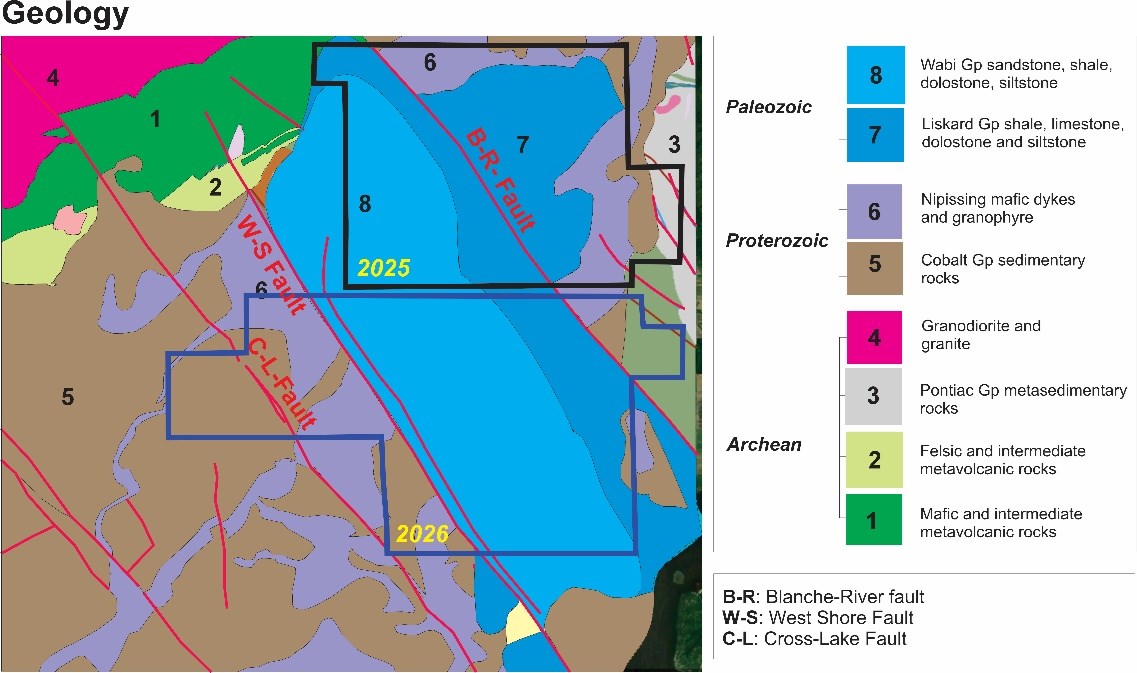
Prof. Marc Richer-Laflèche (Ph.D., INRS) highlights the unique structural and lithological setting of the Ontario Témiscamingue Graben as a premier exploration environment. The region is characterized by a major morphotectonic depression bounded by significant normal faults, including the West Shore, Cross-Lake, and Blanche-River faults.
The geological model hinges on two primary drivers:
- Sedimentary Reservoirs: The presence of thick Paleozoic sedimentary rocks (such as the Liskeard and Wabi groups) provides both potential reservoirs for hydrogen storage and mudstone cap rocks that could inhibit the escape of gases to the atmosphere.
- Magmatic Sources: The presence of Nipissing dikes, remnants of a Large Igneous Province (LIP), is of paramount importance. These mafic magmatic rocks are rich in Fe2+-bearing minerals like olivine. When these minerals react with groundwater—a process known as serpentinization—they generate molecular hydrogen. Furthermore, the thick Huronian Supergroup sedimentary layers, rich in potassium, may contribute to hydrogen production through radiolytic processes.
Collaborative Community Engagement
A hallmark of QIMC’s approach is its commitment to local partnership. The 2026 program will see the company working directly alongside the Timiskaming First Nation (TFN). This collaboration extends beyond simple land access; it involves training, data-collection roles, and employment opportunities for local community members. By integrating local knowledge and ensuring community participation, QIMC aims to foster a sustainable and mutually beneficial exploration environment.
Management Commentary
John Karagiannidis, President and CEO of QIMC, emphasized the strategic shift in the company’s trajectory. "Ontario is one of the most strategic assets in our clean hydrogen portfolio, and this program is about turning reconnaissance into conviction," Karagiannidis stated. "Our objective is clear: convert what we’ve found on the ground into a ranked, drill-ready set of targets for the next stage of development."
He noted that the simultaneous advancement across Quebec, Ontario, and Nova Scotia provides a "proven strategy and model," allowing for a cross-pollination of geological insights that would not be possible if the provinces were studied in isolation.
Broader Implications: The Future of Hydrogen Exploration
Natural hydrogen is an emerging asset class with the potential to significantly impact the global energy transition. Unlike grey hydrogen (derived from natural gas) or green hydrogen (derived from energy-intensive electrolysis), natural hydrogen—often referred to as "gold" or "white" hydrogen—could provide a clean, continuous, and potentially low-cost energy source.
QIMC’s systematic, science-led approach serves as a litmus test for the viability of the Canadian Shield as a hub for this resource. If the 2026 program successfully defines clear, high-priority targets, it could catalyze a broader exploration rush into the Témiscamingue region. However, as the company notes, these methods are indirect; while they define the "plumbing" and "structure" of the subsurface, the ultimate confirmation of commercially viable hydrogen accumulations will depend on the results of future drilling.
Risk Disclosure and Forward-Looking Statements
The company maintains a transparent stance regarding the inherent risks of exploration. All data points—soil-gas, gravity, and seismic—are screening-level tools. They indicate potential for hydrogen accumulation but do not guarantee its presence, volume, or economic deliverability. The 2026 exploration program remains subject to weather conditions, permitting, and market variables. QIMC continues to operate under the assumption that its disciplined R2G2™ framework will provide the necessary rigor to mitigate these risks as they move toward the next milestone in their corporate development.
As the industry watches the developments in Ontario, QIMC’s progress provides a vital case study in how junior exploration companies can leverage modern geophysical techniques to explore for a new, transformative energy source.