
By Science Editorial Staff
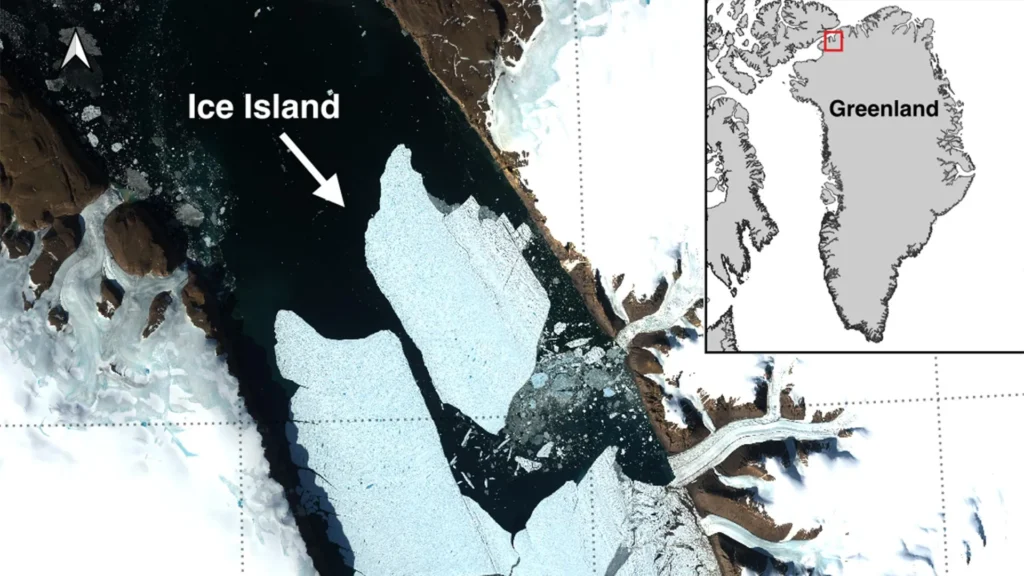
In a landmark event that has captured the attention of the global cryosphere research community, Greenland’s Petermann Glacier has shed a colossal fragment of its floating ice tongue. On August 4, 2026, a 76.4 square-kilometer ice island—roughly the size of Manhattan—broke away from the glacier’s northern reaches. The event, identified by researchers at the University of Ottawa (uOttawa), marks the most significant calving event in the Arctic since 2020 and the largest loss of floating ice for the Petermann system since 2012.
As climate change continues to reshape the polar landscape, this massive detachment serves as a stark indicator of the instability inherent in Greenland’s remaining ice shelves. Beyond the immediate geological implications, the event has triggered a coordinated international effort to track the movement of the iceberg, as it poses potential, long-term risks to Arctic shipping lanes and offshore infrastructure.
The Anatomy of the Event: Main Facts and Scale
The newly birthed ice island is a behemoth of frozen history. Measuring approximately 76.4 square kilometers and estimated to be up to 150 meters thick, the tabular iceberg represents a significant reduction in the Petermann Glacier’s structural integrity. Unlike the jagged, irregular icebergs often associated with mountain glaciers, this "tabular" iceberg is characterized by its flat, expansive surface, a feature more commonly seen in the massive ice shelves of Antarctica.
The detachment was confirmed following high-resolution imagery captured by the European Space Agency’s (ESA) Sentinel-1 satellite mission. The data revealed that the fracture occurred along the eastern side of the glacier’s floating tongue, a region that had been showing signs of extreme stress for several years. For glaciologists, the scale of this calving is significant, not merely for its size, but for the clarity with which it demonstrates the rapid transition of Arctic ice tongues from stable, long-lived structures into fragile, retreating systems.
Chronology: A Multi-Year Deterioration
The calving on August 4 was not a sudden accident, but rather the culmination of a predictable, albeit alarming, progression of instability. Since 2019, an international consortium—led by the University of Ottawa and including the University of Stirling, Environment and Climate Change Canada (ECCC), Lancaster University, and the University of Leeds—has maintained a constant watch over the Petermann Glacier.
2019–2023: Early Warning Signs
Satellite monitoring provided the first clues of the impending rupture. Researchers noted the development of lateral rifts along the glacier’s central axis. These fractures, visible through Synthetic Aperture Radar (SAR), allowed the team to map the "hinge zones" of the glacier—the areas where the ice transitions from grounded land-ice to the floating ice tongue.
August 3, 2026: The Critical Threshold
On the eve of the event, ESA satellite imagery confirmed that the structural integrity of the eastern tongue had reached a tipping point. Deterioration along the centerline had accelerated, and the mechanical tension within the ice exceeded the threshold of its tensile strength.
August 4, 2026: The Separation
By 20:00 UTC, the separation was complete. The massive ice island had fully detached from the parent glacier. Adam Garbo, a PhD student in glaciology at uOttawa’s Department of Geography, Environment and Geomatics, was the first to identify the full separation during his routine analysis of the satellite data.
"Petermann Glacier has long been one of Greenland’s largest remaining ice tongues," Garbo noted in a press statement. "We’ve anticipated this break for years, and seeing it finally happen is remarkable, if sobering."
Supporting Data: The Future of the Petermann Tongue
The August 4 event is likely only the beginning of a larger disintegration process. Based on current glaciological modeling, the research team anticipates at least two more major calving events in the near future. These predicted detachments are estimated to be 94 km² and 84 km², respectively.
Should these predictions manifest, the cumulative loss would total approximately 254 km², effectively shrinking the Petermann Glacier’s floating tongue by 22 percent. This would fundamentally alter the dynamics of the glacier, potentially reducing the "back-pressure" that the tongue exerts on the land-based ice stream. Such a reduction could accelerate the flow of the glacier into the ocean, thereby contributing further to global sea-level rise.
A Window into Polar Change: The Scientific Perspective
While the Southern Ocean surrounding Antarctica is famous for producing massive tabular icebergs, the Arctic has historically been a different environment. The presence of large-scale, long-lived ice islands in the Arctic is a rare phenomenon that provides researchers with a "living laboratory."
Dr. Anna Crawford of the University of Stirling, a key collaborator in the study, highlights the importance of this event for global climate science. "While large, tabular icebergs are relatively common in the Southern Ocean, Arctic ice islands are far rarer," she explains. "By studying this specific event, we gain invaluable knowledge about how these enormous ice masses develop, how they interact with ocean currents, and how they eventually fragment. This is information that can be transferred across polar regions to better predict the future of ice shelves everywhere."
The research team is utilizing this opportunity to study the "life cycle" of an ice island. This involves observing how the structure interacts with the seabed (if it grounds), how it responds to warmer seawater temperatures, and how the meltwater flux affects local marine ecosystems.
Implications: Hazards to Shipping and Infrastructure
Beyond the theoretical and climate-related implications, the birth of a 76.4 km² ice island presents immediate logistical and safety challenges. Massive ice fragments of this magnitude are not passive; they are active, moving hazards.
The Lifecycle of a Hazard
The ice island is expected to remain intact for years, drifting through the Arctic waters. Over time, however, it will inevitably fracture into smaller, increasingly dangerous "growlers" and "bergy bits." These smaller fragments are notoriously difficult to track via standard satellite imagery, creating significant risks for maritime navigation.
Official Responses and Monitoring
Environment and Climate Change Canada (ECCC) has already initiated a comprehensive tracking program. Dr. Abigail Dalton of the Canadian Ice Service emphasizes the severity of the threat. "These are thick blocks of ice that can drift for years," Dalton says. "As they fracture, they become harder to track. This creates a moving hazard for vessels, commercial shipping, and offshore resource operations that rely on clear navigation through the Arctic."
The ECCC is currently coordinating with international maritime agencies to ensure that real-time data regarding the ice island’s trajectory is disseminated to ships operating in the region. This monitoring is part of a broader, ongoing effort to mitigate the risks posed by the increasing frequency of Arctic ice shelf instability.
Conclusion: A Changing Arctic
The calving at Petermann Glacier is more than just a localized event; it is a symptom of a rapidly warming Arctic. As the research team at the University of Ottawa and their partners continue to analyze the data, they remain focused on the broader goal: understanding the mechanical and thermal processes that govern the retreat of our planet’s last great ice shelves.
The project is far from over. Garbo and his colleagues are currently planning follow-up missions that will incorporate aerial drone surveys, satellite tracking, and potentially in-situ sensor deployment on the ice island itself. By documenting the aftermath of this massive collapse, they hope to provide the global community with a clearer understanding of the thresholds being crossed in our polar regions.
As the ice island drifts into the unknown, it serves as a silent, frozen witness to the environmental changes occurring at the top of the world—a massive, floating reminder that the Arctic is not static, and that the changes happening there will eventually ripple out to affect the entire globe.