
For years, the horological conversation surrounding TAG Heuer has been dominated by the meteoric rise of the "Glassbox" Carrera. Its retro-futuristic, bubble-dome sapphire crystal and seamless, bezel-less aesthetic have arguably become the defining face of the modern Carrera lineage. Yet, in the shadow of this avant-garde darling, a vital, more traditional segment of the brand’s catalog has been quietly awaiting a renaissance.
TAG Heuer has finally answered that call with the launch of the next-generation Carrera Chronograph Sport. This is not merely an update; it is a fundamental recalibration of what a dedicated, bezel-equipped sports chronograph should be in the contemporary market. By trimming the excess, refining the proportions, and leaning into a sharper, more automotive-focused design language, TAG Heuer has elevated the "Sport" moniker from a niche variant to a formidable pillar of the collection.
The Evolution: From Bulk to Balance
To understand the significance of the new Carrera Chronograph Sport, one must first address its predecessor. The previous iteration, while undeniably capable, was characterized by a massive 44mm case that stood 15.5mm tall. While it catered to those who favored a "big watch" presence, it often struggled to find balance on the average wrist.

The new model represents a major shift in design philosophy. By downsizing to a 42mm diameter and a 14.17mm thickness, TAG Heuer has achieved a "Goldilocks" profile. With a lug-to-lug distance of 48mm, the watch sits comfortably in the same arena as the legendary Omega Speedmaster Professional. While it retains a bold, masculine presence, the redesigned sloping lugs and a more sculpted caseback ensure that the watch hugs the wrist, effectively masking its vertical height. This is a watch that manages to look "tough" without appearing cumbersome—a feat of engineering that aligns the Carrera Sport with the refined sensibilities of modern high-end watchmaking.
Chronology of a Design Shift
The Carrera has always been rooted in motorsports, tracing its lineage back to the 1963 original. Over the decades, the design has oscillated between the elegant, minimalist three-hand styles and the aggressive, tachymeter-bezel-equipped chronographs meant for the track.
- 1963: The birth of the Carrera as a clean, highly legible dashboard for drivers.
- The 2000s and 2010s: The era of the "Carrera Sport" expanded, often utilizing large, heavy cases to compete with the rising popularity of oversized luxury watches.
- 2023–2025: The "Glassbox" revolution reshaped the brand’s image, focusing on sapphire-driven design and vintage warmth.
- 2026: The release of the new Carrera Chronograph Sport. This marks the brand’s acknowledgment that while innovation is vital, the "conventional" sports chronograph—complete with a ceramic bezel and high-contrast dial—remains a cornerstone of the brand’s identity.
Aesthetic Precision: The Dial and Bezel
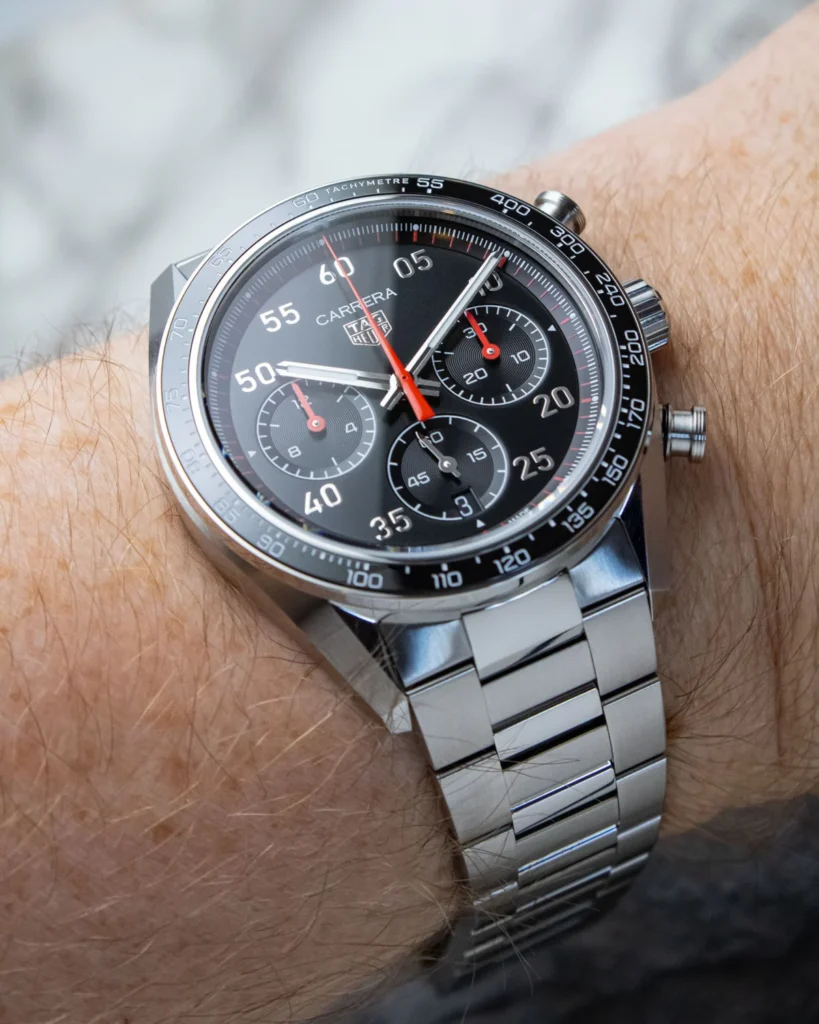
The most striking departure from the standard Carrera is the return of the fixed bezel. After years of the "bezel-less" trend, the inclusion of a glossy, piano-black ceramic insert feels like a return to form. The insert, paired with a polished surround, gives the watch a muscular, gauge-like appearance that fits the "Sport" branding perfectly.

However, the real magic lies in the dial. TAG Heuer has moved away from the faceted indices of the standard Carrera, opting instead for bold, polished Arabic numerals. This design choice, previously seen in limited collaborative efforts like the Carrera Porsche, is now a permanent feature of the Sport line. The result is a dial that is undeniably automotive, echoing the typography found on vintage speedometers.
In the black-on-black configuration, this design truly shines. The contrast between the sun-drenched polished numerals and the deep, recessed "azurage" subdials creates a sense of depth that is rare in this price segment. The addition of subtle red accents on the chronograph hands and the outer minute track provides a burst of energy that justifies the "Sport" name without sacrificing the brand’s inherent sophistication.
Supporting Data: Technical Specifications
The watch is powered by the in-house TH20-00 automatic chronograph movement, the backbone of TAG Heuer’s current catalog. This movement is a testament to the brand’s vertical integration and commitment to reliability.

- Power Reserve: 80 hours (allowing the watch to be set down on a Friday and picked up on a Monday morning ready to run).
- Frequency: 28,800 vibrations per hour (4Hz).
- Actuation: Column-wheel with a vertical clutch, ensuring a smooth start/stop action for the chronograph function with no stutter in the seconds hand.
- Water Resistance: 100 meters, ensuring it is more than just a desk-diver; it is a legitimate daily-wear sports watch.
- Case Material: High-grade stainless steel with a mix of brushed and polished surfaces.
- MSRP: $6,850 USD.
The movement finishing—visible through the sapphire caseback—features the signature shield-motif skeletonized rotor, which is both modern and visually striking, even if the brand has opted for a standard polished column wheel rather than a color-matched one.
A New Milestone in Ergonomics: The Bracelet
Perhaps the most underrated update is the introduction of the new tool-free link removal system on the stainless steel H-link bracelet. For years, collectors have clamored for easier micro-adjustments and sizing capabilities. TAG Heuer has finally implemented a system that allows the owner to adjust the bracelet length on the fly without the need for specialized jeweler’s tools.
The bracelet itself is a masterclass in texture. By alternating between mirror-polished center links and brushed outer links, the bracelet catches the light in a way that makes the watch feel far more expensive than its price tag might suggest. The interplay between the industrial, brushed finish of the case and the reflective, jewelry-like quality of the bracelet creates a visual balance that is often missing in purely "tool-focused" chronographs.

Implications for the Market
The arrival of the new Carrera Chronograph Sport signals a strategic move by TAG Heuer. By segmenting the Carrera line—the "Glassbox" for the vintage-inspired collector and the "Sport" for the modern performance-seeker—the brand is effectively covering two distinct demographics.
The implications are clear: TAG Heuer is no longer relying on a "one size fits all" approach to the Carrera. They recognize that there is a massive market for a watch that feels as at home in a business meeting as it does in a race car cockpit. This is a watch designed for the enthusiast who wants the heritage of the Carrera but demands the durability and legibility of a modern ceramic-bezel chronograph.
Final Verdict
The TAG Heuer Carrera Chronograph Sport is a triumph of refinement. It avoids the common trap of trying to be "everything to everyone." Instead, it is a focused, intentional, and highly polished piece of kit. It respects the history of the Carrera while embracing the material and mechanical advancements of the 21st century.

At $6,850, it positions itself firmly in the mid-luxury space, offering a compelling alternative to competitors from Omega, Tudor, and Breitling. For those who felt the previous Carrera Sport was too large and the Glassbox too delicate, this new release is the answer they have been waiting for. It is, quite simply, the best version of the modern Carrera Sport that TAG Heuer has ever produced.