
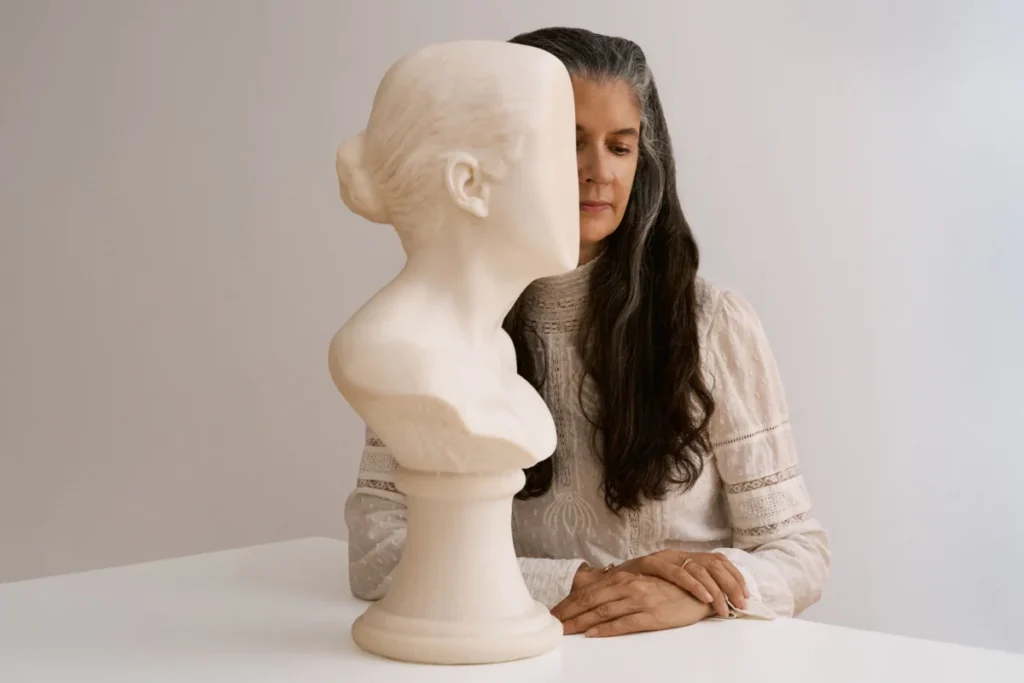
Janine Antoni does not merely make art; she performs the act of existing through matter. For over three decades, the Bahamian-born artist has occupied a singular space in the contemporary art world, one where the boundaries between the body and the object are consistently dissolved. From her iconic 1993 installation Lick and Lather—in which she eroded soap and chocolate busts of her own likeness through the intimate acts of washing and consuming—to her explorations of movement and dance, Antoni has interrogated how we inhabit our physical forms. As she prepares for her first major museum retrospective at the Museum of Contemporary Art (MCA) Chicago, the art world is once again reckoning with a practice that treats the human body as both a tool and a site of historical inquiry.
The Architecture of the Self: Main Facts and Artistic Philosophy
At the heart of Antoni’s work is a fundamental discomfort with the static nature of the traditional art object. In her studio in Brooklyn’s Park Slope, she surrounds herself with the remnants of her process: molds, photographic documentation, and the tools of her trade. She is famously known for titles that are verbs—Gnaw, Moor, Tear, Lick and Lather—which serve as a critique of the museum industry’s tendency to categorize art solely by material.
“We have lost our connection to the way the objects we are in contact with every day are made,” Antoni observes. “This alienates us from our world.”

Antoni acts as an antidote to this material estrangement. She replaces traditional chisels with her teeth, paintbrushes with her own hair, and bronze molds with the impressions of her bones. Her work is a forensic investigation of presence; she captures the "warmth of a recently vacated seat," treating her sculptures as an interface between the artist and the audience. As she frequently notes, “The work is just an excuse to get close.”
A Chronological Evolution: From Freeport to the Avant-Garde
Early Life and Formative Influences
Born in 1964 in Freeport, Bahamas, to a Trinidadian mother and a physician father, Antoni’s early life was defined by a proximity to the body in states of both health and crisis. Watching her father treat neighbors in their home, she developed a reverence for the "miraculousness of the body." However, this wonder was tempered by the cultural displacement she experienced at age 13 when she moved to a Catholic girls’ school in Florida. This transition forced a sudden, acute awareness of how gender, race, and class dictate the perception of one’s physical gestures.
The 1990s: Challenging the Canon
Antoni exploded onto the New York scene in the early 1990s, armed with a sharp critique of the male-dominated Minimalist canon. Her 1992 installation Gnaw remains a definitive moment in this era. By taking 600-pound blocks of lard and chocolate—references to the geometric purity of Sol LeWitt and Tony Smith—and gnawing away at them with her own teeth, she transformed sterile, masculine-coded cubes into messy, visceral artifacts of consumption.

The 1993 Whitney Biennial served as a watershed moment for her, cementing her reputation as a voice for identity politics and social justice. By that same year, her Lick and Lather installation for the Venice Biennale had already become a lightning rod for discourse. The piece, featuring busts that were slowly worn away through tender, repetitive contact, challenged the traditional preservationist ethos of the museum.
The Somatic Shift: Movement and Medicine
Following a breast cancer diagnosis at age 33, Antoni’s practice moved toward the rhythmic and the somatic. Her engagement with 5Rhythms and Continuum Movement allowed her to integrate dance into her sculptural work. This evolution culminated in her collaboration with the legendary choreographer Anna Halprin. Through Paper Dance (2013–2016), Antoni turned the act of movement into a sculptural exercise, drawing with shadows and motion on paper, treating the performance as a "history filtered through the lens of flesh."
Supporting Data: Mentorship and the Feminist Lineage
Antoni’s influence extends far beyond her own exhibition history. As a professor at Columbia University from 2000 to 2012, she fostered a generation of artists—including Chitra Ganesh, Aki Sasamoto, and Liz Magic Laser—who have since defined the contemporary performance landscape.

Her pedagogy was rooted in a radical accessibility. She taught students to treat the "whole city as a classroom" and emphasized the importance of nurturing the creative process over the production of a final commodity. This collaborative spirit defines her studio as well; she speaks of her assistants and peers as co-creators, noting that her work is a dialogue rather than a monologue.
Her commitment to feminist history, sparked by her RISD professor Mira Schor, remains a cornerstone of her identity. By seeking out the work of marginalized women artists like Mierle Laderman Ukeles and Carolee Schneemann, Antoni placed herself within a lineage of "maintenance art"—work that honors the invisible labor of daily life.
Official Responses and Curatorial Perspectives
The upcoming retrospective at the MCA Chicago, co-organized by Deputy Director Joey Orr and independent curator Adrian Heathfield, represents a critical consolidation of Antoni’s career. According to Orr, the show will offer a comprehensive look at her sculptures, drawings, and videos, but will emphasize that “there’s no way to walk out of the exhibition without having had an experience with the body.”

The curatorial team has faced the unique challenge of exhibiting works that were designed to be temporary or self-destructive. This has prompted a broader conversation about the nature of the "re-performance" and the preservation of ephemeral art. When asked if her work could be performed by others—specifically pieces like Loving Care, where the artist uses her own hair to paint the floor—Antoni remains contemplative.
“If you asked me 20 years ago, I would say no,” she admits. “Because all those works were about my relationship to myself.” However, she now sees the potential for her art to transcend her specific biography, stating, “I’m looking for new interpretations of the work that honor its past meanings and push them forward to meet our moment.”
Implications: The Legacy of the Trace
Janine Antoni’s career raises profound questions about the nature of the archive. If the traditional museum is a graveyard for objects, Antoni’s work acts as a living archive of human experience. By focusing on the "traces" left by the body—the bite mark in chocolate, the impression in cowhide, the shadow on paper—she forces us to consider our own physical presence in the world.

The implication of her work is that history is not something that happens to us; it is something we perform. As she continues to prepare for her retrospective, she remains committed to the idea that art is not meant to be looked at from a distance, but to be felt. Her practice suggests that even as our bodies age and our cultures shift, the fundamental human drive to connect—to "get close"—remains our most potent creative force.
In an era increasingly dominated by digital abstraction and the alienation of the virtual, Antoni’s insistence on the reality of the body feels more urgent than ever. Her forthcoming exhibition will not just be a survey of past achievements, but a vital, breathing testament to the power of the flesh to resist erasure, to define space, and to hold the memory of our collective human experience. As she bridges the gap between the 1990s avant-garde and the current moment, Antoni continues to prove that while the body is ephemeral, the resonance of its actions can last a lifetime.