
For the vast majority of watch enthusiasts, the appreciation of horology is a passive pursuit. It is an exercise in visual consumption—peering through exhibition casebacks at the rhythmic dance of balance wheels, analyzing the architecture of bridges, and debating the merits of escapements through the lens of macro photography. While books, documentaries, and online forums provide a theoretical roadmap to how these machines keep time, the physical act of horology remains an elusive, often intimidating barrier.
Hampden Watch, a brand deeply embedded in the historical tapestry of American watchmaking, has successfully dismantled this barrier. With its "First Hand" workshop in Chicago, the company has created an immersive bridge between the enthusiast and the artisan. Participants don’t just watch a demonstration; they spend an entire day at the bench, ultimately leaving with a Swiss mechanical timepiece they have assembled from the ground up.
The Genesis of an Experiment
Launched in December 2025, First Hand began as a bold question posed by the leadership at Hampden Watch: Could an individual with absolutely no prior technical experience be taught to bridge the gap between novice and watchmaker in a single, eight-hour session?

The challenge was immense. Watchmaking requires a level of dexterity, patience, and spatial awareness that is typically honed over years of apprenticeship. The program needed to teach participants how to disassemble a movement, reassemble it, install a dial and hands, case the watch, and perform critical quality control—all without compromising the integrity of the timepiece.
Thirty sold-out sessions and more than 200 graduates later, the experiment has been declared a resounding success. What started as a proof-of-concept has evolved into a permanent, highly sought-after cornerstone of the Hampden brand. With bookings already extending through 2027 and a massive new facility currently under construction, the program has proven that the hunger for tactile, authentic craftsmanship is stronger than ever.
A Day in the Life: The Anatomy of the Workshop
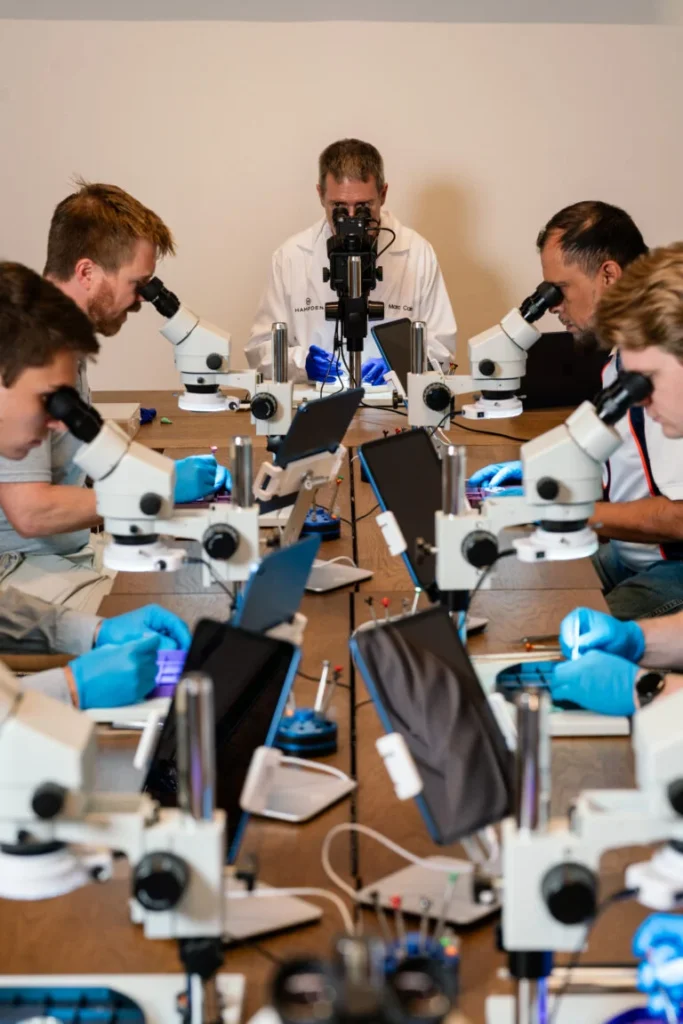
The First Hand experience is defined by its intimacy. Eschewing the lecture-hall format, Hampden limits each session to a maximum of six students, overseen by three expert instructors. This 2:1 ratio ensures that every attendee receives near-constant guidance, mitigating the inevitable frustrations that arise when working with components smaller than a grain of sand.

Morning: Theory and the 6498 Caliber
The day begins at 9:00 AM with a crash course in movement theory. Participants are introduced to the fundamental mechanics of the Swiss manual-wind 6498 movement. Originally developed by Unitas roughly 75 years ago, the 6498 is the industry standard for educational purposes. Its robust architecture, large diameter, and visible, uncluttered layout make it the perfect platform for students to understand the interplay between the mainspring, the gear train, and the escapement.
Unlike traditional watchmaking schools that rely on the classic jeweler’s loupe—a tool that can be notoriously difficult for beginners to master—Hampden outfits every bench with high-quality binocular microscopes. This shift in technology is a game-changer. By enlarging the field of view and providing consistent lighting, the microscopes significantly lower the barrier to entry, allowing students to focus on the mechanics rather than the physical strain of magnification.
Technology-Assisted Precision
Recognizing that no two students learn at the same pace, Hampden has developed proprietary software deployed on iPads at every station. This digital guide provides step-by-step graphical instructions that mirror the live demonstrations performed by the instructors. If a student falls behind, they can review the steps independently; if they surge ahead, they are provided with supplemental educational material, ensuring the class dynamic remains fluid and stress-free.

The Afternoon: From Mechanism to Masterpiece
Following a chef-catered lunch, the focus shifts from the abstract mechanics to the aesthetic identity of the watch. Students select from eight exclusive, Chicago-inspired dial designs—with evocative names like "Harbor Blue," "Stockyard Green," and "Foundry Gray"—and perform the delicate task of installing the dial and hands.
The final stages involve casing the movement, timing the watch, and subjecting it to rigorous water-resistance testing. The resulting 42mm timepiece is not merely a souvenir; it is a fully functioning, Swiss-made instrument. To personalize the achievement, Hampden engraves the movement with the student’s initials and the year, cementing the watch’s status as a bespoke heirloom.
The Weight of History: The Wein Family Legacy
A unique facet of the First Hand experience is its context. The workshop is not housed in a sterile industrial park, but at the heart of the Wein family’s operations. The Wein family’s involvement in the watch industry spans four generations and over a century, beginning in 1922. Today, the family manages a portfolio of iconic brands, including Hampden, Clinton, Benrus, and Wolbrook.

Participants are treated to a private tour of the company’s extensive historical archive. This collection, which showcases 150 years of American watchmaking, serves as a grounding force for the day’s activities. For many collectors, seeing these rare, historical pieces in the metal—and hearing the stories of the families who built them—is just as impactful as the act of building their own watch. It transforms the day from a technical class into a pilgrimage through the history of timekeeping.
Supporting Data and Participant Feedback
The program’s success is not just anecdotal. With a perfect 5.0-star rating across 60 verified reviews, the consistency of the experience is notable. According to internal data provided by Hampden, 100% of participants recommend the course.
The geographical reach of the workshop is equally impressive. While the program is based in Chicago, approximately 40% of attendees travel from out of state. The program has drawn enthusiasts from both the East and West Coasts, and in one notable instance, from as far north as Utqiagvik, Alaska. This draw suggests that the "experience economy" in luxury goods is shifting toward high-value, skill-based engagements.

Future Implications and Expansion
The success of the First Hand program has significant implications for the future of the watch industry. It demonstrates that collectors are increasingly looking for ways to engage with their passion beyond the point of purchase. By democratizing the "maker" experience, Hampden is fostering a new generation of watch enthusiasts who possess a deep, structural understanding of their collections.
The Evolution: Advanced Workshops
Responding to the growing demand from alumni, Hampden is currently developing an advanced workshop. This second-tier program will shift the focus to the more complex Sellita SW200 automatic movement, housed in a more compact 37mm case. This move represents a "graduation" path for students who have mastered the manual-wind 6498 and are eager to tackle the intricacies of automatic winding systems.
Facility Upgrades
To support this growth, Hampden is preparing a dedicated 1,700-square-foot facility, scheduled to open in the winter of 2026. This expansion will allow for larger class sizes and more complex training modules, solidifying Chicago’s position as a modern hub for horological education.

Conclusion: A Direct Path to Mastery
The First Hand workshop is priced at $2,100 USD, a fee that covers the instruction, the materials, the lunch, and the timepiece itself. While some might view the price tag through the lens of retail value, those who have completed the program argue that the real value lies in the "aha!" moment that occurs when a gear finally finds its seat and the movement begins to tick under the student’s own hand.
For the collector who has spent years wondering what truly happens beneath the dial, the First Hand workshop provides a definitive answer. It is a rare opportunity to step out from behind the display case and into the light of the workshop, trading the role of the passive observer for that of the active participant. In a world of mass-produced luxury, Hampden Watch is betting that the most valuable thing an enthusiast can own is not a brand name, but the knowledge of how their watch was built—because they were the ones who built it.