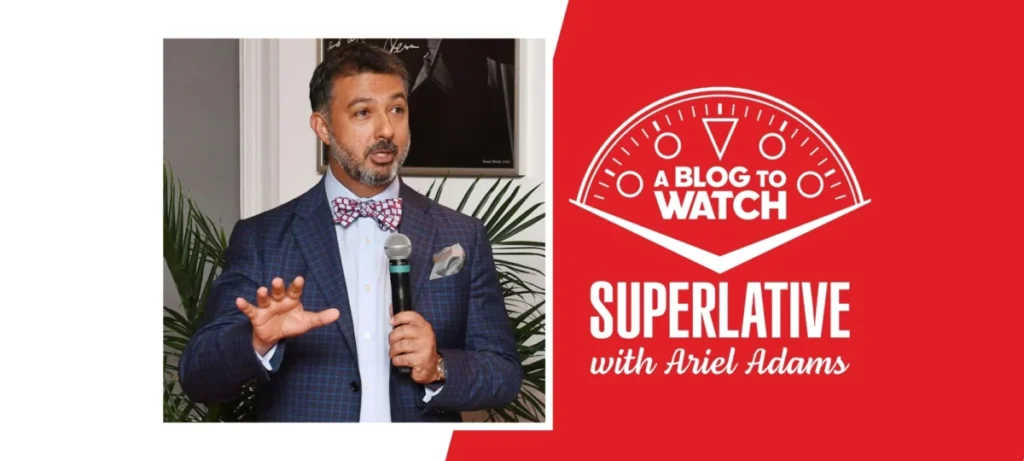
In the rarified world of high-end watchmaking, where technical specifications, movement architecture, and materials science often dominate the conversation, there exists a critical, often overlooked component: the human connection. On this week’s episode of the Superlative Podcast, aBlogtoWatch founder Ariel Adams sat down with seasoned watch industry executive Ahmad Shahriar to dissect the shifting landscape of luxury horology.
Shahriar, a veteran whose career has spanned some of the most prestigious names in the industry, currently serves as a vital bridge between heritage watchmaking and the North American market. Representing the storied houses of Arnold & Son, Angelus, and the recently revitalized Favre Leuba, Shahriar offers a unique perspective on the tension between corporate standardization and the raw, unbridled passion that defines independent watchmaking.
The Trajectory of an Industry Insider: A Professional Chronology
Ahmad Shahriar’s career is a masterclass in the evolution of luxury retail and brand management. His journey through the watch industry reads like a directory of the most respected names in the Swiss watchmaking pantheon.
From Corporate Giants to Independent Agility
Shahriar cut his teeth in the high-stakes environment of large luxury groups. His tenure at houses such as Ulysse Nardin, Blancpain, and Breguet provided him with a foundational understanding of how global conglomerates operate. During these years, he witnessed the transition of watchmaking from a craft-focused endeavor to a high-volume, marketing-driven luxury business.
However, the rigidity of corporate structures—characterized by top-down decision-making and a heavy emphasis on quarterly KPIs—began to feel at odds with the soul of horology. Shahriar notes that while large groups possess the resources to maintain heritage, they often lose the "local touch" that is required to nurture a genuine collector base.
The Pivot to Independence
In his current capacity, working alongside Samir Shah, Ahmad has pivoted back to the roots of the industry. By representing Arnold & Son, Angelus, and Favre Leuba, he has returned to a business model that values agility. For Shahriar, the shift is not just professional; it is ideological. He advocates for a return to the "hands-on" approach, where the person representing the brand is as invested in the collector’s journey as the watchmaker is in the caliber’s accuracy.
The Philosophy of Passion: Why People Matter More Than Data
A central theme of the discussion between Adams and Shahriar is the perceived decline of the "personal" in the digital age. As e-commerce platforms and algorithmic marketing take over, the role of the brand representative is being hollowed out. Shahriar argues that this is a dangerous trend.
The "Passionate Representative" Model
Shahriar posits that a watch is not merely a utility or an investment; it is a story. "When you buy an independent watch," he notes, "you are buying into the vision of the people who made it." He argues that collectors are increasingly fatigued by the sterile, polished interactions found in major boutiques. Instead, they crave direct lines of communication to those who understand the technical and artistic nuances of the product.
The Pitfalls of Corporate Micro-Management
A major point of friction explored in the podcast is the impact of excessive micro-management from corporate headquarters. When decisions regarding the North American market are made by individuals thousands of miles away—individuals who may not understand the specific cultural context of the local collector—the brand inevitably suffers.
Shahriar highlights that "data-driven" decisions often prioritize short-term profit over long-term brand equity. By stripping local teams of their autonomy, corporations risk turning their watches into commodities rather than cherished artifacts. His current role serves as a case study for the alternative: local teams empowered to build organic, community-based relationships that transcend the transactional.

Supporting Data: The Independent Surge
The rise of independent watchmaking is not just a sentiment; it is a measurable trend. In recent years, data from auction houses and secondary market indices shows a distinct shift in collector behavior.
- Market Diversification: While historically dominant brands (the "Big Three" and their contemporaries) remain the bedrock of the market, the share of total collector spend directed toward independent watchmakers has seen double-digit growth annually since 2020.
- The "Relationship" Premium: Studies on luxury consumer behavior indicate that younger generations—the burgeoning demographic for high-end watches—prioritize "authenticity" and "brand values" over historical name recognition.
- The Velocity of Innovation: Independent brands, unencumbered by the massive manufacturing overheads of large groups, are currently the primary drivers of material innovation and complex movement development. Arnold & Son and Angelus, for instance, have utilized their creative freedom to produce highly experimental designs that corporate groups would deem too risky.
Official Perspectives: Navigating the Future
During the podcast, Ariel Adams probed into how these brands—Arnold & Son, Angelus, and Favre Leuba—are navigating the current economic headwinds. The consensus is clear: the path forward for an independent brand is transparency.
Arnold & Son and Angelus: The Technical Vanguard
These brands represent a commitment to high horology that is increasingly rare. By maintaining small production runs, they ensure a level of exclusivity that is inherently attractive to collectors. Shahriar emphasizes that the challenge lies in communicating this complexity to a wider audience without watering down the message.
Favre Leuba: The Heritage Pivot
Favre Leuba occupies a fascinating space as one of the oldest watch brands in history. Its resurgence relies on a delicate balance: honoring its storied past (notably its historic contributions to diver watches and altimeters) while introducing modern manufacturing standards. Shahriar’s role here is crucial—he acts as the curator of the brand’s identity in a market that is currently being flooded with "heritage reissues."
Implications for the Collector and the Industry
What does the shifting landscape mean for the average enthusiast? The implications are twofold.
For the Collector: A Shift in Strategy
Collectors are being encouraged to look beyond the "hype" brands. As Shahriar suggests, the most rewarding collection is one built on relationships. The collector of the future will be defined by their depth of knowledge and their connection to the creators of their timepieces. Investing in a brand that is accessible, transparent, and passionate is, in the long run, a much safer bet than chasing market trends dictated by anonymous corporate entities.
For the Industry: A Call to Reform
The watch industry is at a crossroads. The "corporate era," defined by aggressive expansion and impersonal service, is showing signs of exhaustion. Shahriar’s experience serves as a roadmap for what could be a necessary industry-wide correction. Brands that continue to ignore the value of the human connection, or that continue to treat their regional representatives as mere order-takers, will find themselves increasingly alienated from the very enthusiasts who sustain them.
Conclusion: The Human Element
As the Superlative Podcast episode draws to a close, it leaves the listener with a profound sense of optimism. The watch industry is not dying; it is simply shedding its skin. Ahmad Shahriar represents a new (or perhaps, very old) breed of executive—one who understands that at the end of the day, a watch is just a piece of metal and glass. It only becomes a "timepiece" when it is imbued with the passion, the story, and the human interaction of the people who bring it to market.
For those interested in exploring the work of Ahmad Shahriar and the brands he champions, further information can be found at:
- Arnold & Son Official Website
- Angelus Watches Official Website
- Favre Leuba Official Website
- Ahmad Shahriar on LinkedIn
The future of horology belongs to the independent, the bold, and, most importantly, the authentic. As Shahriar proves, when you prioritize the person over the product, the product eventually takes care of itself.