Approximately 201 million years ago, Earth underwent one of its most transformative and violent biological crises: the end-Triassic mass extinction. As the supercontinent Pangea began to fracture, a series of cataclysmic volcanic eruptions tore through the crust. These eruptions, associated with the Central Atlantic Magmatic Province (CAMP), pumped staggering volumes of carbon dioxide into the atmosphere, triggering a rapid, greenhouse-driven warming of 5 to 10 degrees Celsius.
New research, published July 21, 2026, in Nature Geoscience, reveals that this warming did more than just heat the planet; it fundamentally restructured the Earth’s surface, turning forests into scorched, fern-dominated savannahs. Led by an international team of geologists from Utrecht University, the study suggests that these fern-covered landscapes acted as a catalyst for a destructive feedback cycle, where opportunistic plants fueled massive, repeating wildfires that gripped the planet for hundreds of thousands of years.
The Anatomy of an Extinction: A Chronological Reconstruction
The end-Triassic extinction is characterized by a "fern spike"—a well-documented geological horizon where forest-dwelling trees vanished and were almost instantly replaced by aggressive, hardy fern populations. Scientists have long puzzled over the persistence of these fern-dominated landscapes, which lasted anywhere from 40,000 to 300,000 years.
The timeline of this catastrophe began with the massive volcanic outgassing of the CAMP eruptions. As global temperatures spiked, the primary forests of the Triassic could not adapt to the sudden heat and shifting rainfall patterns. As these forests collapsed, the resulting soil erosion and habitat fragmentation created a "blank slate."
Ferns, which act as pioneer species, rapidly colonized these barren landscapes. However, the new study suggests this was not merely a passive transition. By analyzing sediment from four distinct drill cores—including a vital 640-meter-long core from the United Kingdom—researchers were able to map the intensity of the period. They found that the fern spike was not just a symptom of climate change, but a primary driver of the wildfire-prone "hellish world" that followed. As the ferns grew, they created vast, dry mats of biomass that proved to be highly combustible, leading to a recurring cycle of fire that prevented the return of deep-rooted forest ecosystems for millennia.
The Methodology: Tracking Fire Across Deep Time
Reconstructing wildfire activity from 200 million years ago is a notoriously difficult task. Traditionally, geologists rely on two primary indicators: fossil charcoal and polycyclic aromatic hydrocarbons (PAHs)—chemical markers produced by the incomplete combustion of organic matter.
However, these traditional methods carry significant limitations. Charcoal fragments can break down during transport, leading to overestimations of fire intensity, while PAHs can migrate through geological strata, making them unreliable indicators of local fire events. To overcome these hurdles, the team at Utrecht University introduced a novel, low-cost, and highly effective analytical tool: the Palynomorph Darkness Index (PDI).
The Palynomorph Darkness Index
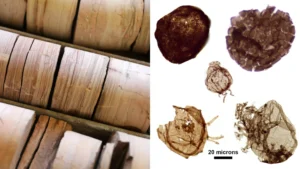
The PDI measures the color changes of organic microfossils, specifically pollen and spores. Under normal circumstances, these fossils darken as they are buried deeper into the Earth’s crust, due to the pressure and heat of diagenesis (the process by which sediment turns into rock). Generally, the deeper the sediment, the darker the fossil.
"But here, we found a very different pattern," explains Dr. Bas van de Schootbrugge, a senior author of the paper. "The oldest and deepest pollen and spores in the cores remained lightly colored. Yet fossils from the extinction interval became progressively darker, eventually reaching an extremely dark brown. Once the extinction period ended, the fossils returned to a pale yellow color."
By using a light microscope connected to a digital camera, the team converted the color of 15,000 individual microfossils into an average grayscale value. This allowed for an unprecedented level of precision in comparing samples across different locations and basins. Because the darkening occurred simultaneously across all four study sites—despite their distinct geological histories—the researchers concluded that the color shift was not a product of burial depth, but of an environmental "outside force": the intense, repeated exposure to heat from widespread wildfires.
Supporting Data: The "Dark Zone" Correlation
The strength of the study lies in the alignment of these datasets. When the researchers overlaid the PDI results with the charcoal and PAH records, a clear, unmistakable trend emerged. The "Dark Zone"—the strata containing the darkest fossils—perfectly overlapped with the peak of the fern spike and the most intense periods of greenhouse warming.
Crucially, the team compared the darkening effect across different plant groups. If the darkening were a biological trait of the ferns themselves, the researchers would have expected to see different results for tree pollen versus fern spores. Instead, they found that all plant groups exhibited the same darkening effect during the extinction interval. This "universal" response serves as a robust indicator that the darkening was caused by external combustion rather than inherent plant physiology.
The data confirms that the extinction was not a single "event," but a prolonged period of environmental instability where fire became a constant, defining feature of the global landscape.
Official Perspectives: Nature as a "Disaster Species"
The role of ferns in this ecological collapse is paradoxical. Often viewed as delicate forest undergrowth, ferns are, in reality, evolutionary survivors.
"Ferns are truly remarkable plants that have withstood many crises throughout Earth history," says Dr. Van de Schootbrugge. "Some species can adapt to some of the most extreme environments. They can be considered to be true disaster species."
According to the study, the ferns’ resilience is exactly what made them so dangerous. When a wildfire swept through these fern-covered savannahs, the surface foliage would be incinerated. However, the subterranean root systems of the ferns remained intact, allowing them to resprout with incredible speed. This gave them a massive competitive advantage over trees, which take decades to reach maturity. By repeatedly out-competing other vegetation, the ferns maintained their dominance.
Furthermore, the study posits that these ferns created a lethal "fuel ladder." As they dried out, their dense, mat-like growth provided the perfect tinder for subsequent fires. In this way, the ferns responded to the initial climate-induced deforestation by filling the void, and then actively sustained the fire-heavy environment that kept the forests from recovering.
Global Implications: A Warning from the Deep Past
The implications of the Utrecht University findings extend far beyond the history of the Triassic. The study paints a vivid picture of a "perfect storm": a combination of massive atmospheric CO2 injection, widespread deforestation, and the subsequent rise of opportunistic, fire-prone vegetation.
For modern climate scientists, the end-Triassic scenario offers a sobering look at how ecosystems can be trapped in a destructive feedback loop. When climate change alters the landscape to the point where dominant vegetation is replaced by fire-dependent species, the risk of "runaway" ecological degradation increases exponentially.
"The lesson we can learn from this is that the combination of climate change, deforestation, and the spread of opportunistic species can provide all the ingredients for a perfect storm," concludes Dr. Van de Schootbrugge.
As modern Earth faces its own challenges with rising temperatures and increasing wildfire frequency, the "Dark Zone" of the Triassic serves as a cautionary tale. The collapse of the ancient world was not just a result of volcanic heat, but a direct consequence of the cascading effects of a shifting biosphere. By understanding the mechanisms that turned the Earth into a fire-prone, fern-dominated wasteland 201 million years ago, researchers are gaining critical insights into the resilience—and the potential fragility—of our modern global ecosystem.