Diamonds, the quintessential symbol of enduring love and unparalleled luxury, have captivated humanity for over two millennia. Beyond their dazzling sparkle and inherent value, these precious gemstones possess a hidden characteristic that adds another layer of intrigue: fluorescence under ultraviolet (UV) light. While this phenomenon is well-known, its underlying science, relevance to gemologists, and implications for collectors often remain shrouded in mystery. Pat Daly FGA DGA, a seasoned expert in the field, illuminates this fascinating aspect of diamond science, offering a comprehensive exploration of what causes diamond fluorescence and why it matters.
The Diamond’s Inner Light: A Gemological Perspective
For centuries, diamonds have been revered in the jewelry trade. Their composition, however, remained an enigma until the late 18th century when scientists definitively established them as being primarily composed of carbon. The intricate details of their atomic structure and chemistry were only truly unveiled in the early 20th century. This burgeoning understanding, spurred by the increasing industrial applications of diamond, has driven in-depth scientific study, revealing the profound connection between a diamond’s properties, its structure, and its detailed chemical makeup.
At the heart of understanding diamond fluorescence lies the concept of "defects." A theoretically perfect diamond would consist solely of carbon atoms arranged in a flawless, three-dimensional lattice, with each carbon atom bonded to four others. However, in reality, deviations from this ideal structure are common. These "defects" can manifest as impurities within the carbon lattice or as missing atoms (vacancies). Far from being mere imperfections, these structural anomalies are of paramount importance to gemologists. They are the key determinants of a diamond’s color and, crucially, its luminescent responses. This luminescent behavior, or fluorescence, serves as a vital tool in distinguishing natural diamonds from treated or synthetic counterparts.
Decoding Diamond Types: The Role of Nitrogen and Boron
The classification of diamonds into different "types" is a fundamental aspect of gemological analysis, primarily based on the quantity and distribution of two key impurities: nitrogen and boron.
Type I Diamonds: These comprise the vast majority of natural diamonds and are characterized by the presence of nitrogen atoms in significant quantities, often measured in hundreds of parts per million (ppm).
Type II Diamonds: In stark contrast, Type II diamonds contain minimal amounts of nitrogen, typically less than 10 ppm, though this figure can vary slightly depending on the source.
The behavior of nitrogen within the diamond lattice is the primary driver of fluorescence in Type I diamonds. Initially, during the diamond’s formation deep within the Earth’s mantle, nitrogen atoms are thought to exist as dispersed ions. Over millions of years, as these diamonds journey towards the Earth’s surface, these nitrogen atoms undergo aggregation. They begin to pair up and, subsequently, form clusters of four nitrogen atoms surrounding a vacancy – a void where a carbon atom should be.
The specific arrangement of these nitrogen aggregates dictates their impact on both color and luminescence. Single nitrogen atoms, for instance, are responsible for the distinct yellow hues seen in some diamonds, while exhibiting minimal luminescence. Conversely, clusters of four nitrogen atoms around a vacancy have no discernible effect on luminescence, and pairs of nitrogen ions are known to "quench" or suppress fluorescence. Neither of these specific defects significantly influences the diamond’s color.
The Dance of Light: Blue Fluorescence and its Significance
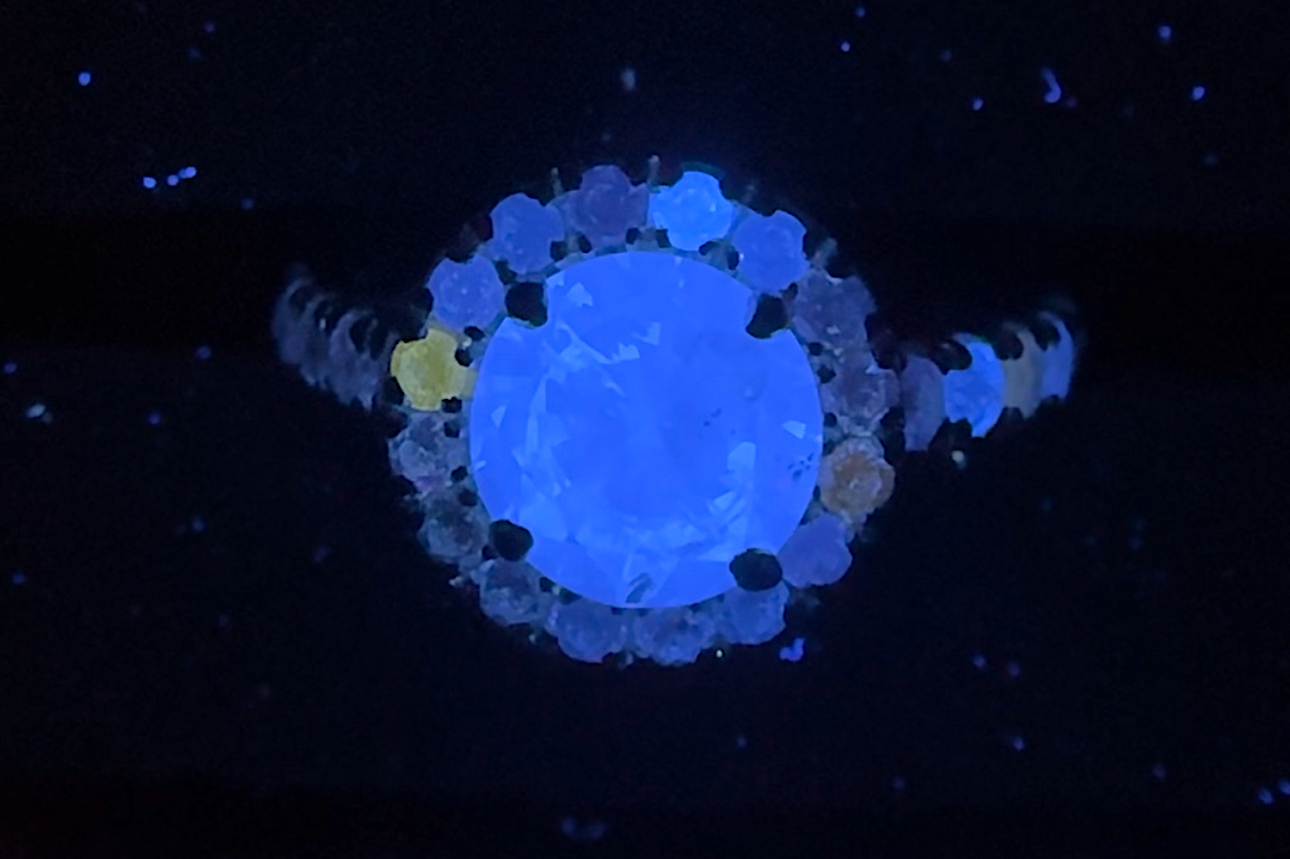
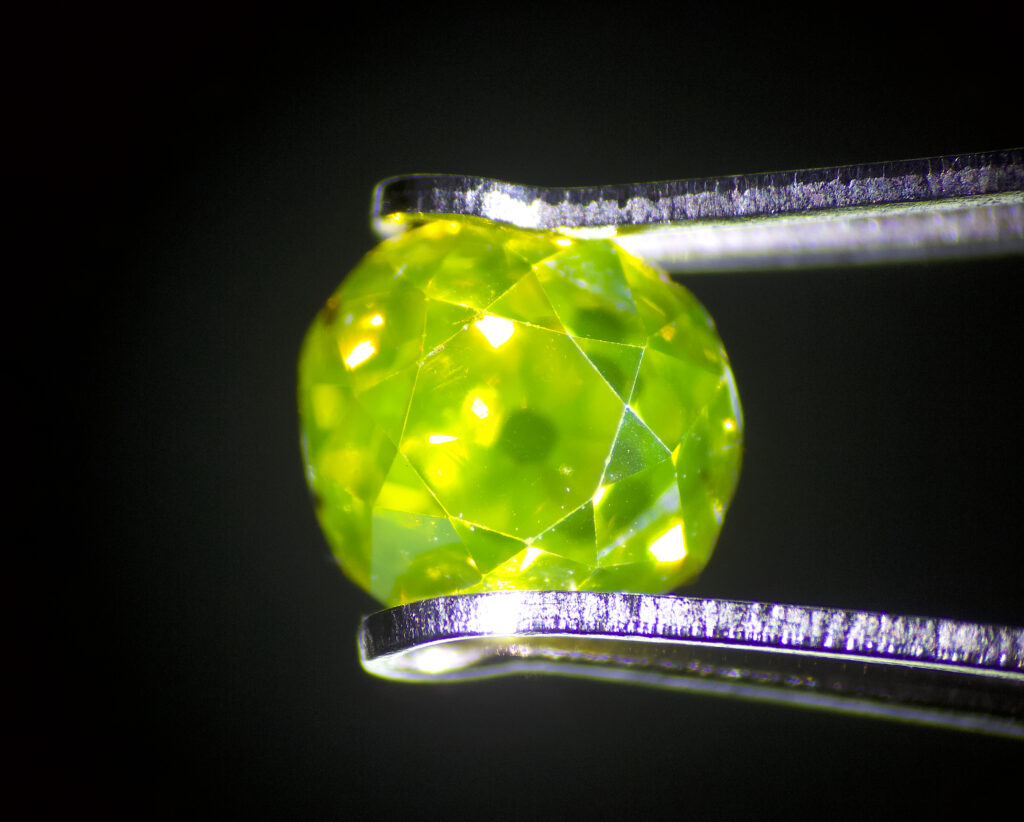
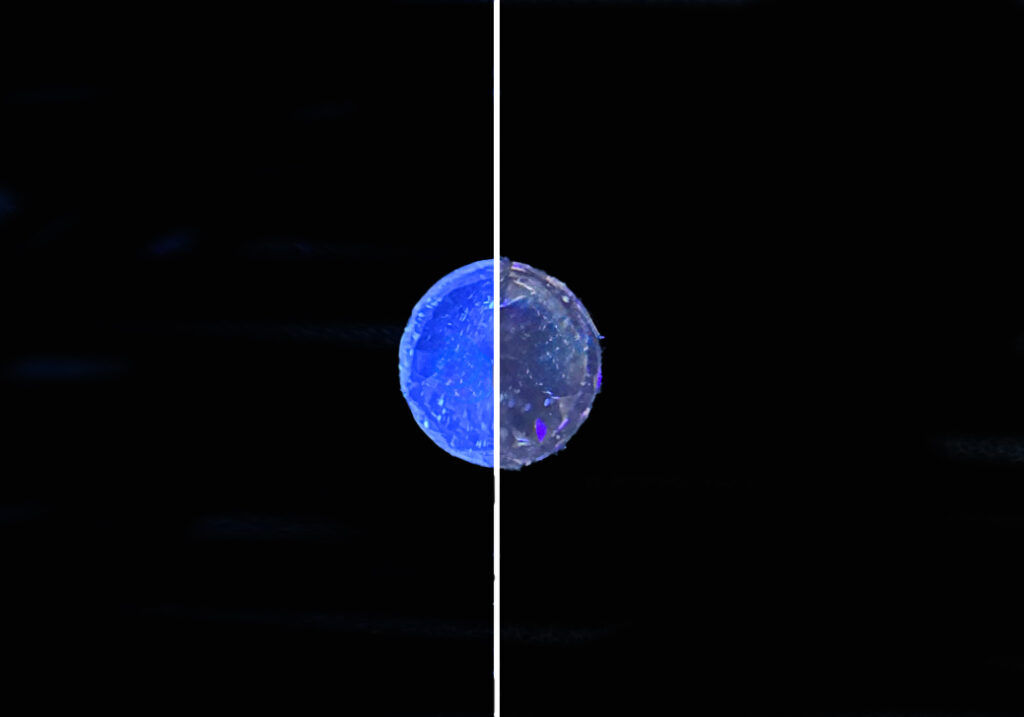
A significant proportion of natural diamonds, approximately 98%, exhibit a particular structural characteristic: groups of three nitrogen atoms surrounding a vacancy. This specific aggregate is responsible for imparting a yellowish tint to the diamond and, crucially, triggers a mesmerizing blue fluorescence when exposed to long-wave ultraviolet (LWUV) light. Following this initial blue glow, these diamonds often display a secondary phenomenon known as phosphorescence, emitting a yellowish light for a brief period after the UV source is removed.
The intensity of this blue fluorescence is directly correlated with the concentration of these nitrogen-vacancy aggregates, balanced against the presence of nitrogen pairs that might quench the luminescence. It is estimated that between one-third and all natural diamonds of this type can exhibit fluorescence, with the specific response contingent upon the wavelength of the UV light used, the viewing conditions, and the sophistication of the observation instrument. The presence of this characteristic blue fluorescence is considered strong evidence for a diamond’s natural origin.
In some instances, this blue fluorescence can be so pronounced that it is perceptible even under the ultraviolet component of natural daylight. The strength of a diamond’s fluorescence is often noted on grading reports, as some individuals perceive it as having a detrimental effect on the stone’s overall appearance. However, this viewpoint is not universally held within the gemological community.
A Spectrum of Luminescence: Beyond Blue
While blue fluorescence is the most commonly observed, nitrogen atoms, in combination with vacancies, can give rise to a fascinating spectrum of luminescent colors. For example:
- Green Fluorescence: Arises from the combination of two nitrogen ions with a vacancy, or four nitrogen ions with two vacancies.
- Orange Fluorescence: Is attributed to a single nitrogen ion paired with a vacancy.
Yellow fluorescence, on the other hand, is believed to originate from planar defects known as platelets. These are essentially flat arrangements of carbon atoms, interspersed with some nitrogen.
The captivating color of pink diamonds is thought to stem from "dislocations" – structural faults within the atomic lattice caused by distortions in the crystal. These dislocations can sometimes interact with nitrogen atoms. Most natural pink diamonds fall under Type I classification and typically display blue or yellow fluorescence.
Type II Diamonds: A Realm of Purity and Unique Luminescence
Type II diamonds, characterized by their exceptionally low nitrogen content, are further subdivided into Type IIa and Type IIb.
Type IIa Diamonds: These contain very little to no nitrogen. Generally, Type IIa stones do not exhibit fluorescence under standard gemological conditions. However, a rare subset of naturally colored pink diamonds belonging to this type can emit an orange glow under LWUV light. This phenomenon is attributed to a specific defect involving a nitrogen ion associated with a vacancy. While this particular defect is uncommon in natural stones (found in less than 1% of pink diamonds), it is notably prevalent in artificially colored and synthetic pink diamonds.
Type IIb Diamonds: These diamonds possess a small but significant quantity of boron. Boron is believed to be the primary cause of the distinctive color in most blue diamonds and their associated luminescence. While Type IIb diamonds typically show little fluorescence under long-wave UV, they can exhibit bluish, greenish, or orange to red fluorescence when exposed to short-wave ultraviolet (SWUV) light. A common characteristic of these diamonds is phosphorescence, which can persist for up to a minute after the UV source is removed. Bluish and greenish hues are the most frequent, but red phosphorescence is also well-documented. Intriguingly, most natural blue diamonds phosphoresce red, though this effect can be masked by the dominant blue-green luminescence. The balance between these luminescent and phosphorescent properties, and their fading rates, has been proposed as a method for identifying individual stones, potentially allowing for the recognition of recut diamonds from stolen rough.
Luminescence in the Laboratory: Synthetic and Treated Diamonds
The luminescent properties of synthetic and treated diamonds offer valuable diagnostic clues for gemologists.
- Treated Pink Diamonds: Including synthetic pink diamonds, often exhibit an orange glow under UV light. This is a rare characteristic in natural pink diamonds, making it a significant indicator.
- High-Pressure, High-Temperature (HPHT) Treated Stones: Diamonds treated using HPHT methods, which typically contain nitrogen, can develop bright yellow and green body colors and display intense fluorescence in similar hues under UV light.
In contrast, blue fluorescence under LWUV is relatively uncommon in synthetic diamonds. Many synthetic diamonds that do fluoresce tend to emit an orange to yellow or greenish glow, which is generally more pronounced under SWUV light than LWUV. Furthermore, many smaller diamonds produced via HPHT methods contain boron and exhibit long-lasting phosphorescence, sometimes even stimulated by daylight. While irradiation can diminish this effect, it adds to the cost and is not always applied.
The Cutting Edge of Detection: Advanced Instruments
The distinct luminescent behaviors of natural and synthetic diamonds have paved the way for the development of sophisticated instruments designed to aid the trade in screening and identifying these gemstones. Among the most advanced are the Diamond View and SYNTHdetect, developed by De Beers. These instruments leverage the unique responses of diamonds to ultraviolet radiation to differentiate between natural and laboratory-grown stones.
Fluorescence in Short-Wave Ultraviolet: Unveiling Growth Patterns
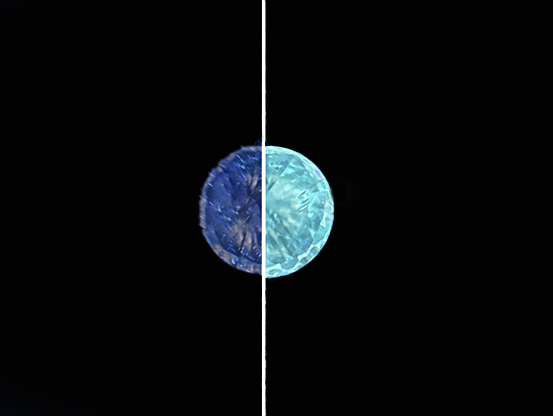
Short-wave ultraviolet radiation, with a principal wavelength of approximately 225nm, elicits a luminescent response from virtually all diamonds. Crucially, the colors emitted by natural and synthetic stones often differ. This is because defects tend to accumulate at varying rates on different faces of a growing crystal, leading to distinct luminescent patterns. These patterns can even be recognized on polished diamonds, providing insights into their original growth habit. Natural diamonds typically grow as octahedra, while HPHT synthetics often display prominent cubic faces. CVD-grown synthetics, on the other hand, exhibit layers parallel to a specific pair of cube faces.
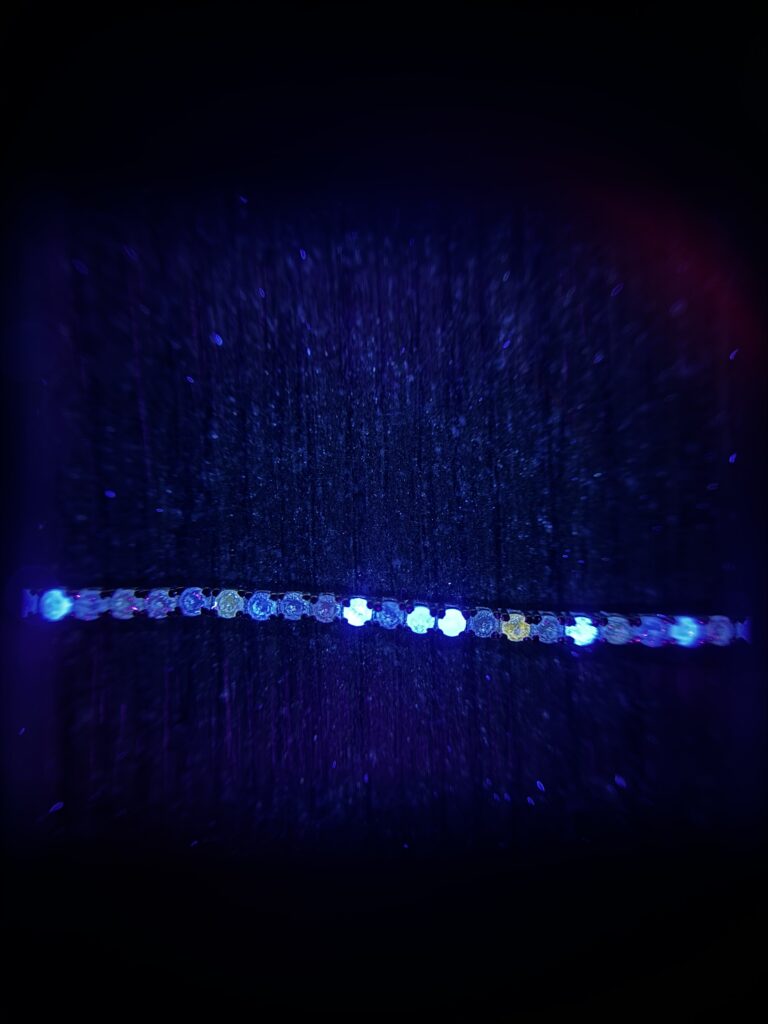
The SYNTHdetect instrument utilizes this short-wave radiation to test multi-stone jewelry. By analyzing the colors and short-term changes in luminescence, it can effectively distinguish between natural and synthetic diamonds.
In conclusion, diamond fluorescence is far more than a mere visual curiosity. It is a complex scientific phenomenon rooted in the atomic structure and chemical composition of these precious gems. For gemologists and diamond collectors alike, understanding fluorescence provides invaluable insights into a diamond’s origin, its unique characteristics, and its place within the intricate world of gemstone identification. The luminous enigma of diamond fluorescence continues to be a vital tool in the ongoing quest to appreciate and authenticate these timeless treasures.