

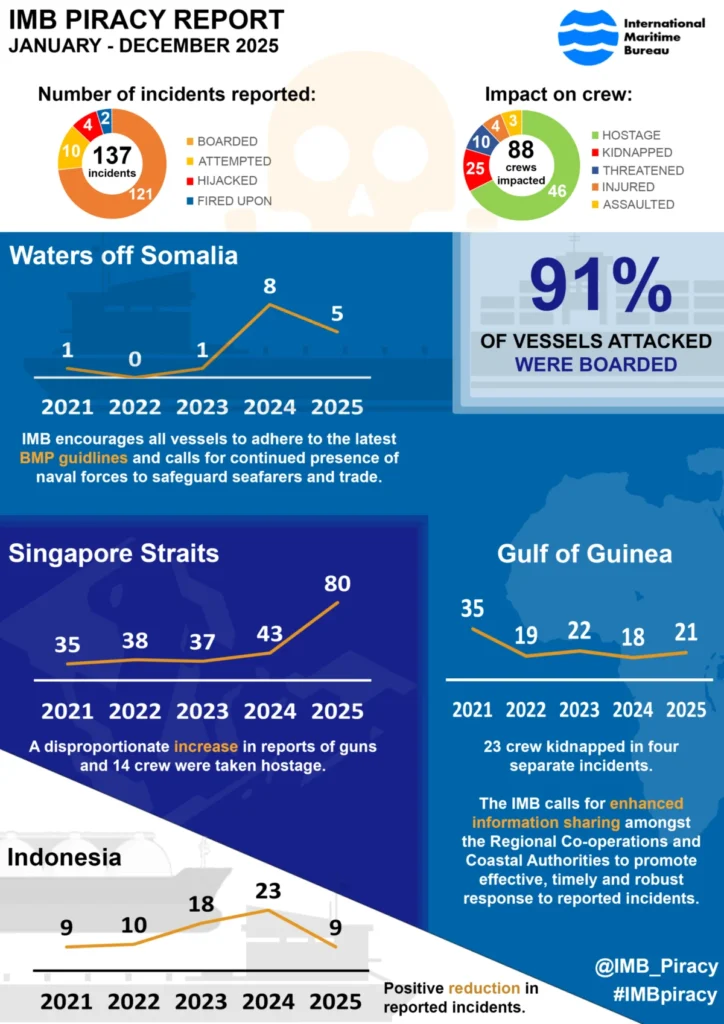
London, 15 January 2026 – The global maritime landscape faced a precarious year in 2025, marked by a measurable uptick in piracy and armed robbery against vessels. According to the latest Annual Piracy and Armed Robbery Report released by the ICC International Maritime Bureau (IMB), the international shipping community experienced a resurgence in security challenges, even as traditional hotspots in the Somali basin remained largely contained through robust naval interventions.
While the majority of the 137 recorded incidents were classified as "low-level" opportunistic crimes, the sheer frequency of attacks—up from 116 in 2024 and 120 in 2023—serves as a stark reminder of the persistent vulnerability of the world’s "blue highways."
The State of Global Maritime Security: An Overview of 2025
The 2025 data paints a complex picture of maritime crime. Of the 137 reported incidents, the vast majority involved vessels that were successfully boarded by perpetrators (121 cases). The intensity of these encounters varied, ranging from petty theft to high-stakes hijacking and armed assault. The report notes that four vessels were hijacked during the calendar year, and two were fired upon, while 10 additional incidents were classified as attempted attacks.
The geographical epicenter of these disturbances shifted toward Southeast Asia, specifically the Singapore Straits. This critical maritime artery, which handles a massive percentage of the world’s containerized trade, saw the highest concentration of reported incidents. The density of vessel traffic in these narrow straits, combined with the proximity of multiple jurisdictions, continues to provide cover for opportunistic criminals looking to plunder stores, equipment, or ship supplies.
Conversely, the threat posed by Somali-based piracy, which paralyzed international shipping in previous decades, remained largely suppressed throughout 2025. The continued presence of international naval task forces and the implementation of Best Management Practices (BMP) by the shipping industry have proven effective in keeping these waters relatively secure, preventing a return to the widespread hostage-taking crises of the past.
Chronology of Escalation: Tracking the 2025 Trend
The trajectory of maritime crime throughout 2025 did not occur in a vacuum; it reflected broader geopolitical instabilities and economic pressures.
- Q1 2025 (January–March): The year began with a steady stream of reports from the Singapore Straits and the Indonesian archipelago. The focus remained on low-level boarding, primarily during the hours of darkness, targeting tankers and bulk carriers at anchor or underway in busy traffic lanes.
- Q2 2025 (April–June): As global shipping volumes surged to meet mid-year consumer demand, reports of armed robbery spiked. Data indicated that criminal syndicates became more emboldened, utilizing faster, more agile craft to intercept slower-moving vessels.
- Q3 2025 (July–September): This period saw an alarming increase in the use of weaponry. The IMB noted a shift in the modus operandi of attackers, who were increasingly willing to display firearms to intimidate crews into surrendering control of the vessel or its cargo.
- Q4 2025 (October–December): The final quarter confirmed the year-end statistics, showing a consolidated rise in total incidents compared to the previous two years. Despite heightened patrols, the cumulative impact of these minor, yet frequent, interruptions contributed to rising insurance premiums and operational delays.
Supporting Data: Analyzing the Human and Material Cost
The statistical breakdown of the 2025 report reveals both positive developments and deeply concerning regressions. While the total number of incidents is up, the "human cost" remains the most volatile metric in the bureau’s findings.
The Human Toll
In 2025, 46 crew members were taken hostage, a significant decrease from the 126 recorded in 2024 and 73 in 2023. This drop, while seemingly positive, is offset by a worrying increase in kidnapping and physical assault.
- Kidnappings: 25 crew members were reported kidnapped in 2025, nearly double the 12 recorded in 2024 and a marked increase from the 14 in 2023. Kidnapping for ransom remains a lucrative, albeit high-risk, venture for organized criminal groups operating in volatile coastal zones.
- Physical Violence: Beyond hostage-taking, the report highlights that 10 crew members were threatened, four were injured, and three were assaulted during boarding incidents.
The Escalation of Weaponry
The IMB’s data regarding weaponry is perhaps the most concerning indicator of the year. The use of firearms was reported in 42 incidents in 2025, a dramatic increase from 26 in 2024. This suggests that maritime criminals are becoming better armed and more willing to engage in lethal force to achieve their objectives. Conversely, the use of knives—the traditional weapon of choice for opportunistic boarders—dropped slightly from 39 incidents in 2024 to 33 in 2025, reinforcing the narrative that pirates are pivoting toward higher-caliber intimidation tactics.
Official Responses and Strategic Perspectives
The ICC International Maritime Bureau has been a vocal advocate for systemic change, urging governments and industry stakeholders to move beyond reactive security measures.
A Call for Global Cooperation
ICC Secretary General John W.H. Denton AO emphasized the existential link between maritime security and global economic stability. "Maritime trade remains a cornerstone of real economic activity and growth," Denton stated upon the release of the report. "The rise in reported maritime incidents highlights the importance of protecting seafarers and securing key shipping routes—not only for crew safety, but for the stability of global supply chains and the economies that depend on them."
Denton further underscored that the solution is not a purely military one. "Ensuring safe passage at sea requires sustained cooperation, with regional and international partners working together to safeguard maritime commerce. This includes better information sharing, more robust judicial follow-through on apprehended criminals, and a collective commitment to protecting the men and women who keep our world supplied."
Industry Vigilance
Industry leaders are responding by doubling down on "hardening" measures. This includes the installation of razor wire, the use of water cannons, and the deployment of "citadels"—secure rooms within a ship where crew can retreat if the vessel is boarded. While these measures protect the crew, they do not address the root causes of the crime, such as local poverty, political instability in coastal regions, and the lack of maritime law enforcement capacity in certain jurisdictions.
Implications: Supply Chains and the Future of Maritime Law
The rise in maritime incidents has profound implications that extend far beyond the deck of a container ship.
Economic Impact and Supply Chain Fragility
In an era of "just-in-time" logistics, any interruption to shipping is magnified. Even if a vessel is not hijacked, the mere threat of boarding can force ships to deviate from their routes, increase speeds—leading to higher fuel consumption and emissions—or invest in expensive private maritime security companies (PMSC). These costs are inevitably passed down to the consumer, contributing to inflationary pressures on global goods.
The Jurisdictional Challenge
A significant hurdle in combating piracy is the lack of a unified legal response. Many incidents occur in waters where maritime law is loosely enforced or where multiple nations claim overlapping jurisdiction, leading to "legal black holes." When perpetrators are caught, the process of extradition and prosecution is often hampered by bureaucratic inertia or a lack of domestic laws that specifically criminalize maritime piracy.
The Path Forward
To reverse the trend seen in 2025, experts suggest a three-pronged strategy:
- Enhanced Intelligence Sharing: Establishing real-time reporting channels between commercial vessels and regional navies to ensure rapid response to distress signals.
- Capacity Building: Providing technical and financial support to the coastal nations where piracy is prevalent, enabling them to patrol their own territorial waters more effectively.
- Judicial Harmonization: Encouraging international treaties that mandate the prosecution of maritime criminals, ensuring that there is no "safe haven" for those who attack merchant vessels.
As 2026 begins, the maritime industry stands at a crossroads. While the containment of Somali piracy stands as a success story of international cooperation, the rise in incidents in the Singapore Straits and the increased use of firearms underscore that the threat has not disappeared—it has merely evolved. The safety of the global economy and the lives of thousands of seafarers depend on whether the international community can foster a similar level of commitment to securing the rest of the world’s oceans.



