

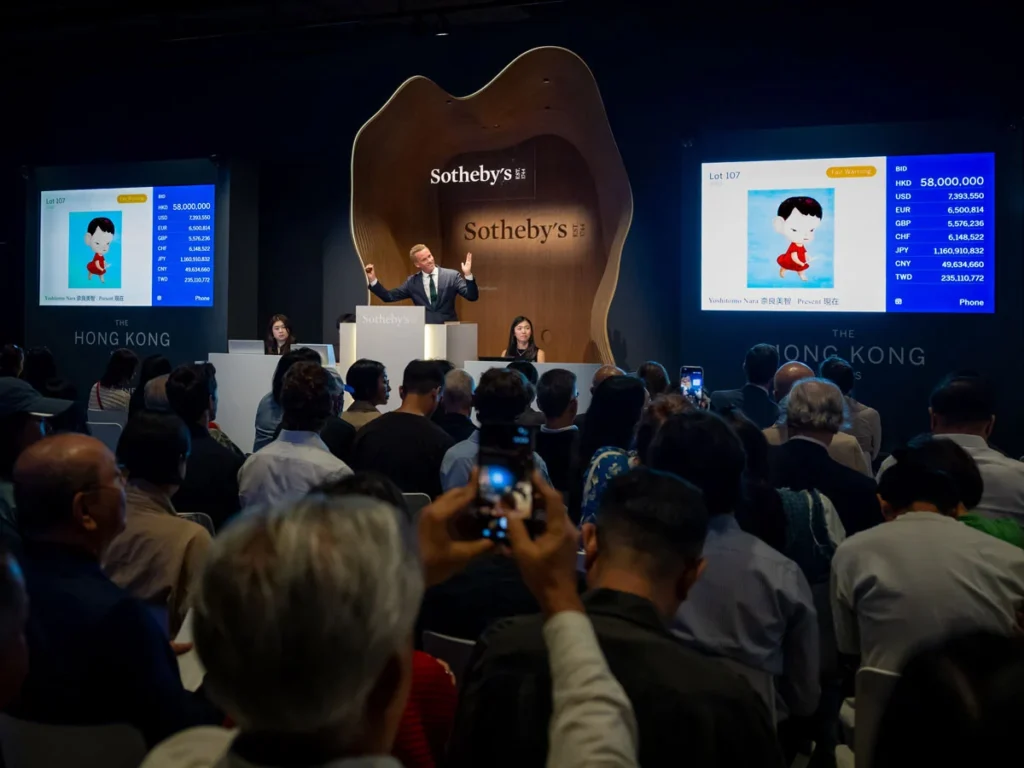
The Hong Kong art market, long the crown jewel of the Asian secondary market, currently finds itself at a complex crossroads. As the autumn auction cycle concluded in late September, the results from the "Big Three"—Sotheby’s, Christie’s, and Phillips—revealed a landscape defined by cautious optimism, strategic withdrawals, and a starkly uneven macroeconomic backdrop. While the total sales figures showed an upward trajectory compared to the previous spring season, the underlying data suggests a market that is increasingly selective, where the air is thinning for eight-figure "trophy" lots.
The Macroeconomic Backdrop: A Tale of Two Asias
The performance of the Hong Kong sales cannot be divorced from the broader economic anxieties currently gripping the Asia-Pacific region. The market is operating under a "mixed-weather" system. On one hand, Mainland Chinese equities reached a 13-month low recently, placing significant pressure on the disposable budgets of traditional powerhouse collectors from the PRC. Furthermore, the Japanese yen’s dip to a multi-decade low in June has altered the buying power and consignment strategies of one of the region’s most established collector bases.
Conversely, there are pockets of significant liquidity. South Korea’s economy has shown remarkable resilience, propelled by a surge in semiconductor exports. Simultaneously, Hong Kong and Singapore continue to benefit from an influx of capital from the Middle East. As geopolitical friction persists in the West, sovereign wealth and private high-net-worth capital from the Gulf states are increasingly viewing Hong Kong as a vital financial conduit.
However, the "boots on the ground" reality for commercial galleries remains grim. The abrupt closure of Tang Contemporary’s Wong Chuk Hang space—attributed to months of rent arrears and a "sharp contraction in sales"—has served as a sobering reminder that the primary market is bearing the brunt of China’s domestic economic headwinds. This fragility set the stage for an auction week where the houses had to work harder than ever to secure confidence.
Chronology of the Autumn Sales: From Foujita to Basquiat
Sotheby’s: The Joe Lewis Catalyst
The auction week commenced on Monday, September 28, at Sotheby’s, which utilized a high-profile single-owner collection to build early momentum. The evening opened with a dedicated sale of works by Léonard Tsuguharu Foujita, consigned by British billionaire Joe Lewis.

The strategy proved effective. Building on the success of a Lewis-consigned sale in London earlier this year, the Hong Kong auction realized $8.7 million. The star of the show was Foujita’s 1949 oil-and-ink masterpiece, Le rêve (Hommage à La Fontaine). Estimated at a modest $510,000–$765,000, it ignited a bidding war that ended at $3.38 million. This "white-glove" energy, however, did not entirely translate to the main marquee sale that followed.
As the night progressed, buyer risk aversion became palpable. The most significant blow to the evening’s prestige was the last-minute withdrawal of Mark Rothko’s 1965 masterpiece, Untitled (Plum and Dark Brown). Estimated at $9.94 million to $16.3 million, its removal suggested that the house could not guarantee a price that met the consignor’s expectations in the current climate. Despite this, Yoshitomo Nara’s Present (1994) provided a solid anchor, selling for $9.13 million.
Christie’s: Global Bidding and Old Master Surprises
On Tuesday, Christie’s took the stage with a more diverse offering that attempted to bridge the gap between European Old Masters and contemporary Asian stalwarts. The house achieved a perfect sell-through rate, though this "white-glove" status was technically manufactured through the pre-sale withdrawal of two major lots: a Jonas Wood pot painting and a Cheong Soo Pieng landscape.
The evening was characterized by "buoyant underbidding." A standout moment occurred during the Old Master segment when Peter Paul Rubens’s Landscape with Willows sparked an intense duel between two telephone bidders. The hammer eventually fell at $1.5 million, 150% above its low estimate. The contemporary sector saw similar heat for Liu Ye, whose work triggered a "head-to-head" battle between a Hong Kong local and a Western collector, signaling that top-tier Asian artists still command global, rather than just regional, competition.
Phillips: A Leaner, Edgier Strategy
The week concluded on Wednesday at Phillips. This sale was watched with particular scrutiny following the high-profile departure of Asia chairman Jonathan Crockett and several senior staff members. Acting interim lead Dina Zhang presented a lean catalog of just 16 lots, focusing on "experimental and edgy" works to differentiate the house from its larger rivals.

The strategy resulted in a 94% sell-through rate and a total of $6.7 million. While the numbers were smaller, the house successfully sold a Gerhard Richter Abstraktes Bild (1983) for $2.93 million, proving it could still handle blue-chip secondary market inventory despite its internal leadership transitions.
Supporting Data: By the Numbers
The combined total for the modern and contemporary art evening sales at Christie’s, Sotheby’s, and Phillips reached $223.6 million. This represents a $58.7 million increase from the $164.9 million achieved during the Spring 2024 season.
| House | Total Sale (USD) | Sell-Through Rate | Top Lot |
|---|---|---|---|
| Sotheby’s | $124.3 Million | 91% | Yoshitomo Nara, Present ($9.13M) |
| Christie’s | $92.6 Million | 100% (Adjusted) | Jean-Michel Basquiat, Ancient Scientist ($9.81M) |
| Phillips | $6.7 Million | 94% | Gerhard Richter, Abstraktes Bild (522-1) ($2.93M) |
Key Trend: While the totals are up, the reliance on single-owner collections (like the Joe Lewis holdings) is high. Without the Lewis injection, Sotheby’s total would have dropped by nearly $37 million, illustrating how much "fresh-to-market" estate material is currently propping up the totals.
Official Responses: Insights from the Rostrum
The leaders of the auction houses remained steadfast in their commitment to the region, though their comments reflected a shift in strategy.
Cristian Albu, Christie’s Asia Pacific Head of Auction:
Albu addressed the mixed performance of Gerhard Richter’s Abstraktes Bild (1991), which sold for $4.47 million, 26% below its low estimate. "We took a bit of a risk by bringing this particular Richter… this marked the first time Christie’s presented a painting executed in oil on wood in Asia." He suggested that more "contextual exhibitions" are needed to help Asian collectors appreciate the full breadth of a Western artist’s material experimentation.

Dina Zhang, Phillips interim Head of Modern & Contemporary Art, China:
Zhang was vocal about dispelling rumors of a Phillips retreat from Asia. "Whenever we are competing for a major consignment… I always ask clients to give us a fair shot. We remain very competitive in specific price ranges."
Ada Tsui, Christie’s Asia Pacific Vice President:
Tsui highlighted the resilience of the "Kusama Market." Despite Yayoi Kusama’s A-Pumpkin (YHP) hammering below its low estimate, Tsui noted that the final price of over $7 million was "respectable," arguing that the market had already "priced in" the artist’s advanced age and that steady demand for her work remains a pillar of regional stability.
Implications: The Shrinking Eight-Figure Pool
Perhaps the most insightful analysis of the season came from Yuki Terase, co-founder of Art Intelligence Global. Terase pointed to a structural shift in the secondary market that poses a challenge for the next year of sales.
"We have a vast pool of collectors who can comfortably and intuitively spend up to a few million dollars," Terase noted. "But once you cross into eight figures and above, the buyer pool shrinks dramatically."
The sale of Jean-Michel Basquiat’s Ancient Scientist (1984) for $9.81 million serves as a perfect case study. While it was the most expensive work sold in Asia this season, its hammer price was only 11% above the low estimate. This suggests that for works priced over $10 million, the market is no longer driven by "bidding wars" between existing participants. Instead, success now depends on unlocking fresh capital—finding the one or two new high-net-worth individuals who are entering the market for the first time.

Conclusion: A Market of "Specifics"
The autumn 2024/2026 season in Hong Kong proves that the era of "a rising tide lifts all boats" is over. Success in the current climate is determined by the specificity of the work: its medium, its freshness to the market, and its ability to appeal to a global audience rather than just a regional one.
Hong Kong remains the undisputed hub for art commerce in Asia, but its future growth will depend on how well it can pivot away from a reliance on Mainland Chinese liquidity and toward a more diversified, globalized collector base. For now, the market is in a state of "fragile resilience"—stable enough to avoid a crash, but too cautious to call a full recovery.



