

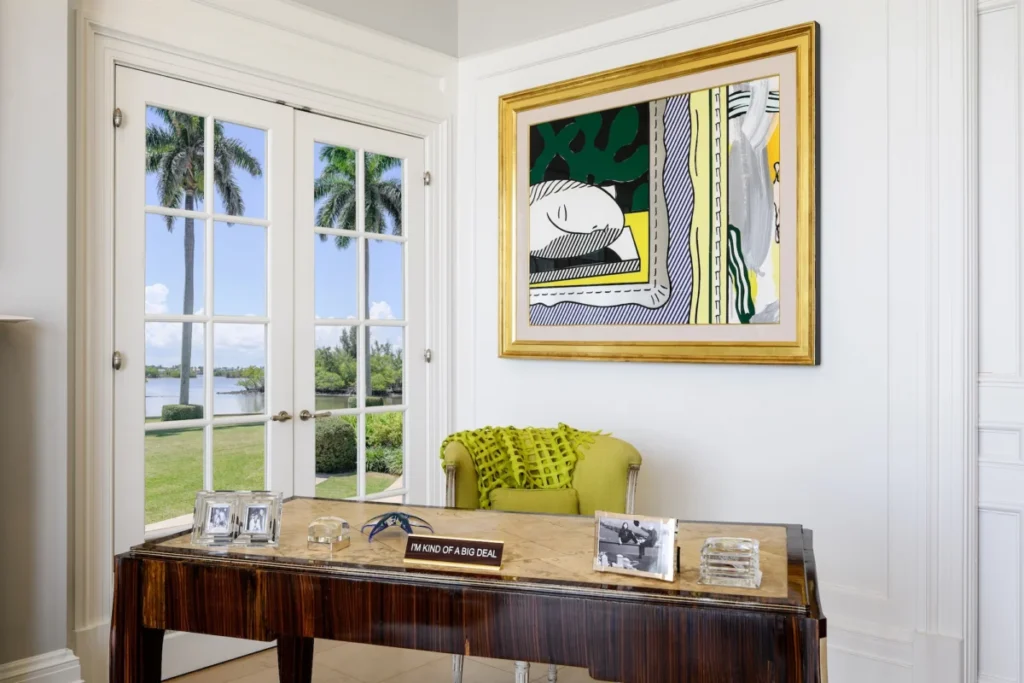
The international art market is bracing for a landmark event this November as Sotheby’s prepares to unveil the private collection of the late cable television pioneer Ted Baum and his wife, the acclaimed interior designer Ruth Baum. With an aggregate estimate exceeding $100 million, the collection represents a masterclass in twentieth-century connoisseurship, spanning the bridge between American Post-War dynamism and European avant-garde abstraction.
Consisting of more than 130 works, the collection is not merely a hoard of blue-chip assets but a curated narrative of a couple’s fifty-year journey through the evolution of contemporary art. The sale, which will be dispersed across a dedicated evening auction, a subsequent day sale, and various themed auctions throughout the coming year, arrives at a pivotal moment for the global art market as major houses compete for dominance in the high-stakes November season.
Main Facts: The Crown Jewels of the Baum Estate
The Ted and Ruth Baum collection is anchored by a formidable selection of masterpieces from the titans of American and European art. The centerpiece of the upcoming November 16 evening sale is a duo of works, each carrying an estimate of $10 million to $15 million. The first is a seminal painting on paper by Mark Rothko, Untitled (1967), a work that the Baums famously cited as the catalyst for their deep dive into contemporary collecting. Joining it at the top of the ledger is an iconic work by Ed Ruscha, whose market has seen a meteoric rise in recent years.
Beyond these headliners, the collection boasts significant depth:
- Joan Mitchell: The artist’s Green Book of Barbara Guest (1960) is expected to fetch in the region of $12 million. As Mitchell’s market continues to reach new heights, this work—linked to the celebrated poet Barbara Guest—is expected to draw intense international interest.
- Pop Art Icons: The collection features major works by Roy Lichtenstein, Tom Wesselmann, and Andy Warhol. Warhol’s The Scream (After Edvard Munch) (1984) carries a pre-sale estimate of $4 million to $6 million.
- European Abstraction: Highlighting the Baums’ sophisticated palate are works by the "Spacialist" pioneer Lucio Fontana, the Italian texturalist Alberto Burri, and the French conceptualist Yves Klein. Fontana’s Concetto Spaziale, Attese (1960) and a major work by Burri are both tagged at $4 million to $6 million.
The sale logistics are equally ambitious. Two dozen of the most prestigious works will be offered during a dedicated single-owner segment of the November 16 evening auction in New York. The following day, November 17, a day sale will handle the middle-market works, with the remaining 100+ items filtered into specialized sales through 2025. To drum up global demand, Sotheby’s has organized a world tour of highlights, stopping in London, Hong Kong, Paris, Los Angeles, and New York.
Chronology: The Evolution of a Fifty-Year Passion
The Baums did not begin their journey as high-stakes players in the global art market. Their collection evolved organically, reflecting their personal growth and the shifting landscapes of the art world from the 1970s through the early 2000s.
The Formative Years (1970s)
The journey began with a modest acquisition in the 1970s when Ruth Baum purchased a sketch by the American Ashcan School painter John Sloan at a charity auction. This initial spark led the couple to explore Modernist works on paper, gradually acquiring drawings and watercolors by European masters like Fernand Léger and Pablo Picasso. During this period, their collecting was characterized by a traditional interest in line and form.

The Rothko Epiphany (1983)
The trajectory of the collection changed forever in 1983. Seeking "one great painting" to anchor their holdings, the Baums acquired Mark Rothko’s Untitled (1967). The vibrant red-and-orange composition on paper resonated with the couple’s personal history. As Ruth Baum later recalled, "The Rothko hit us. That was it. We were children of the ’60s, and the art of that period spoke to us." This purchase marked their transition from collectors of Modernist sketches to serious patrons of Contemporary and Post-War masterpieces.
Expansion and Maturity (1990s–2000s)
Throughout the 1990s, the Baums expanded their horizons to include the heavyweights of Abstract Expressionism and Pop Art. They acquired significant canvases by Joan Mitchell, Sam Francis, and Hans Hofmann, alongside the playful, graphic works of Roy Lichtenstein.
In the 2000s, their focus sharpened on works that challenged the boundaries of the canvas. This era saw the acquisition of Ed Ruscha’s Dimple (1964), a work that appealed to Ted Baum’s intellectual affinity for wordplay and linguistic puzzles. They also began looking toward Europe, recognizing the parallels between American abstraction and the radical movements occurring in Italy and France. In 2000, they purchased Lucio Fontana’s slashed canvas, Concetto Spaziale, Attese, for £333,500—a fraction of its current multi-million dollar valuation.
Supporting Data: Market Analysis and Financial Appreciation
The Baum collection serves as a case study in the financial appreciation of blue-chip contemporary art over several decades. A look at the historical data of their acquisitions reveals a pattern of savvy, long-term investing.
- The Warhol Appreciation: In 2006, the Baums acquired Andy Warhol’s The Scream (After Edvard Munch) at Sotheby’s London for £1.5 million (approximately $2.7 million at the time). Adjusted for inflation, that purchase price is roughly $4.5 million today. With an estimate of $4 million to $6 million, the work is expected to realize a solid return, though its true value lies in its rarity as a dialogue between two of art history’s most famous figures.
- The Fontana Factor: The 2000 purchase of the Fontana for $485,232 (roughly $934,000 in today’s dollars) against a current estimate of $4–6 million represents a staggering increase in value. This reflects the broader market trend where European post-war artists have finally achieved price parity with their American counterparts.
- The Mitchell Momentum: Joan Mitchell’s market has exploded in the last five years, with her auction record now exceeding $29 million. The $12 million estimate for Green Book of Barbara Guest reflects a conservative yet optimistic entry point for a work of its provenance and date.
The decision to spread the collection across multiple sales is a strategic move by Sotheby’s to maintain price integrity. By drip-feeding the 130 works into the market, the auction house avoids "flooding" the market with a single artist’s work, thereby ensuring that demand remains high for each individual lot.
Official Responses: Industry Perspectives
The announcement has elicited significant praise from the art world’s inner circle, highlighting the Baums’ reputation not just as buyers, but as intellectual participants in the art scene.
Wendy Cromwell, a prominent New York-based art advisor who worked closely with the family, emphasized the couple’s intellectual rigor. "From Joan Mitchell to David Hammons, the Baums knew what they liked, were insatiably curious, and kept pushing their eye," Cromwell stated. "The result of their shared passion is a collection that gallops through time, countries and genres. The Baums’ collection tells the story of what it means to collect contemporary art."

Oliver Barker, Chairman of Sotheby’s Europe, noted the couple’s ability to bridge the gap between different artistic movements. "I was immediately struck by their inquisitiveness and the deep level of their research," Barker remarked. "They instinctively understood that artists like Lucio Fontana and Yves Klein were vital to the history of 20th-century abstraction and could sit perfectly well situated in their beautiful interiors alongside Rothko, Mitchell and others."
This sentiment is echoed by the Norton Museum of Art in West Palm Beach, where the Baums were transformative figures. Having funded the museum’s first contemporary art curator position and donated works by Dale Chihuly and Leo Villareal, the Baums’ legacy is already etched into the institutional history of the American South.
Implications: A High-Stakes November for Auction Giants
The arrival of the Baum collection on the auction block is part of a broader "arms race" between Sotheby’s and Christie’s. As the global economy faces headwinds, the auction houses are relying on prestigious, fresh-to-market estate collections to anchor their bottom lines.
The timing is critical. Just days before the Baum announcement, Sotheby’s revealed the Carlos Pedro Blaquier and Nelly Arrieta de Blaquier collection, a massive $450 million haul led by a $180 million Van Gogh. Meanwhile, Christie’s has countered with its own $100 million offering of Old Masters and contemporary art, reportedly from the collection of artist Jeff Koons, featuring a $40 million Picasso.
The Baum sale represents a specific segment of the market: the "Connoisseur Estate." Unlike the speculative buying often seen in the "ultra-contemporary" market, estate sales like the Baums’ offer "provenance-rich" works that have been off the market for decades. This "freshness" is the most valuable currency in the current auction climate.
Furthermore, the sale underscores the philanthropic "end-of-life" cycle of great American collections. With Ted passing in 2021 and Ruth in 2024, the liquidation of their assets serves as both a final tribute to their vision and a redistribution of cultural capital. The proceeds from such sales often find their way back into the arts through the family’s foundations, continuing the cycle of patronage that the Baums championed throughout their lives.
As the gavel falls this November, the art world will be watching closely. The success of the Baum collection will be a bellwether for the health of the blue-chip market, proving whether the "insatiable curiosity" of two dedicated collectors can still command the attention—and the capital—of the global elite.



