COCHISE COUNTY, ARIZONA — GMV Minerals Inc. (TSXV: GMV) (OTCQB: GMVMF) has officially announced the successful conclusion of its 2026 diamond drilling campaign at the Mexican Hat gold project, a cornerstone asset located in the historic mining landscape of southeast Arizona. This milestone marks a significant step forward for the company as it seeks to refine its geological understanding, enhance resource confidence, and advance the project toward a potential production decision.
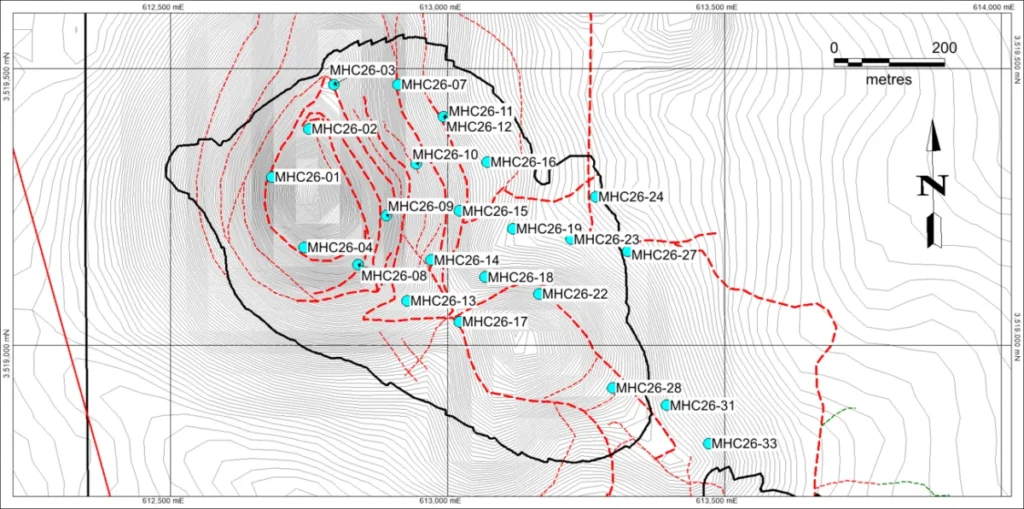
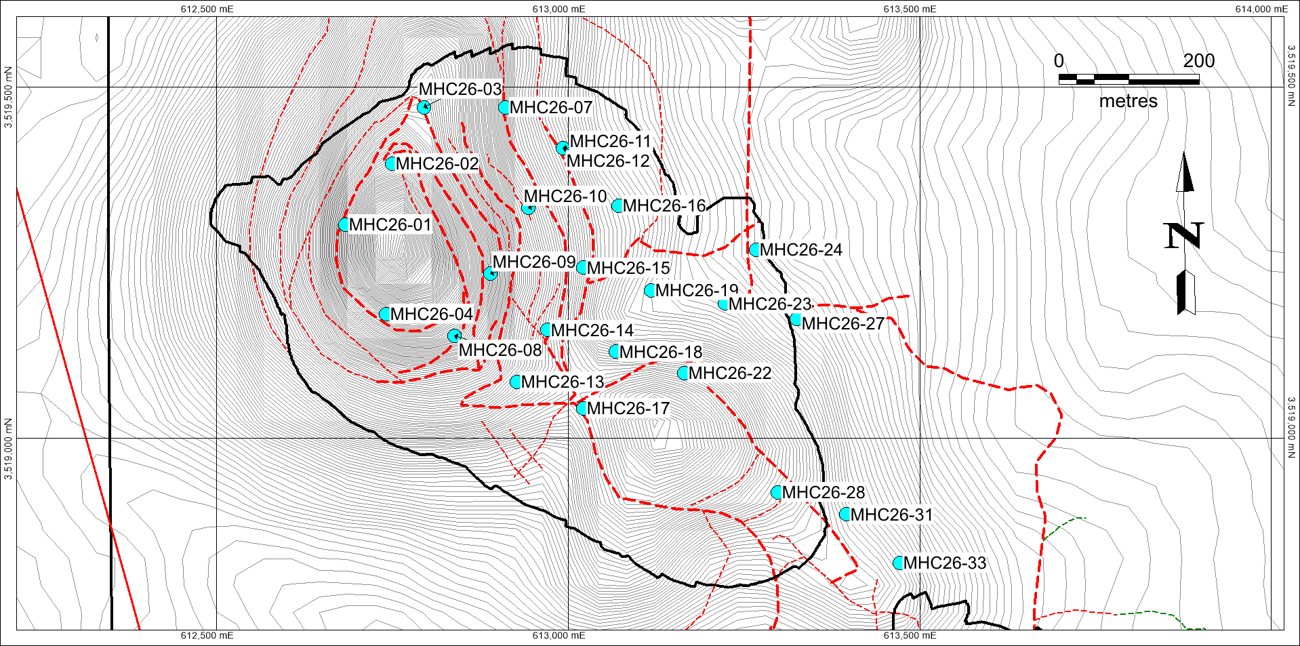
The program, which involved the completion of 4,775 meters of drilling across 25 diamond drill holes, was strategically designed to optimize resource definition and collect critical geomechanical data. By targeting the deposit over a strike length of 950 meters and a width of 370 meters, GMV has effectively stress-tested its existing geological models, providing a robust dataset that will underpin an upcoming, updated National Instrument (NI) 43-101 Mineral Resource Estimate.
The Technical Objectives of the 2026 Campaign
The primary directive for the 2026 program was twofold: to tighten the resolution of the known gold-bearing zones and to provide the geotechnical inputs necessary for sophisticated open-pit slope engineering. To achieve this, the technical team utilized 24 distinct drill platforms, carefully orienting the holes to intersect mineralization at angles greater than 75 degrees. This approach ensures high-quality intercept orientations, allowing for a more accurate representation of the true thickness of the mineralized zones.
The results have been highly encouraging, with all 25 drill holes intersecting significant gold mineralization within the established deposit solids. This consistency not only validates the structural model currently employed by the company but also provides the geological confidence required to transition portions of the inferred resource into the higher-confidence "indicated" or "measured" categories.
Geological Context and Structural Controls
The Mexican Hat Gold Deposit is defined as a structurally controlled, metasomatic gold system hosted within peralkaline Cenozoic volcanic and volcaniclastic rocks. The geological environment is characterized by a complex interplay of trachytic basalts, andesites, latites, and rhyolite breccias.
The mineralization is closely associated with oxidized alkaline fluids that have caused hematization and carbonatization in areas proximal to late-stage fractures. A key factor in the project’s economic attractiveness is the relative lack of silicification, which typically complicates metallurgical processing. Previous column-test results have demonstrated gold recoveries as high as 98%, a metric that remains a highlight of the project’s technical profile.
The deposit is structurally governed by a "Principal Controlling Structure" (PCS)—a listric normal fault that extends for more than 1,500 meters to the northwest. Modeling has identified six additional subsidiary structures that branch off the PCS, striking east-northeast and extending up to 450 meters, creating a highly favorable plumbing system for gold deposition.
Chronology: From Exploration to Resource Definition
The Mexican Hat project has a storied history of exploration, dating back to the late 1980s when it was first explored by Placer Dome (USA). Since acquiring the property, GMV Minerals has been systematic in its approach to de-risking the asset.
- June 2020: The company compiled its previous NI 43-101 Mineral Resource estimate using a base case of $1,375/oz gold.
- August 2025: GMV released an updated Preliminary Economic Assessment (PEA), which served as the blueprint for the current drill program.
- Late 2025 – 2026: Preparations were made for the 2026 diamond drill campaign, focusing on the infill and expansion targets identified in the 2025 PEA.
- October 2026: Completion of the 4,775-meter drilling program, with all assays processed and validated.
- Upcoming (Late 2026): The company expects to release a revised NI 43-101 Mineral Resource Estimate, incorporating the 25 new drill holes and the resulting structural analysis.
Analysis of Supporting Data
The assay results from the 2026 program provide compelling evidence of the deposit’s continuity. Over 94 significant mineralized intervals were identified that exceed the previous minimum cut-off grade of 0.2 gpt gold. On average, these intercepts show 0.87 gpt gold over a width of 7.74 meters.
Notable highlights include hole MHC26-14, which returned one of the highest-grade intersections recorded at the project to date, and hole MHC26-15, which intersected 30.36 meters grading 0.782 gpt gold. Such results are vital for the economic viability of a heap-leach style operation, as they demonstrate the potential for both grade consistency and significant volumes of mineralized material that can be accessed via open-pit mining.
All samples were processed at an independent, certified laboratory using standard fire assay procedures with ICP-AES analysis. The company implemented a rigorous Quality Assurance/Quality Control (QA/QC) protocol, utilizing 189 external blanks and standards alongside duplicates to ensure the integrity of the data.
Official Perspectives: CEO Insights
Ian Klassen, President and CEO of GMV Minerals, expressed satisfaction with the results, emphasizing the impact these findings will have on the company’s future planning.
"MHC26-14 returned one of the highest gold drill intersections reported at the Mexican Hat project to date," Klassen stated. "All drill holes appear to have intersected significant gold mineralization within the established solids, enabling modeling refinements and an enhancement to the accuracy of the resource model. We now have great confidence in the continuity of the mineralization at the Mexican Hat gold deposit. We look forward to receipt of the updated NI Mineral Resource estimate this fall."
Klassen’s confidence reflects the broader sentiment of the management team: that the project is no longer just an exploration play, but a project moving toward the feasibility stages of mine development.
Implications for Future Development
The upcoming Resource Estimate is expected to be a major value-driver for GMV Minerals. By converting inferred resources to higher categories, the company is effectively lowering the technical risk profile of the project, which is a necessary precursor for attracting project financing and securing mining permits.
The 2025 PEA, which projected a 688,000-ounce gold resource at 0.58 g/t, provided the initial foundation. With the 2026 data, the updated estimate will likely provide a more granular look at the deposit’s grade distribution, potentially allowing for the optimization of the pit shell and a more efficient mine plan.
Addressing the Risks
As with any junior exploration company, GMV Minerals acknowledges the speculative nature of its current mineral resources. The company has maintained a transparent stance, noting that "Inferred Mineral Resources" are considered too geologically speculative to have economic considerations applied to them for conversion into "Mineral Reserves."
Investors are cautioned that while the PEA is a positive indicator, it is preliminary in nature. The company must still complete extensive technical studies, metallurgical flow sheet designs, and environmental assessments. The path forward remains contingent on the continued success of the exploration and technical work, as well as broader macroeconomic factors such as the global gold price and the regulatory environment in Arizona.
Conclusion
GMV Minerals stands at a pivotal juncture. The successful completion of the 2026 drill program confirms that the Mexican Hat project is host to a consistent, well-defined gold system with strong potential for open-pit extraction. With the industry currently favoring projects that demonstrate metallurgical simplicity and structural continuity, the Mexican Hat asset is well-positioned to remain a focal point for precious metals development in the American Southwest.
As the company moves toward the publication of its revised resource estimate, stakeholders will be watching closely for the conversion rates of inferred material and the potential for a larger, more economically robust project footprint. Given the high recovery rates and the clear structural controls identified, GMV Minerals has successfully de-risked one of the most critical aspects of the project, moving one step closer to the ultimate goal of commercial gold production.
Disclaimer: This article is for informational purposes only and does not constitute financial advice. Investors are encouraged to conduct their own due diligence and consult with a professional financial advisor before making any investment decisions. The information presented is based on the company’s official disclosures and industry standard practices.