

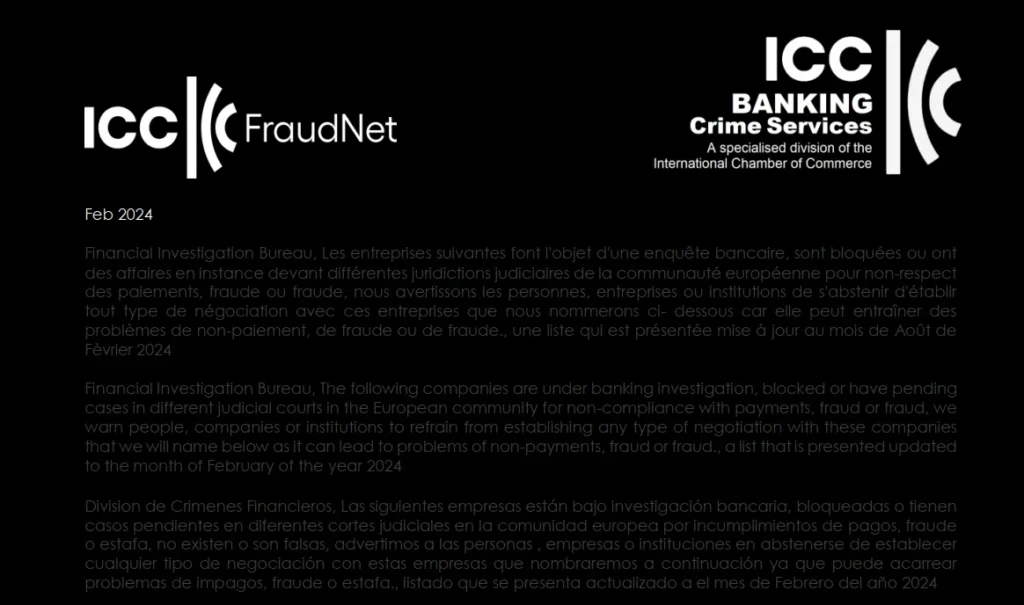
LONDON – The International Chamber of Commerce Commercial Crime Services (ICC-CCS) has issued an urgent warning to the global maritime, logistics, and trade sectors regarding the proliferation of fraudulent “blacklists” currently circulating throughout international business networks. These fabricated documents, which illegitimately carry the ICC-CCS brand and credentials, purport to identify companies and individuals involved in illicit trade or non-compliant activities.
However, officials have categorically dismissed these documents as malicious fabrications, cautioning industry stakeholders that the lists are part of a sophisticated smear campaign designed to damage the reputations of targeted entities.
Main Facts: The Anatomy of the Fraud
The fraudulent activity involves the unauthorized use of the ICC-CCS logo, letterhead, and branding to lend an air of institutional legitimacy to what are, in reality, baseless accusations. These documents typically take the form of formal reports or notifications, listing specific contact details for companies and individuals, accompanied by allegations of malpractice.
The ICC-CCS has confirmed that it does not maintain, compile, or distribute any such blacklists. Furthermore, the organization has no process by which it independently “blacklists” private entities for circulation in the manner seen in these documents.
The primary objective of the perpetrators appears to be twofold:
- Reputational Sabotage: By associating legitimate businesses with fraudulent claims of illicit activity, the creators of these lists aim to isolate these companies from their trading partners, banks, and logistics providers.
- Institutional Impersonation: By piggybacking on the reputation of a globally recognized organization like the ICC-CCS, the fraudsters leverage existing trust in the agency to ensure their misinformation is treated as fact by busy procurement and compliance officers.
Chronology of the Deception
While the ICC-CCS has only recently moved to issue a formal public denouncement, industry analysts suggest that the seeds of this campaign were sown several months ago.
- Initial Discovery: Reports of suspicious documents began surfacing in late 2023, primarily reaching logistics providers and supply chain managers in the EMEA region. These early versions were often shared via encrypted messaging apps and private email threads.
- Escalation: By early 2024, the scope of the distribution widened. The lists began to include a broader array of companies, suggesting that the parties behind the fraud were actively monitoring market competitors.
- The Unauthorized Use of Trademarks: The situation intensified when the fraudulent actors began integrating the ICC-CCS brand more aggressively, using high-resolution imagery and professional formatting to mimic the style of official ICC-CCS bulletins.
- Formal Investigation: Upon receiving multiple inquiries from businesses claiming to be on these lists, the ICC-CCS initiated an internal review, confirming that the documents did not originate from their servers or departments.
- Public Warning: The current phase represents a formal effort by the ICC-CCS to stem the tide of misinformation by alerting the global trade community at large.
Supporting Data: Why Trust Matters in Global Trade
The trade industry relies heavily on due diligence. When a company is vetted, compliance officers look for red flags. These fraudulent blacklists exploit the "due diligence" process by planting false red flags into the ecosystem.
According to trade compliance experts, the impact of such a list is disproportionate to its truthfulness. If a company appears on a document that looks like an official ICC-CCS publication, a bank might freeze credit lines, a shipping line might refuse to carry cargo, and a client might terminate a contract before even verifying the source.
The ICC-CCS has observed that these lists often contain:
- Inconsistent Data: The contact details often feature outdated addresses or misspellings that would not occur in a legitimate ICC-CCS report.
- Non-Standard Formatting: Despite high-quality graphics, the structure of the lists often lacks the standard internal coding or reference numbers typically assigned to official ICC-CCS communications.
- Targeting Patterns: The lists often cluster companies that are direct competitors, suggesting that the motive is commercial warfare rather than genuine regulatory oversight.
Official Responses: A Categorical Dismissal
Michael Howlett, Director of the ICC-CCS, has been unequivocal in his condemnation of the activity. In a statement released to the trade press, Howlett emphasized the danger posed by these documents and urged the industry to verify any suspicious documentation directly through the organization’s official channels.
“ICC-CCS would like to make it clear that our organization does not produce lists of this nature,” Howlett stated. “The contents are entirely false and should not be relied upon. It appears that these lists have been created by unknown parties and circulated with the intent of damaging the reputations of the listed companies. They should be completely disregarded and given no credence whatsoever.”
The ICC-CCS has reiterated that it operates under strict mandates and professional standards. The creation of "blacklists" for public consumption contradicts the legal and ethical framework of the organization. Their role is to assist in the prevention of commercial crime through intelligence, not to act as a tribunal that publicly shames private entities without due process.
Implications: The Long-Term Consequences of Digital Smears
The emergence of these fraudulent documents highlights a growing vulnerability in the digital age of international trade: the ease with which trust can be weaponized.
1. Erosion of Institutional Trust
When bad actors impersonate credible institutions, they degrade the value of those institutions. If businesses begin to doubt the authenticity of documents coming from organizations like the ICC, the entire apparatus of global trade compliance suffers.
2. Legal Repercussions for Perpetrators
The unauthorized use of the ICC-CCS trademark is not merely an ethical breach; it is a legal one. The ICC-CCS is likely evaluating the legal avenues available to identify the perpetrators. While the parties remain “unknown,” digital forensic experts point out that the distribution channels—email servers, messaging platforms, and social media—leave digital footprints that can be tracked.
3. The Need for Enhanced Due Diligence
For the victims of these lists, the damage can be immediate and severe. However, this crisis serves as a reminder for all companies to:
- Verify the Source: Never assume a document is legitimate just because it bears a logo. Use official contact channels to confirm the authenticity of any notification.
- Use Multi-Factor Verification: If a document claims to be from a regulator, check the regulator’s official website for a corresponding announcement.
- Report Anomalies: If you receive a document that appears to be an ICC-CCS blacklist, do not forward it. Report it directly to the ICC-CCS headquarters.
Conclusion: Vigilance as the Primary Defense
The ICC-CCS’s decision to go public with this information is a proactive step in protecting the integrity of the international marketplace. By dismissing these lists as "completely baseless," the organization has signaled that it will not stand by while its reputation is used to fuel corporate sabotage.
The maritime and trade sectors must now adopt a heightened state of skepticism. In an environment where information moves at the speed of light, the ability to discern truth from forgery is a critical competitive advantage.
Anyone who receives a document claiming to be an ICC-CCS blacklist should immediately dismiss it, notify their compliance department, and forward the document to the official ICC-CCS office for investigation. By working together to report and verify, the industry can neutralize this threat and ensure that the vital trust underpinning global trade remains intact.
As Michael Howlett concluded in his address, "The intent here is malice. The only way to combat it is through transparency and the firm refusal to let false information dictate business decisions."
For further verification or to report a fraudulent document, businesses are encouraged to visit the official ICC-CCS website and utilize the verified contact information provided there. Relying on any other source is, in the words of the Director, an invitation to be misled.



