Executive Summary
Sun Summit Minerals Corp. (TSXV: SMN) (OTCQB: SMREF) has officially released the initial assay results from its comprehensive 2026 drilling campaign at the JD Project, located within the prolific Toodoggone Mining District of north-central British Columbia. The company reported successful findings from the first thirteen drill holes at the Creek Zone, highlighting a strategic expansion of high-grade and bulk-tonnage style epithermal gold-silver mineralization.
The 2026 program, which encompasses a 16,000-meter effort across the Creek, Finn, and Schmitt zones, is fundamentally designed to provide the geological bedrock for the company’s inaugural mineral resource estimate, slated for the first quarter of 2027. With visible gold confirmed and significant intervals of precious metal enrichment, the company is demonstrating the viability of its systemic approach to the JD Project’s hydrothermal system.
Chronology of the 2026 Exploration Program
The 2026 drill campaign represents a pivotal moment for Sun Summit as it shifts from broad-based exploration to resource definition. The program was officially launched following the company’s strategic assessment of the Toodoggone district, with the primary mandate to define the lateral and vertical limits of the mineralized zones.
- Mid-2026 Initialization: Sun Summit mobilized for a 16,000-meter diamond drilling program consisting of 55 holes, targeting the Creek, Finn, and Schmitt zones.
- September 2026 Update: The company provided a comprehensive operational update confirming that drilling was well underway, utilizing a grid-based approach designed to test structural continuity.
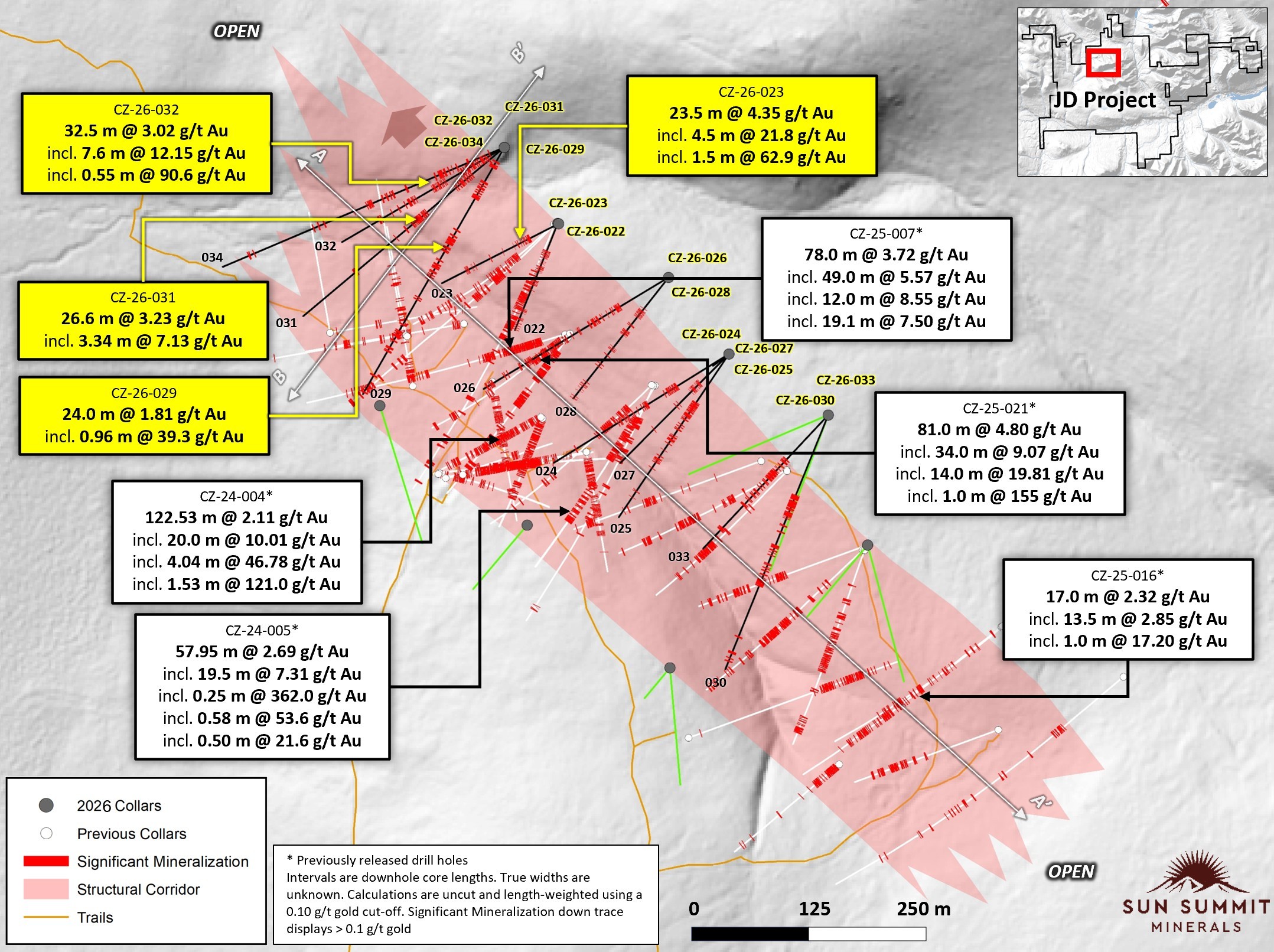
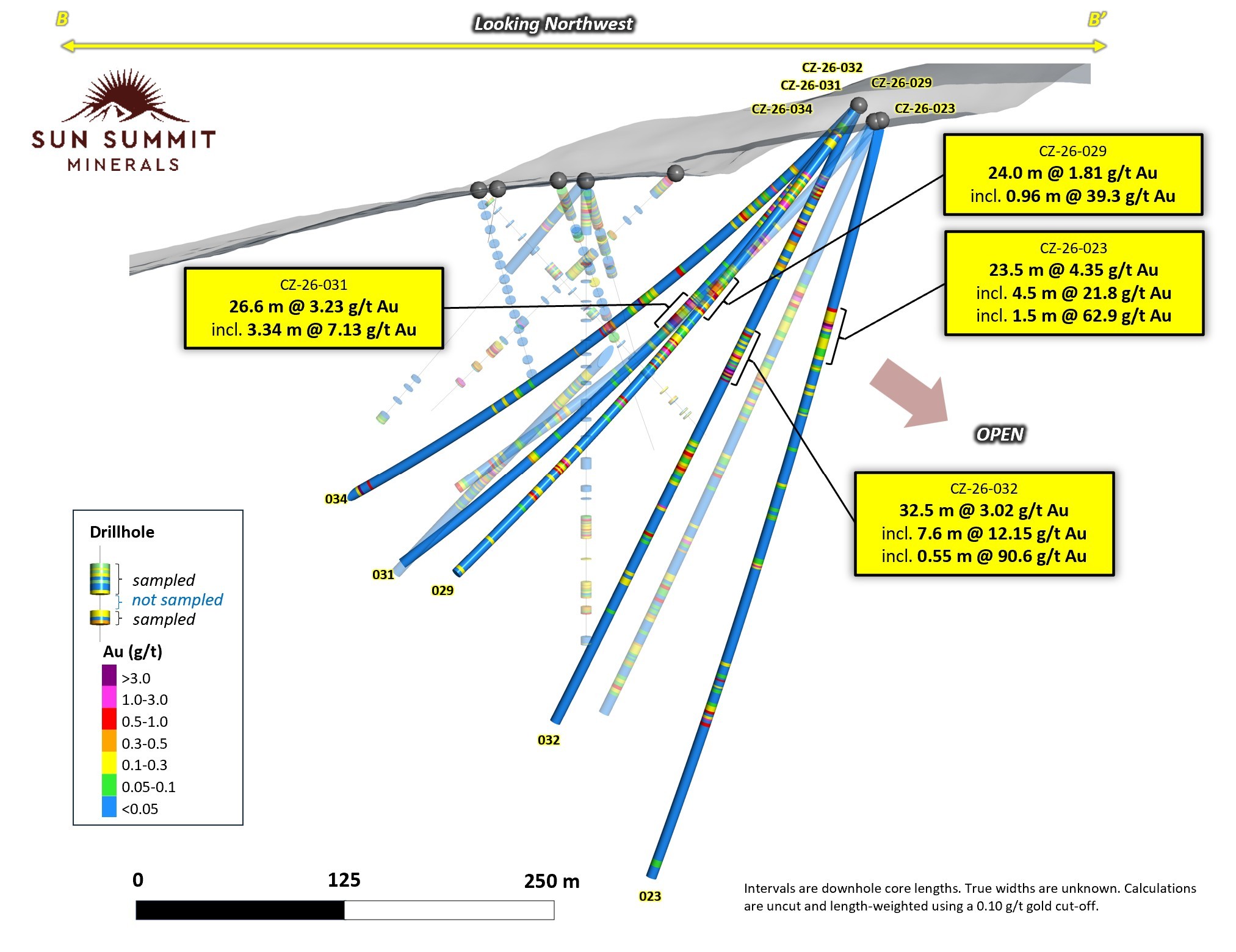
- October 2026 Results: The first 13 holes (CZ-26-022 to CZ-26-034) were processed, analyzed, and released, confirming the expansion of the Creek Zone by approximately 100 meters to the northwest.
- Ongoing Operations: As of this report, assay results for the remaining 42 holes—spanning the remainder of the Creek Zone and the entirety of the Finn and Schmitt zones—are currently in the laboratory pipeline.
Supporting Data and Geological Insights
The technical success of the recent drilling is best evidenced by the geological characteristics of the Creek Zone. All thirteen reported holes intersected a bedded sequence of intermediate volcanic and volcaniclastic rocks belonging to the lower Metsantan Member of the Early Jurassic Toodoggone formation.
Mineralization Characteristics
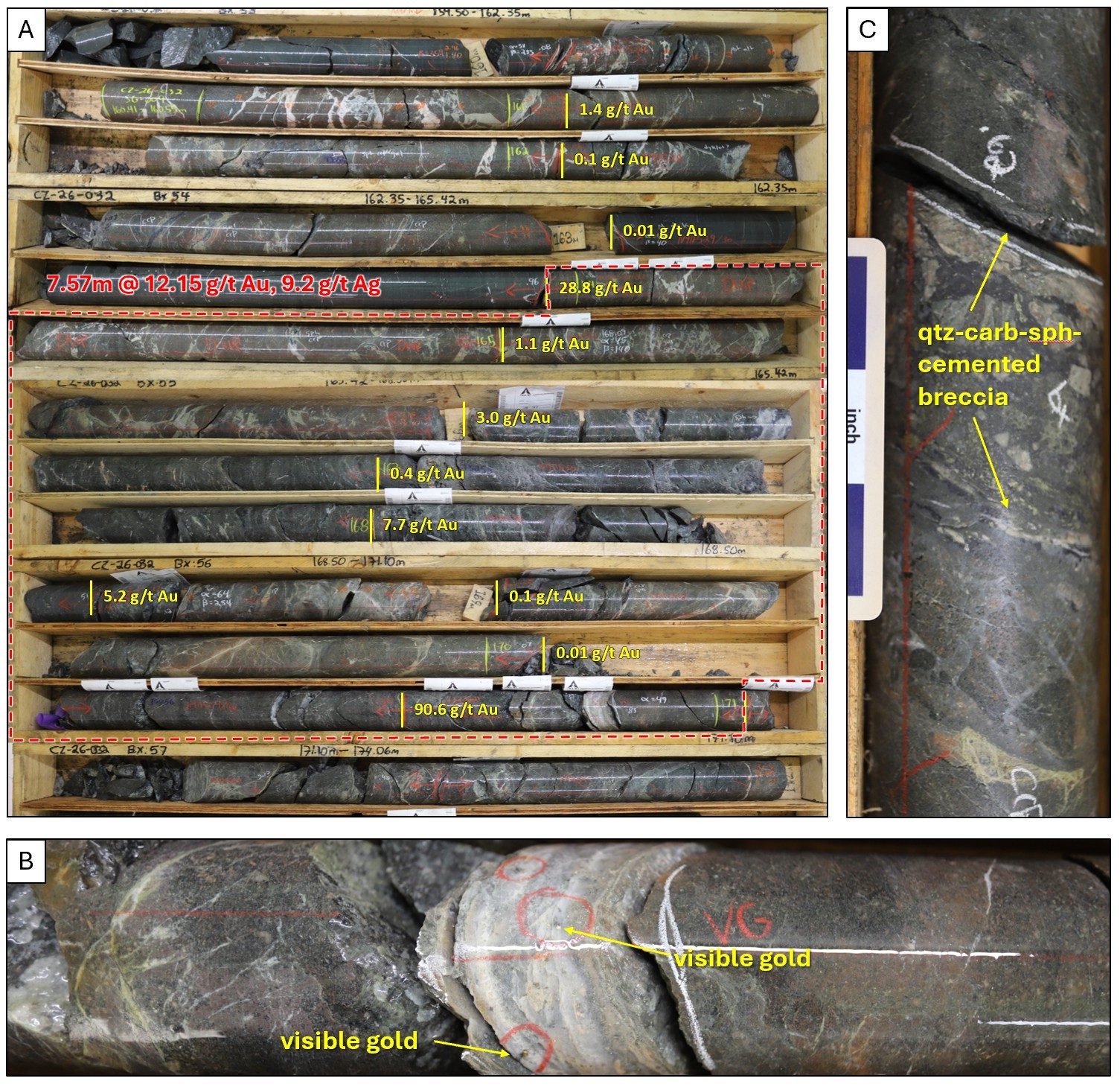
The mineralization discovered is typical of a high-sulfidation epithermal system. Gold and silver are primarily hosted within quartz-carbonate veins, veinlets, and sulfide-cemented breccias. These veins are frequently surrounded by pervasive potassium feldspar alteration halos, a hallmark of the hydrothermal activity that characterizes the JD Project.
Key mineralogical constituents include pyrite, sphalerite, galena, and trace chalcopyrite. Most notably, the presence of visible gold in specific intervals—such as the 90.6 g/t Au and 15.45 g/t Ag over 0.55 meters—underscores the high-grade potential of the feeder structures within the Creek Zone.
Bulk-Tonnage Potential
While the high-grade veins capture attention, the bulk-tonnage potential is equally critical for the upcoming resource estimate. The data shows significant intervals of sericite-chlorite-hematite alteration, which often hosts disseminated pyrite.
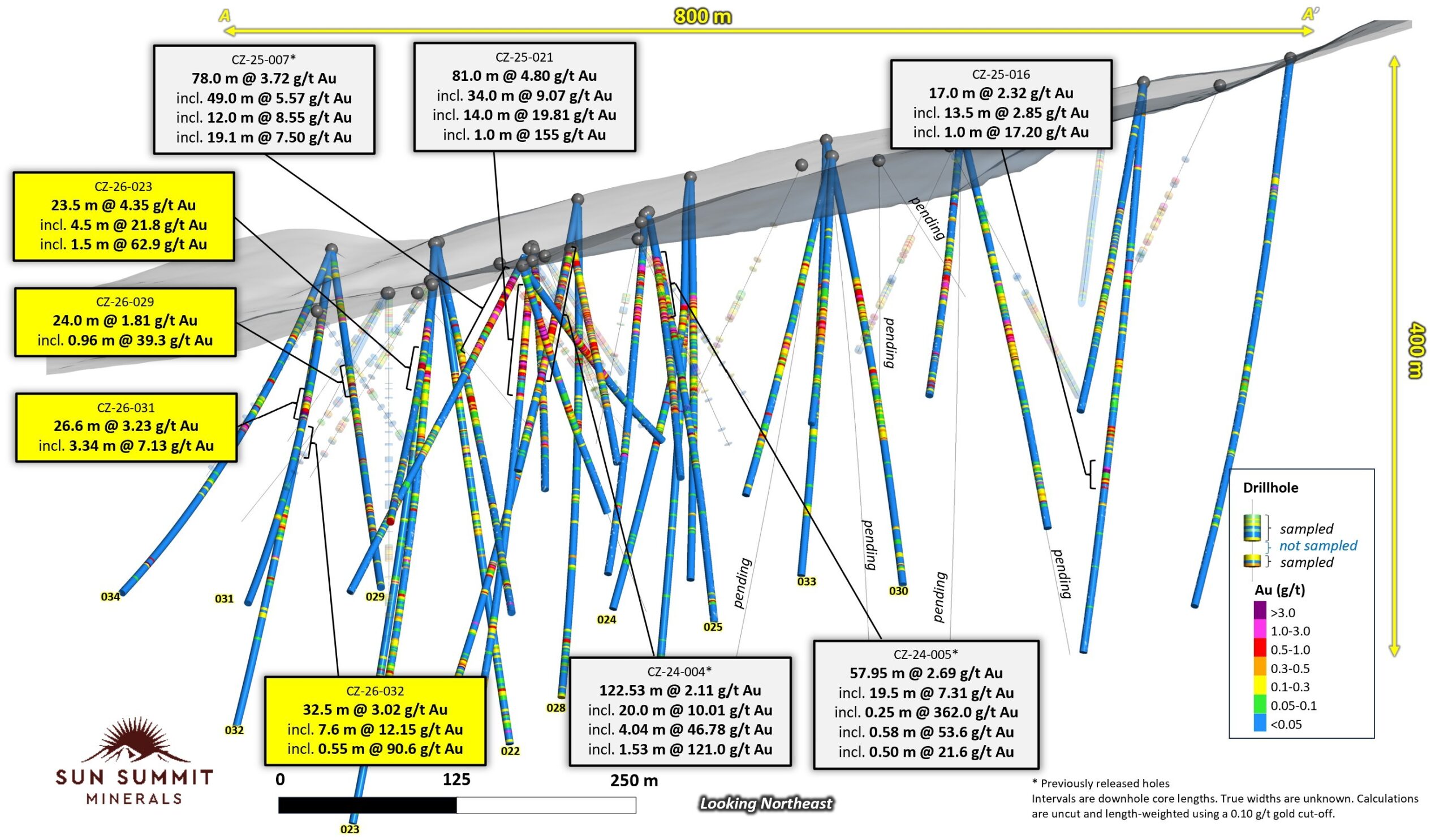
- Hole CZ-26-032: Intersected 31.98 meters of 0.81 g/t gold and 3.64 g/t silver, as well as 32.5 meters of 3.02 g/t gold and 2.53 g/t silver.
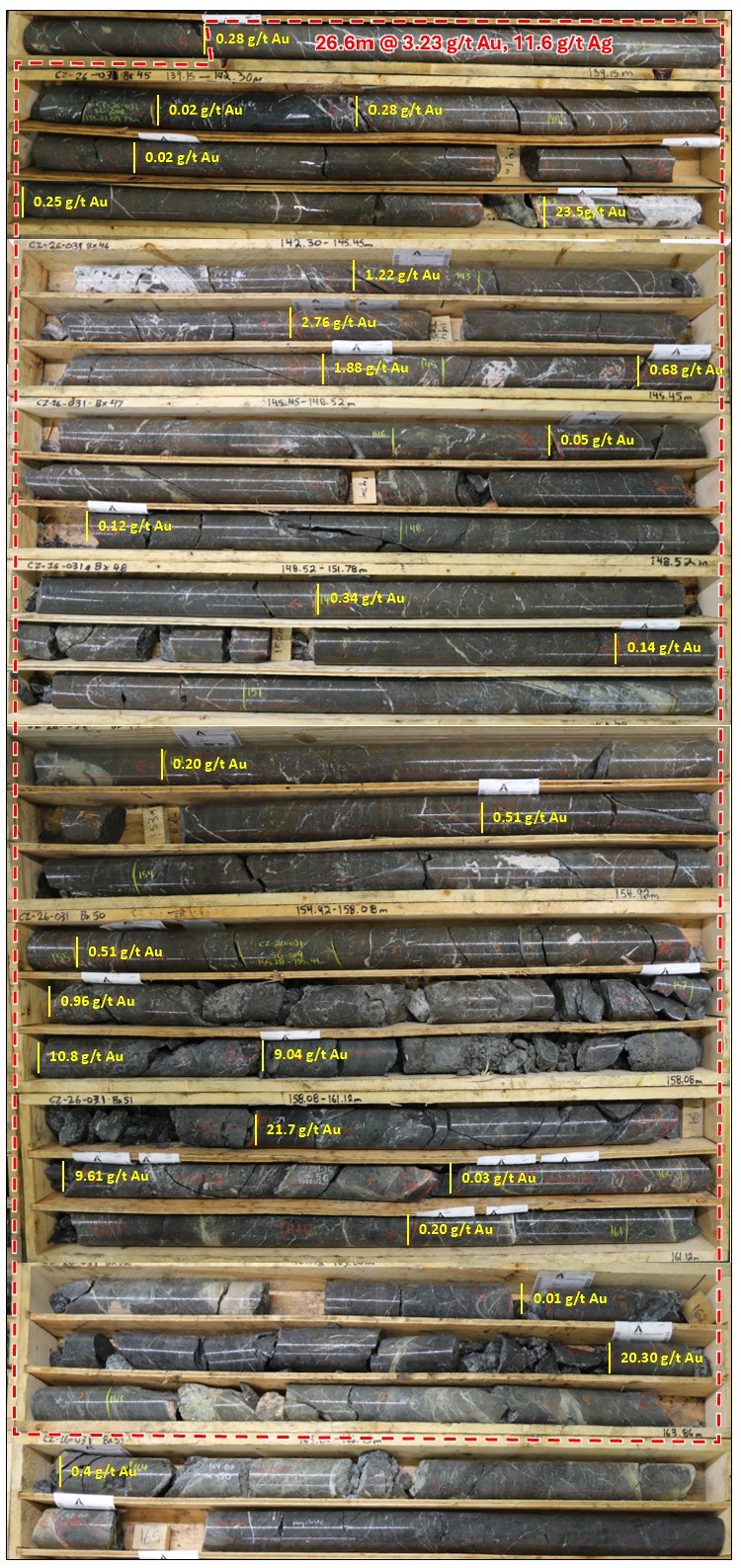
- Hole CZ-26-031: Returned 26.6 meters of 3.23 g/t gold and 11.62 g/t silver.
These intervals indicate that the mineralization is not limited to narrow, isolated structures but is distributed throughout a wider, more accessible volume of rock, which is a positive indicator for future mining economics.
Official Responses and Strategic Vision
Niel Marotta, CEO of Sun Summit Minerals, emphasized the strategic importance of these results in the context of long-term value creation for shareholders.
"Our third drilling campaign at the Creek Zone clearly demonstrates the scale of the mineralized hydrothermal system and, importantly, gives us a clear path toward expanding the zone," Marotta stated. He further noted that the consistency of the grade across drill fences is building significant confidence in the geological model.
"The scale and intensity of alteration encountered across our drilling are highly encouraging for the style of epithermal system we are systematically testing. These findings will help refine our geological model and inform our upcoming Mineral Resource Estimate planned for Q1 2027. We expect to receive the balance of the Creek Zone, Finn Zone, and Schmitt Zone assays over the coming weeks and will provide updates as they become available."
Implications for the JD Project and Shareholders
The implications of the 2026 drill results are manifold, impacting both the immediate geological understanding and the long-term corporate trajectory of Sun Summit.
1. The Path to Mineral Resource Estimation
The primary goal for 2026 is the creation of an inaugural mineral resource estimate (MRE). By systematically testing 60-to-80-meter pierce points, the company is ensuring that the data is robust enough for independent validation. The current results, when integrated with historical data from 2024 and 2025, provide a high-confidence dataset that will form the backbone of the Q1 2027 resource report.
2. District-Scale Potential
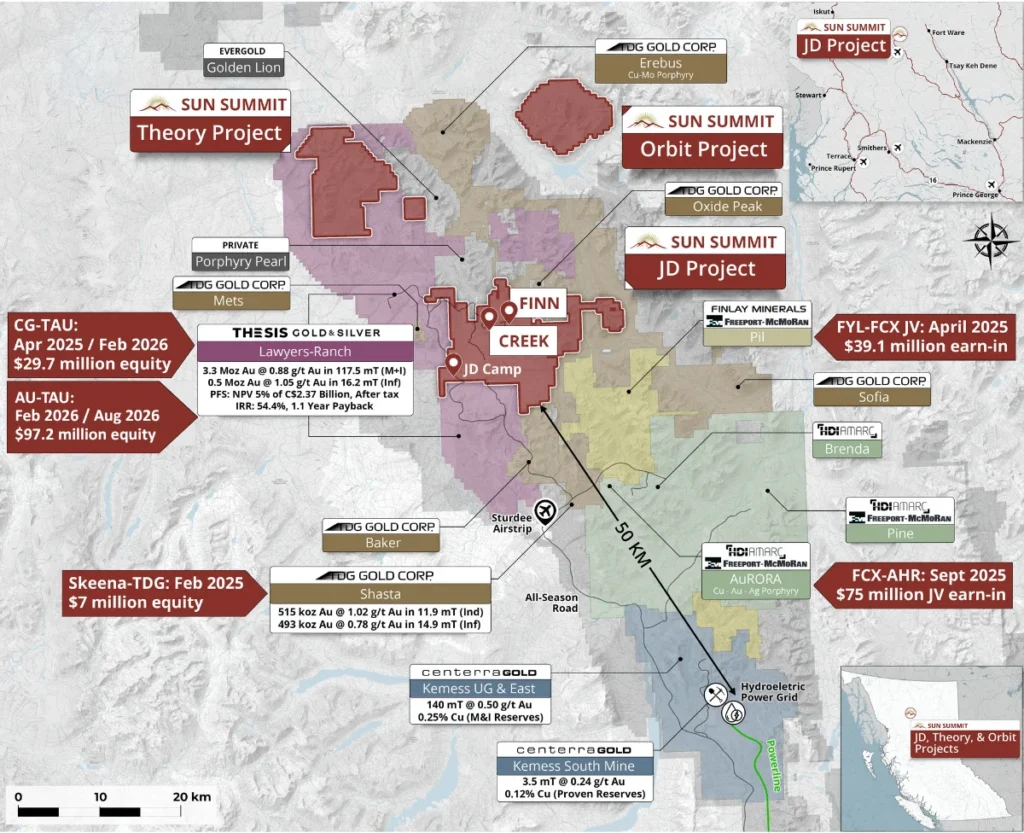
The JD Project is located in a region that has historically hosted significant mining operations, including the past-producing Kemess open-pit mine. Sun Summit’s location—proximal to existing infrastructure, roads, and a hydroelectric power line—provides a distinct advantage in terms of future development costs. The fact that the Creek Zone remains open to the northwest suggests that the mineralized footprint is larger than previously modeled, potentially leading to future expansions.
3. Strengthening Technical Confidence
The rigors of the Quality Assurance and Quality Control (QA/QC) program implemented by Sun Summit cannot be overstated. With 3,495 samples processed and 10.8% of the stream dedicated to QA/QC protocols (including CRM standards, blanks, and duplicates), the company is ensuring that the data meets the stringent requirements of National Instrument 43-101. This transparency is vital for institutional investors and analysts evaluating the project’s technical merit.
Community and Environmental Stewardship
Beyond the drill bit, Sun Summit continues to prioritize community engagement. The company is actively working with local and regional First Nations on whose traditional territories the JD Project is situated. These discussions are focused on identifying employment, contracting, and training opportunities, as well as ensuring that exploration activities are conducted with respect for local heritage and environmental standards. This social license to operate is a fundamental pillar of the company’s operational strategy in British Columbia.
Technical Appendix: Rigor in Exploration
The technical success of the JD Project is built upon precise analytical methods. The company employs:
- Four-acid digestion (ME-MS61): Used for 48-element ICP-MS analysis, providing low detection limits for pathfinder elements that guide geologists toward mineralized cores.
- Fire Assay with Gravimetric Finish: Reserved for samples exceeding 10 parts per million (ppm) gold, ensuring that high-grade results are accurately quantified.
- Wet-Dry Specific Gravity Measurements: Performed at the core shack to ensure that density models used in future resource calculations are accurate.
These methods, combined with the oversight of Ken MacDonald, P.Geo. (Vice President of Exploration), ensure that the data being communicated is of the highest industry standard.
Looking Forward
As the exploration season transitions into the evaluation phase, the focus for Sun Summit remains clear: complete the assaying process, integrate the remaining 42 drill holes into the structural model, and deliver a credible resource estimate in early 2027.
The Toodoggone Mining District continues to be one of the most promising jurisdictions in Canada for epithermal and porphyry-related precious metal exploration. For Sun Summit, the 2026 program has successfully bridged the gap between exploration discovery and resource definition. With the Creek Zone yielding consistent, high-grade results and the wider JD Project showing massive upside potential, the company is well-positioned to maintain its momentum in the coming months. Investors should look for continued updates as the remaining laboratory results are released and the structural domain models are finalized.
Disclaimer: This report is for informational purposes and does not constitute financial, investment, or legal advice. All forward-looking statements regarding future resource estimates or market performance are subject to risks and uncertainties. Readers are encouraged to conduct their own due diligence and consult with a qualified financial advisor before making any investment decisions.