

Main Facts: A Narrative Woven in Silk and Sorrow
In the hallowed, hushed atmosphere of her Spring 2027 runway presentation, Caroline Hu did not merely debut a collection; she unveiled a literary manifesto. The collection, which serves as a tactile translation of a 2,000-word original fairy tale penned by the designer herself, marks a pivotal evolution in her creative trajectory. At its core, the narrative follows a protagonist who ventures away from the comforts of home, only to find herself ensnared within the crumbling, opulent walls of an ancient castle—a purgatorial space between reality and a surreal, haunting dreamscape.
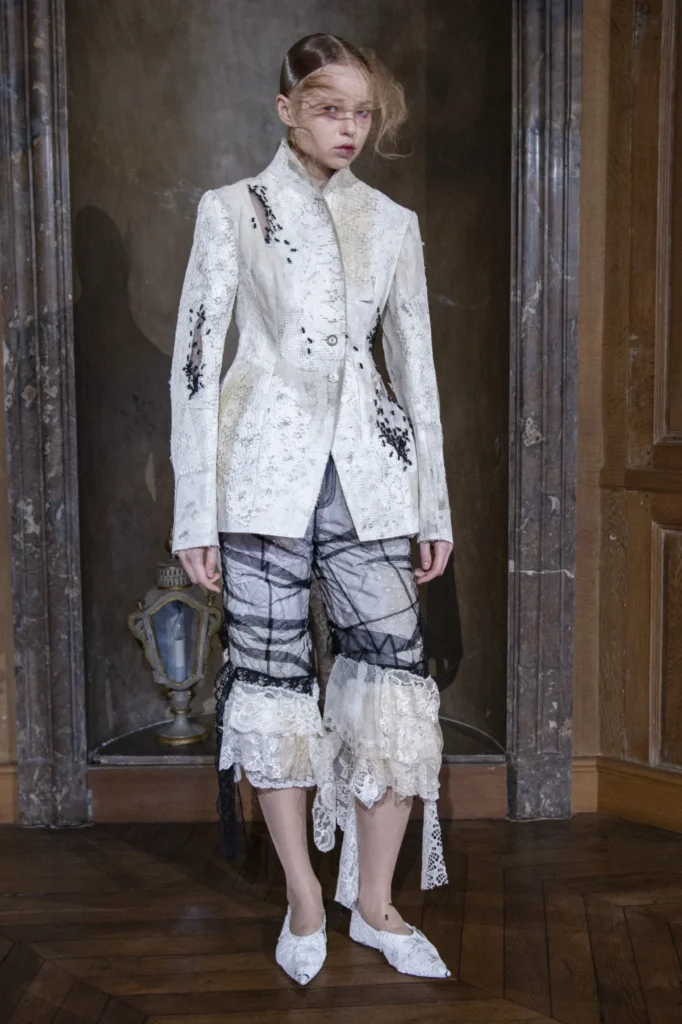
The collection serves as a physical embodiment of this internal journey. Hu’s aesthetic, long defined by a sculptural, avant-garde approach to fashion, has been sharpened by this narrative rigor. The pieces range from intricate, pannier-style dresses featuring the delicate, storied craft of Sophie Hallette lace to garments punctuated by painstaking, ant-like beadwork. The garments serve as pages in a book, with lines from Hu’s own fairy tale hand-embroidered directly onto the fabric, accompanied by recurring motifs of a girl clutching an apple while mounted upon a winged steed.
Chronology of a Vision: From Manuscript to Mannequin
The gestation of the Spring 2027 collection was not a standard seasonal design cycle but an exercise in immersive world-building. The process began months prior with the drafting of the 2,000-word short story, which Hu characterizes as semi-autobiographical. By mapping out the emotional arc of her protagonist—the departure, the entrapment, and the eventual encounter with the "strange world"—Hu established a psychological blueprint for the collection.
During a pre-show walk-through, Hu noted that the transition from text to textile was a method of processing her immediate environment. "I use things as metaphors for the environment I’m in and for what’s happening around me," she explained. This process allowed the design team to treat every silhouette as a narrative device.
In the weeks leading up to the show, the studio transformed into a literary salon of sorts. The intricate hand-embroidery, which captures the visual essence of the story’s protagonist, required hundreds of hours of labor, effectively grounding the ephemeral nature of the fairy tale in the slow, deliberate pace of high-fashion craftsmanship.
Supporting Data: The Convergence of Concept and Commerciality
While the conceptual roots of the collection are deeply ethereal, the Spring 2027 offering is arguably Hu’s most pragmatic to date. A critical observation of the collection is the successful integration of a ready-to-wear sensibility that has historically been secondary to her sculptural, red-carpet-adjacent work.
The Shift Toward Utility
The collection introduces a robust array of tailoring, sophisticated outerwear, and structured trousers. This marks a strategic pivot for the brand, balancing the ethereal, "broken" beauty of her past work with the demands of a modern, professional wardrobe. Data from the showroom indicates that these pieces—specifically the tailored blazers and high-waisted, wide-leg trousers—are designed to hold their own outside the context of the runway.
Materiality and Craft
The materiality of the collection relies on a juxtaposition of textures:
- Sophie Hallette Lace: Used to provide structural integrity to pannier-dresses, emphasizing a Victorian-gothic silhouette.
- Patchworked Textiles: A representation of the "decaying castle," utilizing disparate fabrics to create a sense of fragmented history.
- Hand-Embroidery: Serving as the connective tissue between the literature and the garment, these inscriptions elevate the clothing from mere attire to wearable archival objects.
Official Responses and Creative Influences
When discussing the mood of the collection, Hu points to an unlikely cinematic touchstone: the 1994 film Interview with the Vampire. For Hu, the film represents the perfect balance between the grotesque and the sublime. "I wanted the finished work to look romantic and beautiful, not simply broken or ruined," she remarked.
This tension between the ruined and the romantic is where Hu finds her voice. She explicitly avoids the "distressed" aesthetic that has dominated recent seasons, opting instead for a "haunted elegance." The grit is not in the fabric—which remains pristine and luxurious—but in the silhouette and the narrative weight each garment carries.
Regarding the autobiographical nature of the collection, Hu remains characteristically guarded yet reflective. The story she wrote possesses an open-ended conclusion, a creative choice that mirrors her current professional state. "I’m waiting for all kinds of things, including opportunities," she noted, acknowledging the anxieties and excitements of a designer operating in an increasingly volatile global market. The collection is, in effect, a vessel for her own professional and personal anticipation.
Implications: The Future of Narrative Fashion
The implications of Caroline Hu’s Spring 2027 show are twofold: it signals a move toward "narrative-driven" retail and a maturation of her brand identity.
The Rise of Storytelling as Strategy
In an industry saturated with rapid-fire trends and micro-seasons, Hu’s insistence on a 2,000-word foundational text offers a distinct competitive advantage. By providing a clear, intellectual framework for her designs, she cultivates a loyal base of collectors who aren’t just buying a dress; they are buying into a mythology. This approach elevates the brand from a clothing line to an intellectual property, a trend that is likely to see further adoption among high-end, emerging designers looking to insulate themselves from the pressures of "fast luxury."
Market Positioning
By integrating practical, ready-to-wear pieces, Hu has effectively widened her demographic. The collection caters to the woman who desires the avant-garde spirit of Hu’s vision but requires the utility of a well-cut coat or a durable pair of trousers. This is a critical step for a brand moving from a cult following to global market relevance.
The Open Ending
Perhaps the most poignant aspect of the collection is its refusal to resolve the story. By leaving the protagonist’s fate in the "strange world" undecided, Hu invites the wearer to become a participant in the narrative. The collection does not provide a roadmap; it provides a set of tools for the wearer to navigate their own "castle."
As the fashion industry continues to grapple with the demands of sustainability, authenticity, and creative relevance, Caroline Hu stands out as a designer who understands that fashion is not merely about covering the body—it is about dressing the soul in the stories we tell ourselves to survive. Her Spring 2027 collection is a testament to the fact that when we wear a story, we don’t just dress for the day; we dress for the evolution of our own personal myths. Whether or not the girl in the story finds her way home is ultimately secondary to the journey she takes—and for Caroline Hu, the journey is only just beginning.



