

The Shift to the Italian Capital
In a strategic pivot that signals both maturation and a daring exploration of new aesthetic frontiers, the design duo Marta Marques and Paulo Almeida staged their latest spring collection in Milan this past Sunday. Long heralded as the "darlings of London," the designers have spent the last several seasons experimenting with various presentation formats and geographic locales. However, their arrival in the Italian fashion capital marks a definitive milestone in the brand’s thirteen-year history.
Moving away from the raw, gritty atmosphere of their East London roots, the Milanese debut served as both a homecoming of sorts for the global fashion circuit and a "test and try" for a label that has long defined the vanguard of contemporary street-luxe. The show, held against the backdrop of one of the world’s most prestigious fashion hubs, felt like a deliberate evolution—a marriage of the designers’ anarchic, DIY origins with a newfound, sophisticated composure.
Anatomy of the Collection: A Focus on the Lower Silhouette
The collection was characterized by a distinct architectural focus, with the designers placing an overwhelming emphasis on the silhouette from the waist down. The "Marques’ Almeida" signature—an expert manipulation of volume, texture, and proportion—was on full display, yet it felt refined, tempered by a sense of occasion wear that the duo has been cautiously navigating.
Key pieces included lean taffeta tops cinched at the waist, paired with barrel-leg pants that pushed the boundaries of traditional tailoring. The designers played with depth and dimension, utilizing panels that jutted aggressively from the sides of handkerchief dresses, creating a kinetic energy as models navigated the runway.
Texture was the narrative thread of the collection. Cargo cotton miniskirts were elevated through the addition of billowing trains in velvety silk, bridging the gap between utilitarian streetwear and high-concept evening wear. Maxi ruffles provided a whimsical, voluminous edge to shantung sundresses, while silver sequins—presented in both maxi and mini iterations—transformed standard evening pants into high-octane statement pieces. It was a collection that demanded to be looked at, yet maintained a deliberate, almost studied, sense of nonchalance.
The Evolution of "Occasion Wear"
Ahead of the presentation, Marta Marques sat down with a small group of journalists to discuss the shift in the brand’s trajectory. When asked about the move toward a more "dressy" aesthetic, her response was contemplative.
"We’re exploring this kind of occasion wear and this more dressy approach, always with that grungy undertone," Marques explained. She noted that the brand’s design process is increasingly dictated by the functional needs of their customers. "What is occasion wear for? What do customers need it for? That definitely changes the way we’re approaching design, maybe in a more grown-up way."
Despite this admission, there was a palpable reluctance to label the evolution as "growing up." For Marques and Almeida, the transition is less about abandoning the past and more about expanding the brand’s lexicon. "I think it suits where we are," she offered, noting that the move to Milan reflects a natural progression rather than a forced rebranding.
Bridging the Underground Past and the Modern Future
To understand the significance of this collection, one must look back to 2011, when the brand first emerged from an East London studio. At the time, Marques’ Almeida was synonymous with the raw energy of the underground club scene—unrefined, shredded denim, fraying edges, and a punk-rock sensibility that resonated with a generation of DIY-minded youth.
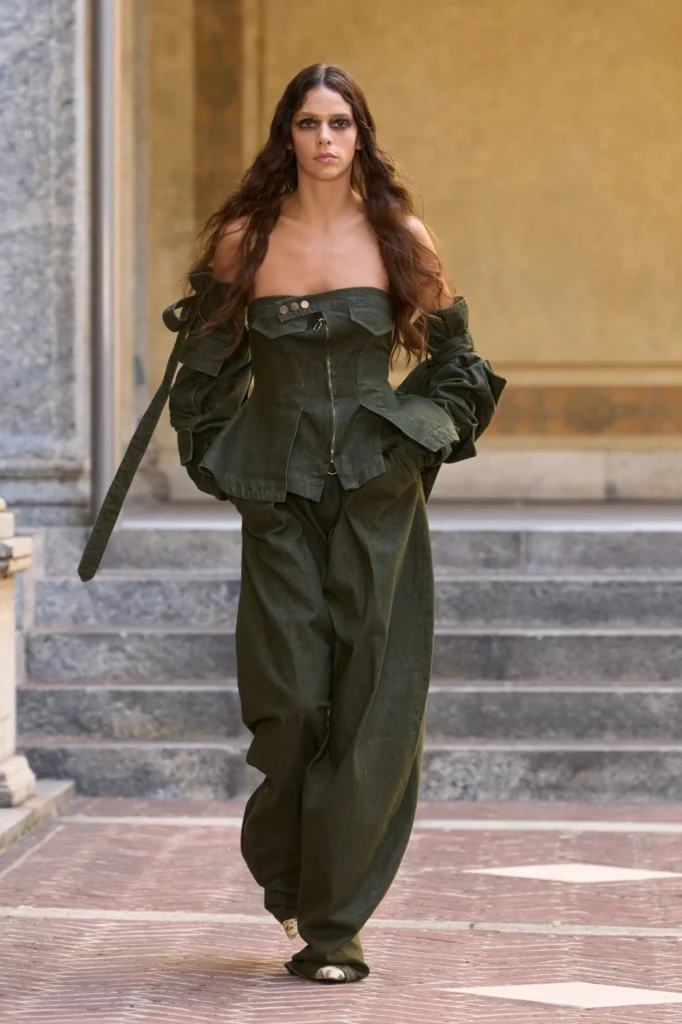
The Milan collection acted as a bridge between that rebellious history and the realities of the contemporary market. While the clothes are undeniably more "put together" than their predecessors, the "grungy undertone" remains the brand’s heartbeat. This was best exemplified in the juxtaposition of elements: a military green bustier paired with baggy pants, or the Goth-tinged black silk bias frock that felt both elegant and subversive.
"It is not so put together," Marques emphasized, clarifying that the polish of the collection is deceptive. Indeed, the styling provided the necessary grit to prevent the garments from feeling overly clinical. A Lycra bodysuit—reminiscent of a base layer—was paired with a voluminous balloon skirt, while floor-sweeping slipdresses were grounded by high-platform, chunky sneakers. The addition of scarf-like tops wrapped haphazardly around the torso further reinforced the idea that the "Marques’ Almeida girl" hasn’t lost her edge; she has simply acquired a more expensive, more versatile wardrobe.
Supporting Data: Market Positioning and Brand Trajectory
The decision to showcase in Milan is not merely an artistic choice; it is a calculated business maneuver. Milan Fashion Week, known for its emphasis on heritage, craftsmanship, and luxury manufacturing, offers a different audience than the avant-garde-focused London Fashion Week. By situating themselves in this environment, Marques and Almeida are positioning the brand for a broader luxury market.
Recent data indicates a shift in consumer behavior toward "elevated basics" and "versatile occasion wear"—exactly the space the designers are currently occupying. By maintaining their unique design DNA—the asymmetrical cuts, the unexpected fabric pairings, and the distinct silhouettes—while elevating the quality of the materials (shantung silk, fine sequins, high-grade taffeta), the duo is successfully capturing a demographic that has moved past the "rebellious spirit" of their twenties but still rejects the stuffiness of traditional couture.
Implications for the Brand and the Industry
The implications of this Milanese debut are twofold. Firstly, for Marques’ Almeida, it proves that a brand can evolve without losing its identity. By reinterpreting their "seminal proposition" through a more mature lens, they have effectively silenced critics who feared that a move toward "grown-up" fashion would lead to the loss of their creative soul.
Secondly, for the industry at large, the show serves as a case study in brand longevity. Many designers who rise to fame through an "underground" or "cult" status struggle to transition into sustainable, high-growth businesses. Marques and Almeida have navigated this by keeping the core of their design language intact while refining their production quality and presentation style.
The "DIY-minded, club-savvy type" who originally championed the brand in 2011 is now older, likely working in professional environments, and attending different types of events. By creating a collection that caters to this demographic, Marques and Almeida are ensuring their own survival. They are not chasing trends; they are growing alongside their audience.
Conclusion: A Delicate Balance
As the final model exited the runway in Milan, the message was clear: Marques’ Almeida is no longer just a London cult brand. It is an international label capable of navigating the complex demands of the modern luxury market. The collection was a triumphant exercise in balancing the past and the future—a reminder that while the hem lengths and the fabrics may have changed, the spirit of the brand remains as defiant as ever.
Whether the designers continue to favor Milan as their primary stage or return to other international hubs remains to be seen. However, this collection has cemented their status as designers who can operate within the "rulebook of composure and polite dressing" while still subverting expectations. They have managed to grow up, but they have done so on their own terms, proving that a little bit of grit goes a long way, even in the most polished of environments.



