

Introduction: The Invisible Frontline
In the vast, ungoverned stretches of the world’s oceans, maritime trade serves as the circulatory system of the global economy. Yet, this system is under constant threat from the shadow of piracy and armed robbery. Since 1991, the International Chamber of Commerce (ICC) International Maritime Bureau (IMB) has operated the Piracy Reporting Centre (PRC)—a 24-hour, 365-day nerve center that acts as the primary global defense against maritime criminality. By bridging the gap between vulnerable vessels and local authorities, the PRC has become an indispensable pillar of international maritime security.
Main Facts: The PRC’s Operational Mandate
The IMB Piracy Reporting Centre operates as a centralized intelligence and response hub. Its core mission is twofold: immediate crisis intervention and long-term data intelligence.
- 24/7 Monitoring: The PRC maintains a constant vigil, serving as a rapid-response point of contact for ships facing imminent threats. Whether a vessel is being stalked in the Gulf of Guinea or navigating the high-risk corridors of the Singapore Strait, the PRC acts as a conduit for distress signals.
- Rapid Dissemination: Upon receiving a report, the Centre coordinates with local maritime response agencies, naval task forces, and coast guards. Simultaneously, it broadcasts warnings and transmits critical alerts to vessels in the vicinity, effectively creating a "neighborhood watch" on the high seas.
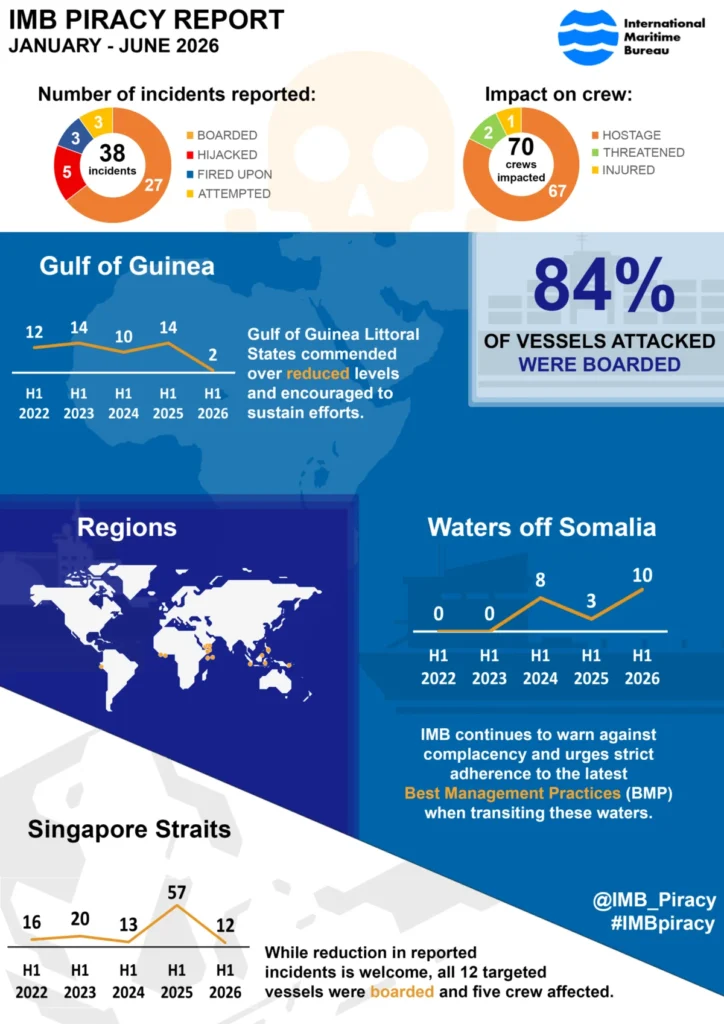
- Data Aggregation: The PRC is the gold standard for global maritime crime statistics. By meticulously recording every actual, attempted, and suspected incident, the Centre provides the maritime industry, insurers, and governments with the evidence required to allocate naval resources and establish maritime security corridors.
Chronology: Three Decades of Evolution
The evolution of the IMB PRC reflects the changing nature of maritime threats over the last 33 years.
1991–2000: The Establishment
The PRC was founded in response to a spike in piracy incidents in Southeast Asia. Initially, it functioned as a clearinghouse for information, aiming to break the "culture of silence" that often prevented shipping companies from reporting attacks for fear of increased insurance premiums or operational delays.
2001–2010: The Rise of the Somali Threat
This decade saw the PRC transition from a reporting body to a critical operational partner. As Somali piracy escalated, the Centre played a vital role in providing tactical intelligence to the international naval coalitions (such as EUNAVFOR and Combined Maritime Forces). The PRC’s data-driven approach helped define the "High Risk Area" (HRA), guiding the industry toward the implementation of Best Management Practices (BMP).
2011–2020: Diversification of Risks
While Somali piracy waned due to the success of international intervention, new hotspots emerged in the Gulf of Guinea and the Sulu-Celebes Seas. The PRC adapted by shifting its focus toward real-time tracking of kidnapping-for-ransom operations and the threat of armed robbery in port anchorages.
2021–Present: The Digital Frontier
Today, the PRC integrates satellite technology, AIS (Automatic Identification System) tracking, and sophisticated data analytics to identify patterns in maritime crime. It remains the essential point of contact for masters, providing the global industry with the situational awareness needed to navigate an increasingly volatile geopolitical landscape.
Supporting Data: Why Reporting Matters
The effectiveness of the IMB Piracy Reporting Centre is entirely dependent on the participation of the shipping community. The ICC IMB maintains that the lack of reporting is the greatest ally of the pirate.
The Under-Reporting Dilemma
For years, the IMB has cautioned that the reported figures are merely the "tip of the iceberg." When shipowners fail to report "near misses" or minor robberies, authorities remain unaware of emerging trends. Without this data, maritime security resources—such as naval patrols or drone surveillance—are often allocated to the wrong geographic sectors.
Data as a Policy Tool
The PRC’s annual reports are utilized by:
- Insurance Providers: To adjust premiums and risk assessments based on empirical data rather than speculation.
- Regulatory Bodies: Including the International Maritime Organization (IMO), to update security protocols and legal frameworks.
- National Governments: To justify the deployment of naval assets and the strengthening of coastal maritime domain awareness (MDA).
Official Responses: The ICC’s Commitment
Michael Howlett, Director of the ICC International Maritime Bureau, emphasizes that the PRC is more than just a call center; it is a vital safety net.
"Our goal is to ensure that no vessel is left to face a hostile boarding alone," says Howlett. "By encouraging masters to report every incident—no matter how small—we create a comprehensive map of the maritime threat landscape. This allows us to advocate for better protection and more robust enforcement from local authorities. We are the voice of the mariner, ensuring that piracy remains at the forefront of the global political agenda."
The ICC’s overarching mission, as the institutional representative of 45 million companies across 170 countries, is to facilitate "business for everyone, everywhere." In the context of the maritime industry, this means securing the supply chains that deliver food, energy, and medicine to the world’s population.
Implications: The Future of Maritime Security
As the world moves toward a more interconnected and digitized maritime future, the role of the IMB Piracy Reporting Centre faces new challenges and opportunities.
The Impact of Cybersecurity
Modern piracy is increasingly overlapping with cyber-threats. As vessels become more reliant on automated systems, the PRC must grapple with how to assist ships that are digitally compromised. The intersection of physical boarding and digital sabotage represents the "new front" in maritime security.
Environmental and Geopolitical Stability
Climate change is shifting migration patterns and depleting fish stocks, which often drives coastal populations toward illicit activities like piracy. The PRC’s long-term data allows international organizations to see the link between regional socio-economic instability and maritime crime. By identifying these correlations, the ICC and its partners can advocate for development aid and capacity building in high-risk regions, addressing the root causes of piracy rather than just the symptoms.
The Imperative of Global Cooperation
The implications of the PRC’s work extend far beyond the shipping industry. Maritime security is synonymous with global economic stability. When piracy spikes, the cost of goods rises, supply chains break, and the global economy suffers. The PRC serves as the connective tissue that forces diverse stakeholders—from private shipowners to sovereign navies—to collaborate toward a common goal: a free, open, and secure ocean.
Conclusion: A Call to Vigilance
The work of the IMB Piracy Reporting Centre is a testament to the power of coordinated information sharing. For over three decades, the PRC has proven that maritime security is not just a military concern, but a collaborative effort that begins with the shipmaster’s report.
As the maritime industry faces an era of unprecedented complexity, the PRC remains a steadfast guardian. Shipowners and masters are urged to continue their cooperation with the Bureau, recognizing that every report filed is a contribution to a safer, more predictable, and more secure global maritime environment. By standing together, the international maritime community ensures that the oceans—the lifeblood of our civilization—remain open to all.
Contact Information
For further inquiries regarding maritime security data, industry trends, or reporting procedures, please reach out to the IMB leadership:
Michael Howlett
Director, ICC International Maritime Bureau
Tel: +44 207 423 6960
Email: [email protected]
The ICC International Maritime Bureau (IMB) is a specialized division of the International Chamber of Commerce (ICC), the world’s largest business organization. Through its advocacy, solution-driven approach, and commitment to standard-setting, the ICC continues to play a leading role in maintaining the integrity of global trade.



