In the fast-paced world of horology, few brands have managed to bridge the gap between bespoke high-end customization and accessible, enthusiast-grade production as effectively as Bamford London. Under the guidance of George Bamford, the brand has carved out a distinct identity that balances a deep reverence for vintage sports watch aesthetics with a modern, high-tech manufacturing ethos. At the heart of this strategy lies the Bamford London GMT—a collection that has quietly become the cornerstone of the brand’s offerings, representing nearly half of their current catalog.
This review examines the Bamford London GMT Forged Carbon, specifically the "Black with White Accents & Gloss Black Dial" edition, to determine why this particular model has become the definitive "traveler’s watch" for the modern enthusiast.

Main Facts: Defining the Bamford London GMT
The Bamford London GMT represents a strategic evolution for the brand. While the Bamford Watch Department is world-renowned for its bespoke customization work and high-level collaborations with legacy watchmakers, Bamford London serves as the brand’s primary line—offering original, non-customized timepieces at a more accessible entry point.
The GMT collection is staggering in its diversity. With 93 watches currently listed on the company’s website, a full 40 of these are GMT models. This proliferation signals a clear brand focus: catering to the global traveler who requires a reliable, legible, and aesthetically distinct multi-timezone companion.

Key Specifications
- Case Material: Forged Carbon (with matte black PVD steel caseback).
- Case Dimensions: 40mm diameter, 11.7mm thickness.
- Lug-to-Lug: 46.5mm.
- Water Resistance: 100 meters.
- Movement: Sellita SW330-2 (4Hz, 56-hour power reserve).
- Crystal: AR-coated sapphire.
- Strap: 20mm width, quick-release rubber strap.
- Price: Starting at £1,450 for steel; £1,800 for Forged Carbon.
Chronology: From Customization to Collection
To understand the Bamford London GMT, one must look at the trajectory of George Bamford’s career. The brand was not born in a vacuum; it was forged in the workshops of the Bamford Watch Department, where George became famous for blackening and modifying iconic timepieces.
The "spiritual" lineage of the current GMT collection can be traced back to several high-profile collaborations. Specifically, the development of the Forged Carbon GMT finds its roots in the TAG Heuer Monaco Chronograph Forged Carbon edition and the Girard-Perregaux x Bamford Deep Diver. These projects allowed the team to experiment with high-tech materials—lightweight, durable, and visually striking.

By taking the lessons learned from these limited, high-end collaborations, Bamford London was able to bring the "cushion case" profile to a broader audience. While the watch industry was saturated with round cases, Bamford saw a gap in the market for a modern, mid-sized cushion-cased GMT. The result is a design that respects the lineage of vintage tool watches while utilizing 21st-century manufacturing processes.
Supporting Data: Why the GMT Works
The success of the Bamford London GMT is not merely based on brand recognition; it is grounded in superior ergonomics and a thoughtful selection of components.

The "Wearability" Paradox
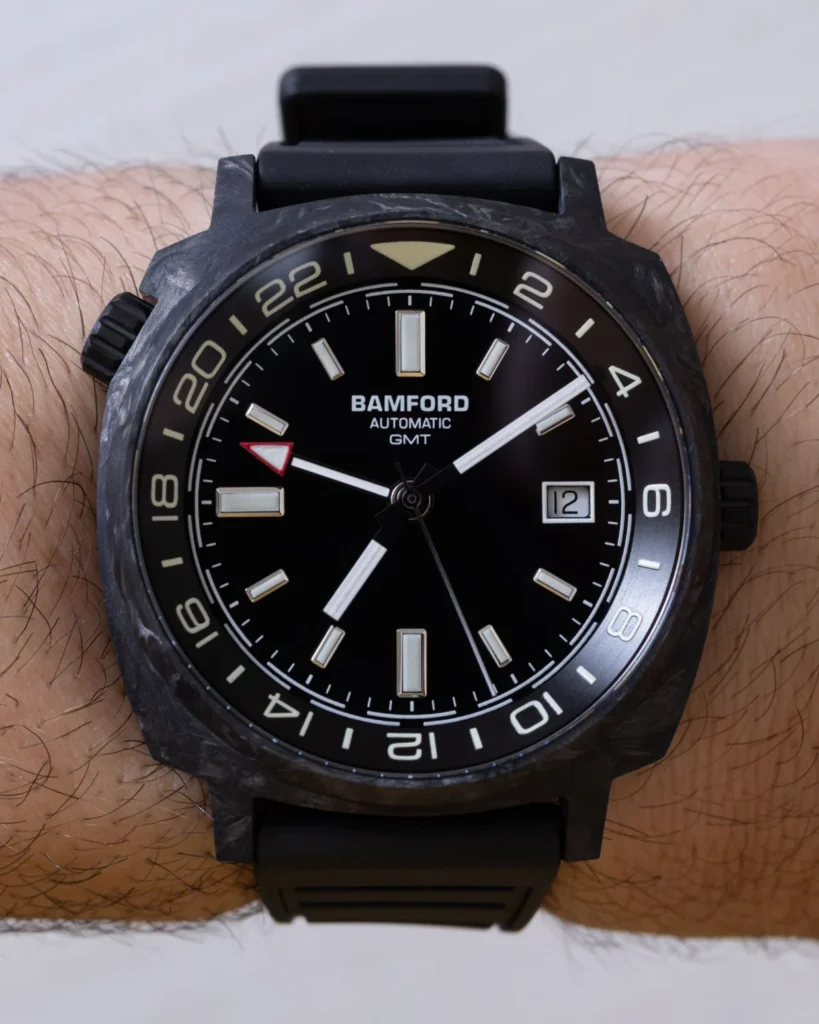
Many prospective buyers, when viewing marketing photography, assume the Bamford GMT is a massive, overbearing timepiece. This is a common misconception associated with cushion-style cases. In reality, the watch is remarkably modest. At 40mm wide and under 12mm thick, it occupies the "sweet spot" of modern sizing. The 46.5mm lug-to-lug distance ensures that the watch sits flush on a variety of wrist sizes, making it an ideal companion for long-haul travel where comfort is paramount.
The Movement
At the heart of the timepiece beats the Sellita SW330-2. This is an industry-standard workhorse, favored for its reliability and ease of service. Operating at 28,800 vibrations per hour (4Hz), it provides a stable 56-hour power reserve. The crown functions are intuitive:

- Standard Position: Manual winding.
- First Position: Quick-set date and independent jumping of the GMT hand.
- Second Position: Time setting.
The inclusion of an independent GMT hand allows the wearer to track a second timezone with ease. Furthermore, the internal rotating 24-hour bezel—operated via the secondary crown at the 10 o’clock position—allows for a third timezone, or alternatively, a rudimentary 60-minute countdown timer.
Design Aesthetics: The Forged Carbon Edge
The "marbled" aesthetic of the forged carbon case is more than a fashion choice; it is an exercise in material science. The organic, chaotic patterns inherent in the carbon fiber curing process ensure that no two cases are exactly identical. This offers a level of "uniqueness" that typically requires a much higher price point. The matte PVD steel caseback adds a layer of durability and keeps the watch skin-friendly for those with metal sensitivities.

Official Responses and Philosophy
George Bamford has been vocal about his personal collection habits, often citing his love for Rolex and vintage sports watches as the primary design influence for his own brand. When asked about the design of the GMT, the brand emphasizes the utilitarian aspect of the watch.
While the watch clearly borrows design cues from the Rolex GMT-Master II—specifically the red arrow GMT hand and the graphic layout of the 24-hour markers—Bamford London has successfully avoided the trap of being a "homage" brand. By shifting to a cushion case and utilizing a secondary crown for the internal bezel, the watch carves out its own distinct visual language. It is a "Rolex-adjacent" thematic experience that stands on its own merits as a contemporary tool watch.

Implications: Where the GMT Fits in the Market
The Bamford London GMT exists in a competitive but often stagnant price bracket. By offering a high-quality, Swiss-made GMT in a unique material (forged carbon) for £1,800, Bamford has effectively challenged larger, more traditional brands that often charge premiums for the same materials.
The Underdog Appeal
The GMT is the "underdog" of the luxury market. It is a watch that rewards the wearer for looking closer. The subtle details, such as the reverse-tapered lume on the seconds hand, demonstrate a level of craftsmanship that is often missed in mass-market production.

A Versatile Platform
The brand’s decision to offer 40 different variations of the GMT—ranging from classic steel to vibrant colorways and technical materials—is a masterclass in modular manufacturing. It allows the consumer to choose a watch that fits their personal style without compromising on the underlying mechanical performance.
Final Verdict: Is It Worth the Investment?
The Bamford London GMT is, at its core, a success. It is a watch that succeeds because it understands its purpose: it is a traveler’s tool that does not take itself too seriously. While some might argue that the GMT bezel markers are slightly oversized, or that the lack of a display caseback prevents us from seeing the Sellita engine, these are minor critiques in the face of a timepiece that offers genuine value.

For the seasoned collector who already owns a "safe" steel sports watch, the Forged Carbon version offers an exciting, lightweight, and artistically textured alternative. For the novice, the steel models provide a robust entry into Swiss watchmaking.
The Bamford London GMT is not just another watch; it is a testament to the fact that when a brand stays true to its design philosophy while keeping the customer’s needs for comfort and utility at the forefront, the result is a timeless, functional, and highly collectible piece of engineering. Whether you are navigating the time zones of the world or the concrete jungles of London, this watch is more than up to the task.