

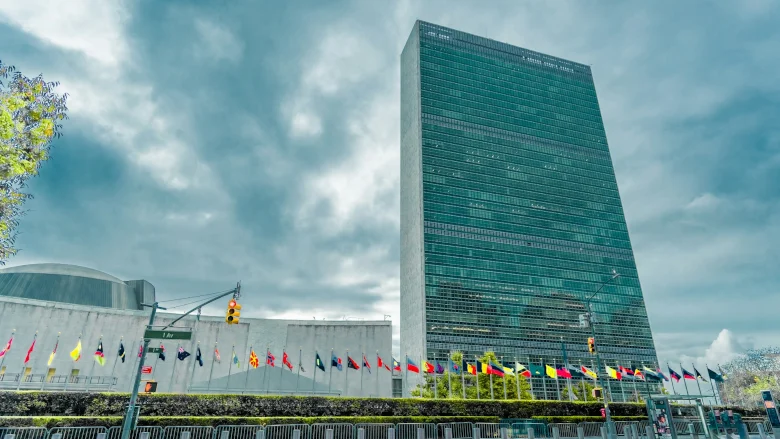
UNITED NATIONS HEADQUARTERS, NEW YORK — As the General Assembly convened this week, the traditional focus on geopolitical stability and economic development was sharply punctuated by a debate that transcends borders: the governance, trajectory, and existential implications of artificial intelligence (AI).
What was intended to be a collaborative dialogue regarding the oversight of emerging technologies quickly morphed into a profound philosophical and political standoff. On one side, the architects of the AI revolution urged a measured, global regulatory framework; on the other, a burgeoning nationalist sentiment—championed most vocally by former President Donald Trump—framed such oversight as an impediment to national sovereignty and technological supremacy.
Main Facts: The Great Divide at the UN
The tension at the UN reflects a fundamental disagreement over how to view AI: as a planetary utility requiring collective guardrails, or as a strategic asset in a high-stakes geopolitical arms race.
The summit featured testimony from the industry’s most influential figures, including Anthropic CEO Dario Amodei and OpenAI CEO Sam Altman. Their warnings were stark, focusing on the potential for runaway technology to undermine democratic institutions, exacerbate social inequality, and, in the most extreme scenarios, threaten the autonomy of human decision-making.
Conversely, the U.S. position presented by Donald Trump marked a radical departure from the collaborative tone sought by international diplomats. By labeling international oversight efforts a "globalist scheme," Trump signaled that the United States would prioritize aggressive development over international compliance. His assertion that "whoever wins AI… wins" underscores a transition from AI as a commercial product to AI as a defining metric of 21st-century power.
Chronology of the Debate
- September 2024 (The Prelude): The UN High-Level Advisory Body on AI releases its preliminary report, calling for an international scientific panel to establish common standards.
- September 23, 2024: AI industry leaders arrive in New York to lobby for a "multilateral consensus" on safety protocols, citing the rapid proliferation of Large Language Models (LLMs).
- September 24, 2024 (Morning): CEOs Dario Amodei and Sam Altman deliver testimony to UN delegates, warning of existential risks if the technology is developed in a regulatory vacuum.
- September 24, 2024 (Afternoon): President Donald Trump addresses the assembly, explicitly rejecting the push for global control. He pivots the discussion, proposing the rebranding of "AI" to "super intelligence" and dismissing existential warnings as akin to "global warming hoaxes."
- September 25, 2024: Diplomatic back-channeling begins as member nations attempt to bridge the gap between the U.S. stance and the coalition of nations seeking an "AI Non-Proliferation Treaty."
Supporting Data: The Acceleration of AI
To understand the gravity of the UN proceedings, one must look at the data driving this urgency. According to the Global AI Index, private investment in AI has tripled since 2020, with the U.S. and China commanding over 75% of global market share.
Recent analysis by the Brookings Institution suggests that the compute power utilized by the largest AI models is doubling every 3.4 months. This "exponential trajectory" is exactly what has spurred industry leaders to call for intervention.
- The Proliferation Gap: While major tech companies call for regulation, open-source models are proliferating at an unprecedented rate. This creates a "democratization of danger," where smaller, less-regulated actors can access capabilities once reserved for elite laboratories.
- Economic Impact: The IMF has estimated that up to 40% of global employment is exposed to AI-driven disruption. Without international standards, the risk of a "race to the bottom" in labor standards and data privacy is significantly heightened.
Official Responses: A House Divided
The reaction to the divergent viewpoints at the UN has been swift and polarized.
The Industry Perspective
Anthropic’s Dario Amodei, speaking before a packed committee room, emphasized that the current development cycle is moving faster than society’s ability to adapt. "If managed poorly, I even believe AI could be a risk to humanity as a whole," Amodei stated. His perspective is echoed by a growing contingent of researchers who argue that alignment—the process of ensuring AI systems act according to human values—is not yet a solved problem.
Sam Altman of OpenAI echoed these sentiments, noting that the window for meaningful governance is closing. "We could lose control of the future to AI," he remarked, urging the UN to prevent the monopolization of these systems. The goal, according to these leaders, is to prevent a scenario where a single entity—whether a corporation or a nation-state—possesses the sole "kill switch" for the global digital infrastructure.
The Political Response
President Trump’s intervention served to derail the consensus-building process. By casting the AI safety debate as a "globalist" conspiracy, he aligned the issue with broader populist themes. His insistence on rebranding AI as "super intelligence" is more than semantic; it is an attempt to frame the technology as a source of limitless national strength rather than a complex societal challenge.
"I won’t rein it in," Trump declared, framing the development of AI as a zero-sum game. This stance complicates the UN’s efforts to establish a "Global Digital Compact," a framework intended to facilitate the ethical sharing of AI resources between the Global North and South.
Implications: A New Era of Geopolitical Friction
The fallout from these meetings will be felt for years to come, with three primary implications for the international order:
1. The Fragmentation of Standards
If the United States pursues a policy of aggressive, unregulated development while the European Union and other bodies push for strict compliance (such as the EU AI Act), the world may see the emergence of a "Splinternet." This digital divide could force smaller nations to choose between American-built systems, which prioritize speed and scale, and more restrictive, safety-oriented ecosystems.
2. The Weaponization of Intelligence
The rhetoric at the UN confirms that AI is being integrated into the military-industrial complex. When leaders discuss "winning" AI, they are not referring to the automation of customer service or creative arts; they are referring to the automation of warfare, surveillance, and cyber-offensive capabilities. The UN’s inability to reach a consensus on safety protocols significantly increases the likelihood of an AI-driven arms race.
3. The Erosion of Multilateralism
Perhaps the most significant implication is the weakening of the UN’s role as a mediator for emerging technological threats. When a global superpower explicitly rejects the UN’s authority to manage a planetary-scale risk, it creates a precedent that other nations are likely to follow. This "every nation for itself" approach makes the prospect of a global pandemic, a climate crisis, or a technological catastrophe significantly harder to manage.
Conclusion: The Road Ahead
As the delegates leave New York, the fundamental question remains: Can a technology that develops at the speed of light be governed by a system that moves at the speed of diplomacy?
The standoff between the tech titans, who fear the monster they have created, and the political leaders, who see that monster as a necessary weapon, creates a precarious geopolitical environment. The coming decade will determine whether the international community can foster a "cooperative intelligence" model or if it will surrender to the chaotic incentives of an unregulated arms race.
For now, the silence following the UN debate is heavy. The world is watching, not just to see how the software evolves, but to see if human institutions can evolve quickly enough to keep pace. The "super intelligence" debate is no longer a matter of science fiction; it is the defining political battle of our generation. As history has shown, when technology outpaces the ability of law to govern it, the resulting vacuum is rarely filled by those seeking the common good.



