

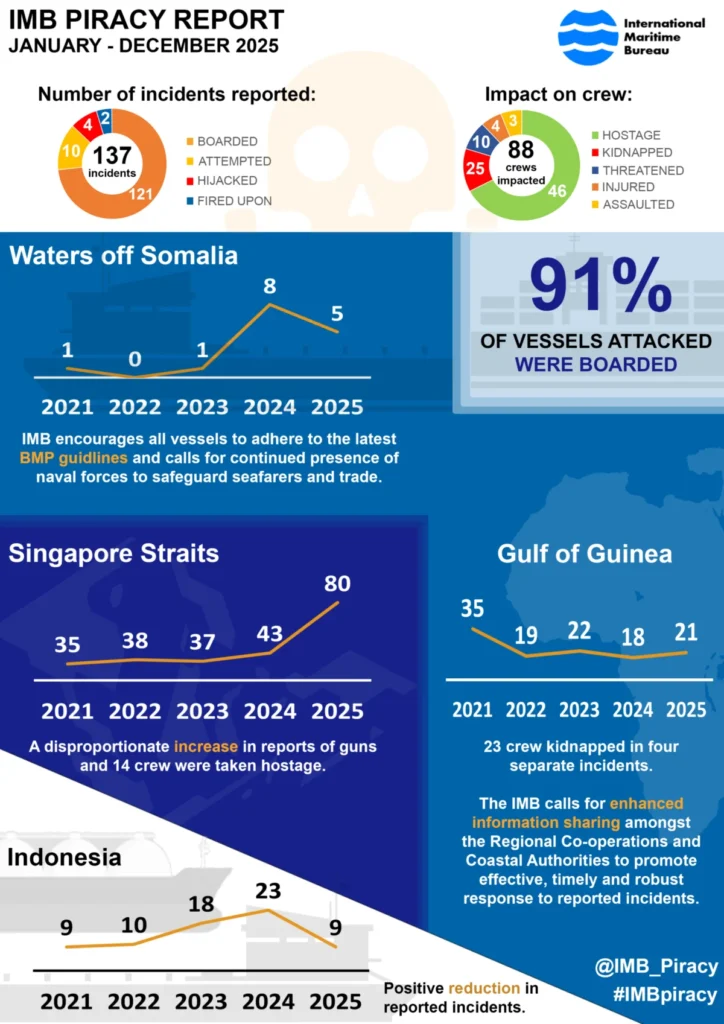
LONDON – The year 2025 has drawn to a close with a concerning uptick in maritime insecurity, as the ICC International Maritime Bureau (IMB) reports a notable surge in piracy and armed robbery incidents globally. While the once-dreaded specter of Somali piracy remains largely contained through persistent naval intervention, new hotspots—most notably the Singapore Straits—have emerged as flashpoints for criminal activity, threatening the fluidity of global trade and the safety of the world’s seafarers.
According to the IMB’s definitive Annual Piracy and Armed Robbery Report, released on 15 January 2026, the international maritime community faced 137 recorded incidents in 2025. This figure represents a significant increase from the 116 incidents documented in 2024 and the 120 observed in 2023, signaling a troubling reversal of previous downward trends in maritime crime.
The State of Global Maritime Security: Key Facts and Findings
The data presented by the IMB paints a complex picture of modern maritime threats. Of the 137 incidents reported throughout the calendar year, the vast majority were classified as "low-level" opportunistic attacks. However, the sheer frequency of these events suggests a emboldened criminal element operating across critical shipping lanes.
The breakdown of the 2025 statistics reveals the following:
- Vessels Boarded: 121
- Vessels Hijacked: 4
- Vessels Fired Upon: 2
- Attempted Attacks: 10
While "low-level" incidents—typically characterized by opportunistic theft while vessels are at anchor or underway in narrow straits—constitute the bulk of these reports, the human cost remains heavy. The report confirms that 46 crew members were taken hostage in 2025. While this is a decrease from the 126 hostages taken in 2024 and 73 in 2023, the data on kidnappings reveals a worsening trend. In 2025, 25 crew members were reported kidnapped, a sharp rise compared to 12 in 2024 and 14 in 2023. Beyond these figures, an additional 10 crew members were threatened, four were injured, and three were physically assaulted, underscoring the persistent danger faced by those who keep global commerce moving.
A Chronological Overview: The Evolving Threat Landscape
The trajectory of maritime piracy over the last three years reflects a shifting geographical and tactical landscape.
2023: A Year of Stabilization
In 2023, the industry recorded 120 incidents. At the time, maritime security experts believed that a combination of increased private maritime security company (PMSC) utilization and improved regional patrolling was beginning to bear fruit. However, the persistence of incidents in the Gulf of Guinea and the Singapore Straits suggested that the "threat" had not been extinguished, merely displaced.
2024: Fluctuations and the Persistence of Risk
The 2024 report showed a slight dip to 116 incidents. However, this period was marked by a spike in hostage-taking (126 individuals), suggesting that while the number of attacks might have fluctuated, the severity of the criminal intent remained high. The maritime industry saw a pivot toward more targeted, high-stakes encounters that tested the resolve of ship operators and regional navies alike.
2025: The Surge
The 2025 data marks a definitive escalation. The rise in reported incidents to 137, coupled with an increase in the use of firearms, indicates that criminal syndicates have become better equipped and more willing to engage in armed conflict. The Singapore Straits, in particular, solidified its status as the most dangerous maritime corridor, with the highest density of reported incidents. Conversely, the Somali coast, once the epicenter of global maritime fear, remained relatively quiet, a testament to the success of sustained international naval presence and "Best Management Practices" (BMP) adoption by commercial vessels.
Supporting Data: The Escalation of Violence
One of the most alarming metrics in the 2025 report is the increase in the use of weaponry during boarding attempts. The "militarization" of piracy incidents is becoming a trend that security analysts are monitoring with extreme caution.
The Weaponry Gap
- Firearms: The use of guns was reported in 42 separate incidents throughout 2025, a significant jump from 26 in 2024. This trend suggests that pirates are increasingly viewing violence as a necessary tool to force compliance from crews, rather than relying solely on intimidation.
- Bladed Weapons: While the use of knives saw a slight decline—reported in 33 incidents in 2025 compared to 39 in 2024—the overall rise in total incidents means that ships are facing a more heavily armed adversary than in previous years.
The correlation between the increase in firearms and the rise in kidnappings cannot be ignored. Kidnapping for ransom remains a lucrative business model for criminal organizations in regions where state authority is weak or policing is hampered by geographical complexities. The shift toward kidnapping represents a calculated move toward higher-value crime, requiring more sophisticated planning and more robust weaponry.
Official Responses: The Call for Coordinated Action
The International Chamber of Commerce (ICC), through Secretary General John W.H. Denton AO, has issued a stark warning regarding the implications of these findings. Addressing the stakeholders of the global economy, Denton emphasized that maritime trade is not merely a logistical convenience but the "cornerstone of real economic activity and growth."
"The rise in reported maritime incidents highlights the importance of protecting seafarers and securing key shipping routes," Denton stated. "This is not just about the safety of our crews; it is about the stability of global supply chains and the economies that depend on them. When shipping lanes become insecure, insurance premiums rise, delivery times fluctuate, and the cost of goods for the end consumer increases."
Denton’s appeal is for a more robust, multilateral approach to maritime security. He argues that regional and international partners must work in tighter concert to safeguard commerce. This includes:
- Enhanced Intelligence Sharing: Facilitating real-time communication between naval task forces and commercial vessels to identify and intercept threats before they materialize.
- Increased Naval Presence: While Somali waters are currently managed, the surge in the Singapore Straits necessitates a re-evaluation of patrolling strategies in the Asia-Pacific region.
- Adherence to BMP: The IMB continues to stress that the use of Best Management Practices is the most effective deterrent against low-level piracy. Shipowners are urged to maintain high-vigilance protocols, including bridge hardening, the use of water cannons, and maintaining strict watch schedules.
Implications for the Global Economy
The economic implications of a rise in maritime piracy are multifaceted. First, there is the immediate cost to the shipping companies—ransom payments, increased security expenditures, and repair costs for damaged vessels. Second, there is the indirect cost borne by the global market.
Shipping routes, such as the Singapore Straits, act as the jugular veins of global trade. Any disruption—or even the perception of increased risk—leads to a tightening of the supply chain. Insurance underwriters, reacting to the 2025 data, are likely to reclassify certain zones as "high risk," leading to a spike in War Risk Premiums. These costs are inevitably passed down to manufacturers and, ultimately, the global consumer.
Furthermore, the psychological toll on seafarers cannot be overlooked. A career at sea is already challenging due to isolation and long periods away from home. The prospect of being fired upon or kidnapped adds a layer of stress that may contribute to a long-term labor shortage within the maritime industry. If the profession is perceived as inherently unsafe, the industry risks losing the skilled talent necessary to operate the increasingly complex vessels of the future.
Conclusion: The Path Forward
The 2025 IMB report serves as a wake-up call for the international community. The containment of Somali piracy is a victory, but it is not a permanent state; it is the result of constant, expensive, and coordinated naval effort. As crime shifts to new theaters, the strategy must shift with it.
The challenge for 2026 and beyond will be to maintain the balance between open, efficient maritime trade and the necessary security measures to protect human life. Cooperation remains the key. Without sustained political will, regional policing, and strict adherence to security protocols, the rise in piracy incidents observed in 2025 could become the new baseline for a volatile decade of global maritime commerce.
The industry stands at a crossroads: either invest in deeper cooperation and smarter security, or risk a steady erosion of the maritime safety standards that have defined the last half-century of globalized trade.



