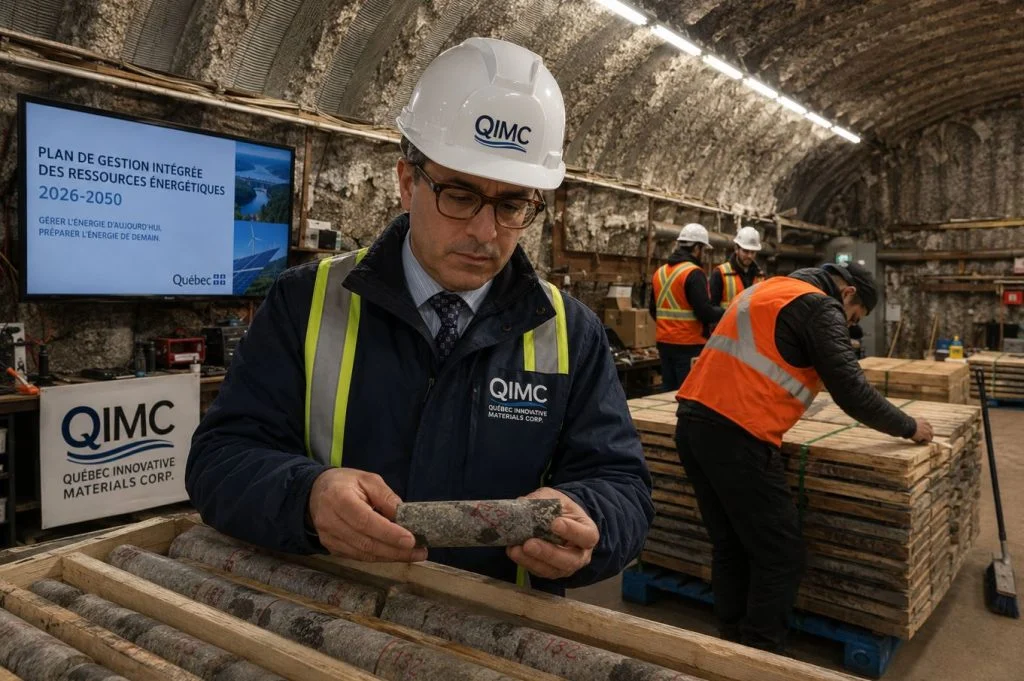
In a significant stride toward unlocking Canada’s clean energy potential, Quebec Innovative Materials Corp. (CSE: QIMC, OTCQB: QIMCF, FSE: 7FJ) (“QIMC”) has successfully concluded an expanded 2D seismic acquisition program in Nova Scotia. The company, which is positioning itself at the forefront of the burgeoning natural hydrogen and helium sector, has exceeded its initial exploration targets, signaling a robust and data-driven approach to subsurface resource identification.
The completion of this program marks a pivotal moment for QIMC as it transitions from initial surveying to the integration of complex geological datasets, effectively creating what the company claims is the most comprehensive exploration database for natural hydrogen in Canada.
Main Facts: The Scope of the Nova Scotia Campaign
QIMC’s recent field operations, conducted by Echo Seismic Ltd., spanned the Apple River, Advocate, Bennett Hill, and Port Greville regions of Cumberland County, Nova Scotia. Originally scoped as a 50-line-kilometre survey, the project was strategically expanded to 63.7 line-kilometres.
This expansion was not merely a matter of scale, but one of precision. As exploration teams identified new "hot zones"—geological areas showing high potential for natural hydrogen, helium, and natural gas—management opted to extend the seismic coverage. The additional 13.7 kilometres of data were specifically engineered to provide a structural bridge between these newly discovered zones and the broader regional geological framework.
By tying these high-potential zones into the structural picture, QIMC aims to define the full extent of the resource trend. The seismic data, now under processing at Earth Signal Processing Ltd. (ESP) in Calgary, will be integrated into the company’s massive, multi-layer exploration model, which combines soil-gas samples, drill core analysis, and geophysical surveys.
Chronology of Exploration: From Soil-Gas to Seismic Integration
The trajectory of QIMC’s operations in Cumberland County reflects a disciplined, step-by-step approach to mineral exploration that prioritizes data verification before moving to costly development phases.
Phase 1: Foundation and Surface Sampling
Long before the seismic trucks arrived, QIMC established a baseline of geological evidence. This included the collection of over 10,000 individual soil-gas samples. Soil-gas surveying is a critical, low-impact tool in hydrogen exploration, allowing geologists to detect micro-seepages of gas migrating from deep subsurface reservoirs.
Phase 2: Subsurface Verification
The company complemented its surface work with over 3,500 metres of drill core analysis. A breakthrough moment occurred with the observation of "free gas" in drill hole DDH-26-05. This discovery provided a tangible link between surface readings and subsurface gas accumulations.
Phase 3: The Seismic Campaign
With the geochemical and stratigraphic foundations laid, the 2D seismic program was commissioned. Seismic surveying acts like an ultrasound of the earth, using acoustic waves to map the architecture of rock layers beneath the surface. By targeting the Bennett Hill line, where the free gas was previously observed, QIMC is now able to correlate that physical gas discovery with the structural traps identified by the seismic imaging.
Phase 4: Current Status (Processing)
The dataset has been handed over to Earth Signal Processing Ltd. The "processing" stage is where raw seismic data is cleaned and transformed into high-resolution images of the subsurface. This stage is ongoing and is being performed alongside the interpretation of previous datasets. As each new "layer" of data is processed, the company’s internal models of the "hot zones" are being iteratively refined and expanded.
Supporting Data: An Unprecedented Canadian Dataset
QIMC’s competitive advantage rests on the sheer volume and diversity of its exploration data. In the current energy sector, "big data" is as vital as the drill bit itself. The company’s current repository for the Nova Scotia district includes:
- Seismic Imaging: 63.7 km of new 2D seismic data.
- Geochemical Data: Over 10,000 soil-gas samples.
- Stratigraphic Data: 3,500+ metres of historical and recent drill core analysis.
- Geophysical Surveys: Comprehensive gravity data, airborne and ground magnetics, and radon-thoron surveys.
The integration of these diverse data streams allows QIMC to build a 3D picture of where natural hydrogen and helium are likely to be trapped. By linking the gas observed in DDH-26-05 directly to the seismic structural images, the company has effectively "de-risked" its exploration strategy, moving from speculative search to a focused assessment of known targets.
Official Perspectives: CEO John Karagiannidis on Strategic Expansion
John Karagiannidis, President and CEO of QIMC, emphasized that the decision to expand the seismic program was driven by the geological data itself.
"Completing 63.7 kilometres of seismic across the Apple River – Advocate – Bennett Hill – Port Greville district is another significant milestone for QIMC and for Cumberland County," Karagiannidis stated. "We expanded this program from 50 kilometres because the ground kept telling us to—every new hot zone we identified for clean natural hydrogen, helium and natural gas deserved coverage, and we now have the line data to tie them together."
Karagiannidis also highlighted the importance of stakeholder relations. Exploration, particularly in rural communities, relies heavily on the "social license to operate." He expressed deep gratitude to the communities of Apple River, Advocate, and Port Greville, the Municipality of Cumberland County, and the Province of Nova Scotia.
"Their support and hospitality made this program possible," he noted, reaffirming the company’s commitment to collaborative development as the project moves toward its ultimate goal: a pilot production pathway.
Implications: The Path to Commercialization and Future Markets
The successful completion of the seismic program has profound implications for QIMC and the broader Canadian hydrogen sector.
1. The Pilot Production Pathway
The ultimate objective of this data-gathering phase is to identify the most viable site for a pilot production well. By narrowing down the structural traps and confirming the presence of gas, QIMC is significantly reducing the financial and operational risks associated with drilling.
2. Regional Scaling
The Nova Scotia project serves as a template for QIMC’s broader mandate. With the Nova Scotia acquisition complete, the company is pivoting its focus toward Quebec and Ontario. The "R2G2™" framework, which QIMC employs to model its district-scale hydrogen exploration, is designed to be scalable. If the methodology works in the complex geology of Cumberland County, it provides a validated playbook for operations in other provinces.
3. Decarbonization and the Energy Transition
Natural hydrogen (often referred to as "white hydrogen") is gaining global attention as a potential game-changer in the green energy transition. Unlike "grey hydrogen," which is produced from fossil fuels, or "green hydrogen," which requires vast amounts of electricity for electrolysis, natural hydrogen is produced by the earth’s natural geological processes. If successfully harnessed, it represents a low-cost, low-carbon energy source that could play a critical role in global decarbonization.
4. Helium’s Strategic Importance
While hydrogen takes the spotlight, the presence of helium is a critical value-add. Helium is a high-value, non-renewable resource essential for aerospace, medical imaging (MRI), and semiconductor manufacturing. Finding helium in conjunction with hydrogen significantly improves the economic viability of a project, providing a dual-stream potential that makes the investment profile more attractive to both shareholders and industrial partners.
Forward-Looking Outlook
As QIMC moves forward, the market will be watching the results from Earth Signal Processing with keen interest. The interpretation of these seismic lines will likely dictate the next phase of the company’s capital allocation.
With the seismic crews scheduled to mobilize toward Quebec and Ontario, the next few months will be a period of intense activity. For a company that has successfully built the most comprehensive natural hydrogen dataset in the country, the transition from "exploration" to "discovery" appears to be the next logical step.
While the risks inherent in mineral exploration—ranging from fluctuating commodity prices to unforeseen geological complexities—remain, QIMC has demonstrated a commitment to scientific rigor that sets it apart in a crowded junior mining sector. As the company continues to process its multi-layer dataset, the "hot zones" are not just expanding; the roadmap for Canada’s potential as a natural hydrogen leader is becoming clearer by the day.