Executive Summary: A Shift in Global Maritime Security
The global maritime landscape experienced a complex transformation during the first nine months of 2024. According to the latest data provided by the International Chamber of Commerce’s International Maritime Bureau (IMB), the shipping industry is witnessing a significant decline in reported piracy and armed robbery incidents in traditional hotspots, including the Gulf of Guinea, the waters off Somalia, and the Singapore Straits.
However, these positive statistical trends mask a persistent and harrowing reality for merchant mariners: the persistent threat of crew kidnappings and hostage-taking. While the frequency of incidents may be trending downward, the severity of individual encounters remains a profound concern for shipowners, insurers, and international security agencies. As the global supply chain faces increasing pressure, the safety of the world’s seafarers remains a fragile variable in the broader maritime economy.
Chronology and Regional Performance: A Nine-Month Overview
The Gulf of Guinea: A Historic Low
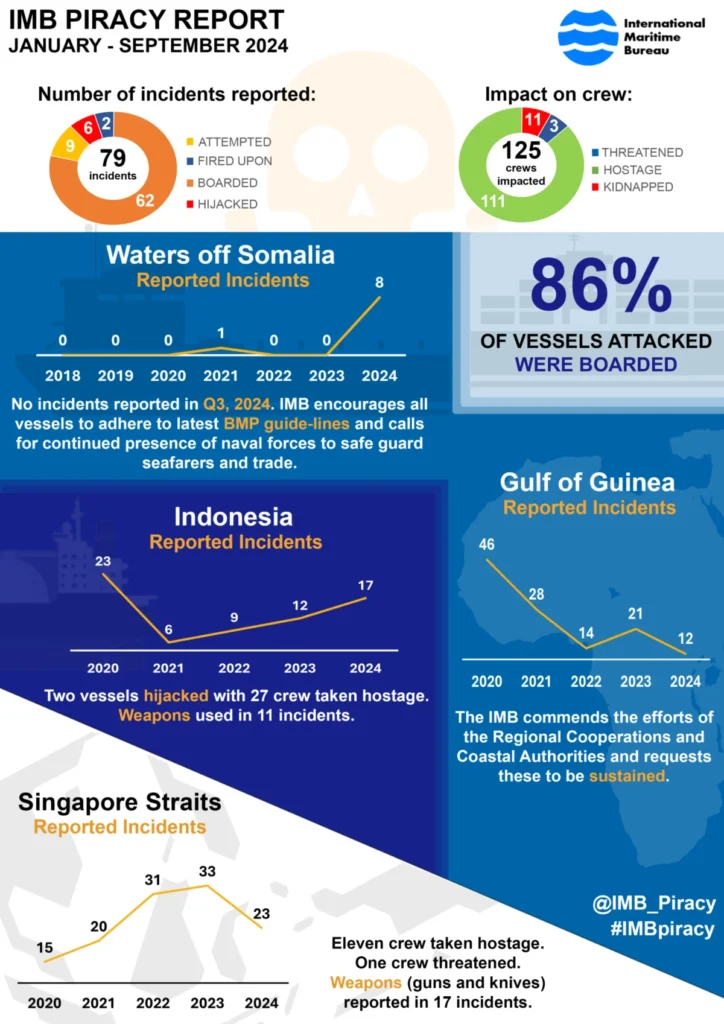
For the shipping community, the Gulf of Guinea has long been considered one of the most perilous regions for maritime transit. Historically plagued by organized kidnapping-for-ransom syndicates, the region has shown remarkable improvement in the current calendar year. Between January and September 2024, only 12 incidents were reported—a figure that stands as the lowest recorded since 1996.
This dramatic reduction is a testament to the enhanced collaborative efforts of regional navies and international stakeholders. Yet, the IMB remains cautious. The persistence of criminal intent in the region is evidenced by the fact that despite the lower volume of attacks, 11 crew members were kidnapped and 21 were taken hostage during this period. These figures demonstrate that while the "volume" of piracy has decreased, the "impact" on individual lives remains disproportionately high.
Somali Waters and the Gulf of Aden: The Monsoon Effect
The waters off Somalia and the Gulf of Aden, once the epicenter of global piracy, saw eight reported incidents in the first three quarters of 2024. Among these, three vessels were hijacked and two were fired upon.
Notably, the IMB reported a complete absence of piracy incidents between July and September. Analysts attribute this lull not necessarily to a permanent reduction in criminal activity, but to the seasonal influence of the monsoon season. High winds and rough seas create significant navigational hurdles for the small skiffs typically used by Somali pirates, effectively forcing a temporary cessation of hostile operations. The industry is currently bracing for a potential resurgence in activity as the weather improves toward the end of the year.
The Singapore Straits: High Frequency, Low Intensity
The Singapore Straits, a critical chokepoint for global trade, recorded 23 incidents in the first nine months of 2024, down from 33 during the same period in 2023. While the numerical decline is statistically significant, the operational profile of these incidents remains alarming. In 96% of the cases, perpetrators successfully boarded the vessels.
These incidents are largely characterized as "low-level" opportunistic armed robberies, where perpetrators target ships under cover of darkness to steal stores or engine parts. Despite their "low-level" classification, the IMB warns that these incidents represent a significant navigational risk. In the congested and treacherous waters of the Singapore Straits, the presence of unauthorized boarders can distract bridge teams, potentially leading to collisions or groundings.
Supporting Data and Statistical Analysis
To understand the scope of these shifts, one must analyze the comparative data provided by the IMB. The following table highlights the year-over-year fluctuations:
| Region | Jan-Sept 2023 Incidents | Jan-Sept 2024 Incidents | Percentage Change |
|---|---|---|---|
| Gulf of Guinea | 14 | 12 | -14% |
| Singapore Straits | 33 | 23 | -30% |
| Somalia/Gulf of Aden | 10 | 8 | -20% |
The data indicates a clear downward trend in the sheer volume of attacks. However, the qualitative data—specifically regarding the 32 crew members affected by kidnapping or hostage situations—serves as a stark reminder that piracy is not merely a logistical problem; it is a human rights crisis.
Furthermore, the "success rate" of boarding in the Singapore Straits, standing at 96%, suggests that current mitigation strategies—such as lookout postings and citadel protocols—require urgent review. If boarders can successfully breach a vessel’s defenses in nearly every encounter, the reliance on passive security measures may be insufficient in the face of increasingly agile criminal elements.
Official Responses and Industry Guidance
The IMB’s Stance on Best Management Practices (BMP)
The International Maritime Bureau continues to be the primary voice advocating for the rigorous application of Best Management Practices (BMP). The IMB urges shipowners to recognize that even in regions where piracy appears to be waning, complacency is the greatest ally of the criminal.
"The safety of the crew, the vessel, and the cargo is non-negotiable," an IMB spokesperson noted. "Adherence to the latest BMP, including the hardening of vessels, the maintenance of a 24/7 watch, and immediate reporting of suspicious activities to the IMB Piracy Reporting Centre (PRC), remains the most effective deterrent against piracy."
Government and Navy Interventions
The decline in the Gulf of Guinea is widely attributed to the "Deep Blue" project and increased patrolling by regional navies in coordination with international partners. These efforts have disrupted the logistical chains that previously allowed pirates to hold vessels for ransom for extended periods. However, the IMB stresses that these gains are fragile. Without sustained investment in maritime domain awareness and regional intelligence sharing, the criminal networks could reconstitute, as has been seen in previous cycles of maritime insecurity.
Implications for Global Maritime Security
Navigational Risks in Congested Waters
The implications of the Singapore Straits data go beyond simple theft. As ships grow larger and the waters become more congested, any incident—even one involving a small group of opportunistic thieves—can have catastrophic results. An engine room alarm triggered by intruders can force a vessel to lose propulsion at the worst possible moment. If a vessel loses maneuverability in a high-traffic area, the risk of a collision involving hazardous cargo is a scenario that keeps maritime safety regulators awake at night.
Insurance and Economic Consequences
The maritime insurance industry is closely monitoring these figures. A reduction in piracy incidents generally leads to lower "war risk" premiums, which directly benefits the global supply chain. However, if the severity of the incidents (e.g., kidnappings) remains high, insurers may be hesitant to lower premiums, citing the "latent" threat that still exists in these regions. The long-term economic stability of shipping routes relies on a predictable and secure environment, not just a seasonal fluctuation in attack numbers.
The Human Element: The Psychological Toll
Often omitted from purely statistical reports is the psychological toll on seafarers. Being held hostage or kidnapped leaves deep scars that affect the mental health and retention of crews. As the industry faces a global shortage of skilled seafarers, the safety of these individuals is not just a moral imperative but an economic one. Shipping companies that fail to implement robust security measures are increasingly finding it difficult to attract and retain high-quality talent.
Conclusion: The Path Forward
The first nine months of 2024 have provided a glimpse of what is possible when coordinated international and regional efforts are applied to maritime security. The historic lows in the Gulf of Guinea are a cause for cautious optimism. However, the maritime industry cannot afford to rest on its laurels.
The threats are evolving. From the seasonal volatility in the waters off Somalia to the high-frequency boardings in the Singapore Straits, the nature of piracy is shifting toward smaller, more opportunistic, and more targeted attacks. To ensure the safety of the global merchant fleet, the following actions are imperative:
- Continued Intelligence Sharing: Enhanced cooperation between coastal states and shipping companies to provide real-time warnings of suspicious activity.
- Investment in Surveillance Technology: Increased use of radar, infrared cameras, and long-range acoustic devices (LRAD) to detect small craft before they reach the hull.
- Crew Training: Regular, high-fidelity security drills that prepare crews not just for detection, but for the containment of intruders should a breach occur.
- Persistent Presence: Maintaining naval and coast guard patrols even during periods of low activity to ensure that criminal networks cannot reorganize.
As we move into the final quarter of 2024, the maritime sector must remain vigilant. The decline in piracy reports is a victory, but it is not a solution. True maritime security is achieved only through constant vigilance, proactive policy, and a steadfast commitment to the safety of the men and women who keep the global economy afloat.