In the modern commercial landscape, the standard of "clean" has undergone a radical transformation. As businesses prioritize the health of employees and clients, facility managers are increasingly moving away from traditional manual cleaning methods, which often fall short in high-traffic environments. Enter electrostatic disinfection—a technology that leverages physics to solve the age-old problem of human error in sanitation. But as adoption rises, so do questions regarding safety, efficacy, and operational standards.
Is electrostatic disinfection safe? The short answer is yes, provided the process is executed by trained professionals who respect the chemistry, the equipment, and the environment. By charging liquid droplets to cling to surfaces, this method provides a level of coverage that traditional wiping simply cannot match. However, the technology is not a "magic wand"; its success depends entirely on rigorous adherence to scientific protocols.
The Core Mechanism: Why Physics Outperforms the Cloth
To understand why electrostatic disinfection has become a cornerstone of advanced commercial cleaning, one must first look at the limitations of the "wipe and spray" method. A standard microfiber cloth is only as effective as the hand guiding it. It inevitably skips the underside of desks, the crevices of office chairs, the complex geometries of computer hardware, and the myriad of touch points that harbor pathogens for hours.
The Science of Charged Droplets and Wrap-Around Coverage
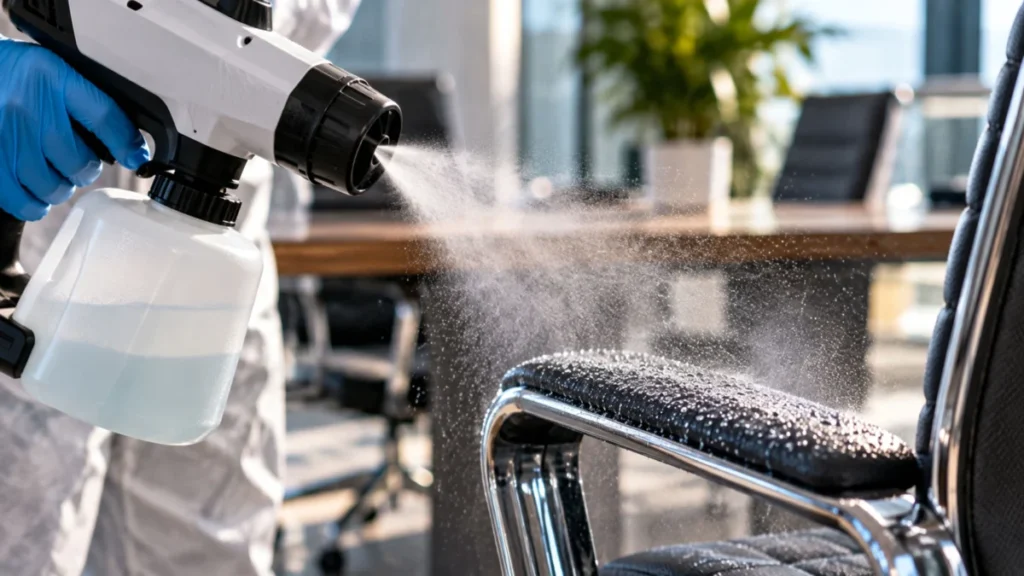
Electrostatic disinfection works by passing a disinfectant solution through an atomizing nozzle. As the liquid exits, it is imbued with a positive electrical charge. Because most surfaces in an office environment—such as desks, monitors, and walls—possess a neutral or slightly negative charge, the droplets are physically drawn to them.
This creates a "wrap-around" effect. Rather than just coating the front-facing surface, the mist follows the electrical field lines, adhering to the sides, backs, and undersides of objects. Because the droplets carry the same positive charge, they repel each other, ensuring they spread out evenly across the surface rather than pooling into a puddle. This results in a thin, uniform film that provides comprehensive coverage without saturating materials.
Navigating Complex Geometries
The true value of this technology shines in cluttered environments. In a typical office or medical clinic, "awkward geometry" is the norm. Cables, chair bases, and door handles are notoriously difficult to clean manually. Electrostatic spraying handles these areas in a single pass. By controlling droplet size—typically between 40 and 80 microns—operators ensure the mist is fine enough to cling to surfaces effectively while remaining heavy enough to prevent dangerous drifting into the breathing zone of the room’s occupants.
Chronology of Adoption: From Hospital Corridors to Corporate Hubs
The shift toward electrostatic technology did not happen overnight. Its trajectory reflects a broader evolution in public health management.
- The Clinical Foundation: Originally developed for hospital isolation rooms and surgical suites, the technology was designed to manage high-risk environments where pathogen cross-contamination was a matter of life and death.
- The Commercial Transition: As public health awareness spiked globally, the technology began migrating into high-traffic commercial spaces. Facility managers recognized that the same "wrap-around" capabilities used to contain superbugs in hospitals were perfect for the "hidden" surfaces of modern corporate offices.
- The Integration Phase: Currently, we are in the era of integration. Leading cleaning services, particularly in major hubs like Calgary, have moved beyond simply offering "cleaning" to providing "advanced commercial disinfection." This shift marks the professionalization of the industry, where providers are now expected to offer validated, data-backed sanitation protocols rather than basic janitorial services.
The Workflow: Where Disinfection Fits the Cleaning Cycle
A common misconception is that electrostatic disinfection can replace routine cleaning. In reality, it is a specialized tool that functions best when integrated into a structured workflow.
Cleaning vs. Disinfecting: The Crucial Sequence
Cleaning and disinfecting are distinct processes that serve different purposes. Cleaning is the mechanical removal of dirt, dust, and organic matter—the "soil" that hides pathogens. Disinfection is the application of chemicals designed to kill those pathogens.
If a technician sprays a disinfectant onto a surface covered in dust or grime, the chemical binds to the dirt rather than the bacteria, rendering it ineffective. Professional protocols mandate that manual cleaning—using detergents and friction—must always precede the electrostatic application. The spray acts as the final "kill step" on a surface that has already been cleared of debris.
The Dwell Time Imperative
The most frequently overlooked detail in disinfection is "dwell time." Every EPA-registered or health-certified disinfectant has a specific contact time—the duration it must remain visibly wet on a surface to effectively neutralize the target pathogens.
- Standard Sanitizers: Often require 30 to 60 seconds.
- Broad-Spectrum Disinfectants: Frequently require 3 to 10 minutes.
Pro Tip: Facility managers should never judge the success of a disinfection by the visual appearance of the surface. A surface may look dry while the dwell time is still running. Operators must time the process using a watch or timer, not by sight. If the surface dries before the dwell time is met, the disinfection claim is void.
Safety and Environmental Considerations
The safety of electrostatic disinfection is not a property of the machine itself, but of the operator’s discipline. When executed correctly, it is one of the safest ways to maintain a sterile environment.
Chemical Selection and Ventilation
The primary risk factor is the chemical agent used. Skilled technicians select low-toxicity, registered formulas—such as hydrogen peroxide or optimized quaternary ammonium compounds—that are safe for indoor use. By managing the airflow (opening windows or running the building’s HVAC system), operators ensure that any residual mist is properly ventilated. Occupants should generally clear the zone during the application and remain out of the area until the dwell time is complete and the surface is dry.
Asset Protection
One of the greatest advantages of the electrostatic method is its gentleness on sensitive equipment. Because the mist is fine and uniform, it does not soak surfaces. Modern electronics, keyboards, and delicate fabric acoustic panels can be treated without the risk of water damage or saturation that often accompanies traditional trigger-sprayers. However, professional services will always perform a spot-test on exotic finishes to ensure chemical compatibility.
Verifying Results: The New Gold Standard
In the current market, facility managers are demanding more than just a "clean" office; they are demanding proof. The transition from "trusting the cleaner" to "verifying the outcome" is the final frontier in facility management.
Comparing Service Tiers
| Attribute | Sanitizing | Disinfection | Electrostatic Application |
|---|---|---|---|
| Primary Target | Bacteria (Safe levels) | Viruses/Bacteria | Full pathogen control |
| Surface Reach | Face-level | Face-level | 360-degree coverage |
| Best Use Case | Food prep counters | Clinic touch-points | Large, high-clutter rooms |
| Control | Short dwell | Label-mandated dwell | Even, measured layering |
The Checklist for Qualified Providers
Before hiring a disinfection service, facility managers should verify the following:
- Training Logs: Does the provider employ certified technicians who understand the physics of electrostatic equipment?
- Chemical Transparency: Can the provider supply the Safety Data Sheets (SDS) for the products they intend to use?
- Protocol Documentation: Do they have a clear, documented sequence for cleaning before disinfecting?
- Verification Methods: Do they use ATP (Adenosine Triphosphate) testing or similar metrics to verify the effectiveness of their work?
Implications: The Future of the Workplace
The adoption of electrostatic disinfection signals a permanent change in how we view the commercial environment. It acknowledges that human health is a bottom-line issue; preventable illnesses lead to lost productivity, high absenteeism, and reduced morale.
By shifting from reactive, manual wiping to proactive, science-based electrostatic applications, businesses are taking a significant step toward "future-proofing" their physical workspaces. As technology advances, we can expect to see even more efficient equipment, safer green-certified chemistries, and tighter integration with building management systems.
In conclusion, electrostatic disinfection is not merely a trend; it is a sophisticated application of science designed to bridge the gap between "clean-looking" and "actually clean." When combined with proper operator training, rigorous adherence to dwell times, and a clear understanding of the difference between cleaning and disinfecting, it offers a robust, safe, and effective solution for the modern, high-traffic commercial facility. The evidence of its efficacy is found in the logs, the testing data, and the confidence of a safe workplace.