

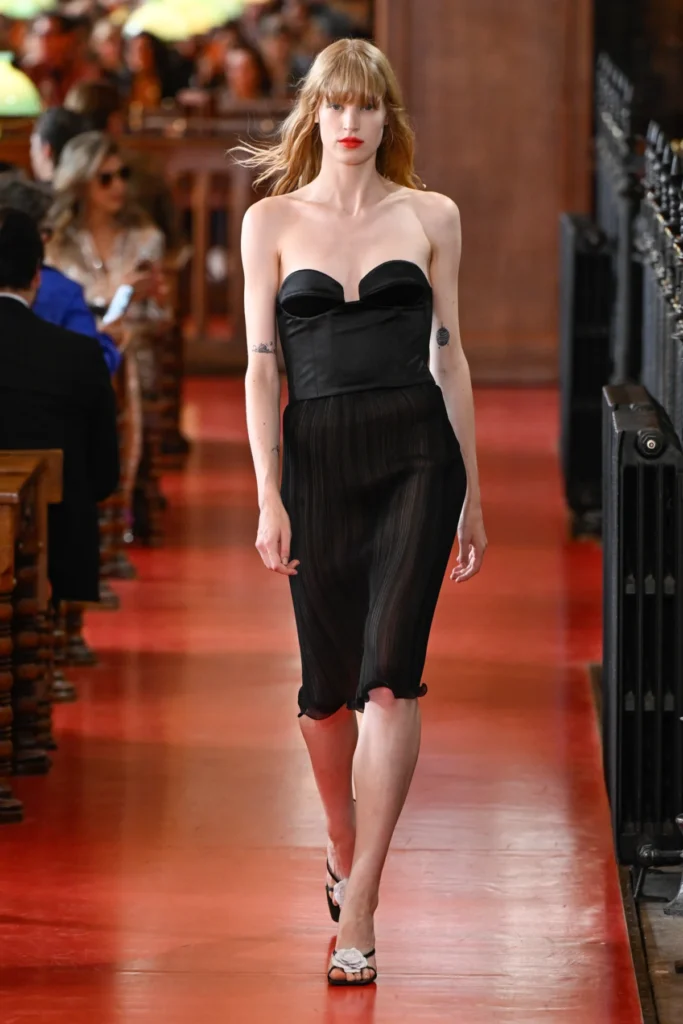
The Setting: A Temple of Ink and Iron
Under the vaulted, industrial iron arches of the historic Sainte-Geneviève Library in Paris’s Latin Quarter, the atmosphere for Valentino’s Spring 2027 ready-to-wear show felt less like a traditional runway and more like a scholarly symposium. As the fashion set navigated the labyrinthine shelves of one of the world’s most venerable repositories of knowledge, they arrived bearing an unusual invitation: a request to donate a book.
The gesture was more than a mere atmospheric flourish; it was a deliberate provocation. Guests—ranging from Hollywood A-listers to global pop icons—participated in a communal act of literary exchange. Alexander Skarsgård, ever the intellectual, arrived with a collection of Icelandic sagas, drawing a parallel between the ancient Norse epics and the endurance of history. "It’s basically the Iliad of the Norse culture," Skarsgård remarked, his choice signaling a reverence for narratives that survive the test of time. Conversely, Thai superstar Jeff Satur brought a manual for manifesting, a modern nod to the intersection of intention and outcome.
This literary backdrop served as the physical manifestation of Creative Director Alessandro Michele’s latest philosophical inquiry: the "Antilibrary."
Defining the "Antilibrary"
The term, coined by the late Italian writer and philosopher Umberto Eco, refers to a collection of unread books—the volumes that sit on shelves as silent witnesses to our curiosity, the knowledge we have yet to acquire, and the potential for discovery that remains untapped.
For Michele, the Antilibrary is a metaphor for the modern wardrobe. "There is something that I like in the idea of having in my closet that beautiful piece that I’m probably never going to wear," Michele confessed during a pre-show briefing. It is a radical departure from the hyper-utilitarian approach of contemporary fashion, which often demands that every garment justify its existence through constant rotation and wear. Michele’s vision invites a different kind of relationship with clothing: one of curation, aesthetic preservation, and quiet appreciation.
Chronology of a Maximalist Vision
The runway show itself was a masterclass in the Roman designer’s signature maximalism, characterized by an off-kilter, nostalgic romanticism that bridged the gap between archival reverence and modern eccentricity.
- The Opening: The show commenced with an exploration of "bourgeois daywear," reinterpreted through a warped, nostalgic lens. We saw 1980s-inspired power blazers paired with lace cycling shorts—a juxtaposition that felt both jarring and undeniably deliberate.
- The Mid-point: The collection transitioned into a series of bold statements, featuring fuchsia satin column dresses adorned with gargantuan, pleated rosette trains that demanded total spatial awareness.
- The Casual Pivot: Michele integrated elements of the everyday, including double-pleated jeans, oversized plaid shirts, and baseball caps embroidered with the phrase "Villain Teen," suggesting a playful subversion of traditional luxury codes.
- The Finale: The collection closed with a series of complex textures: webby mohair cardigans worn over knobbly wool trousers, and harem pants in tree-bark-textured fabric tucked into intricately sequined boots.
Supporting Data: The Financial Context
This aesthetic pivot comes at a critical juncture for Valentino. The fashion house has faced significant fiscal headwinds, reporting a shift from an operating profit of 31 million euros in 2024 to a loss of 103 million euros in the most recent fiscal year.
Critics and industry analysts are watching closely to see if Michele’s highly personalized, "maximalist-intellectual" approach can stabilize the brand’s trajectory. While the financial numbers tell a story of a ship in need of course correction, Michele is betting on a long-term strategy: creating a cultural identity that is immune to the transient nature of seasonal trends. By prioritizing the "human touch" over the "data-driven" approach, he is attempting to re-establish the emotional bond between the brand and the consumer, even if it requires a period of recalibration.
Official Responses and the AI Dilemma
The timing of this show was poignant, coinciding with a summer of intense debate regarding the role of artificial intelligence in creative industries. Reports surfaced earlier this year that Anthropic had utilized a dataset of over 2 million books to train its large language model, Claude—a move that felt like a direct assault on the very intellectual foundations Michele was celebrating in the library.
Michele, who has previously made headlines for his candidly bewildered reactions to the rise of robotics in fashion—most notably his viral, frozen expression during a high-tech display at a Vogue World event in Milan—remains unapologetically humanist.
"I was petrified and I was trying to understand what was going on," Michele said, reflecting on the rise of tech-integrated fashion. "I’m not against technology, but life is about me and the things that surround me. I don’t want to lose everything. I don’t need a second brain."
His stance is clear: fashion should not be a product of algorithmic optimization. He rejects the "AI slop" that permeates modern digital culture, arguing that the chaotic, emotional, and often "random" pairings of his collection are fundamentally human. "I don’t want to live fashion just as something that belongs to numbers," he asserted. "I want to give back to fashion what fashion has always given me. I would love to push people to inject something more, because otherwise we risk falling asleep."
Implications: The Future of the Brand
The implications of Michele’s "Antilibrary" collection are twofold. Firstly, it positions Valentino as a sanctuary for those who are weary of the homogenization of luxury. By championing the unread, the unused, and the "beautifully impractical," Michele is effectively branding the act of aesthetic contemplation as an act of resistance.
Secondly, it challenges the industry’s obsession with efficiency. If AI can predict what we want to buy based on past purchase behavior, it creates a feedback loop of mediocrity. Michele’s designs, which often defy logical styling, act as a circuit breaker. Would an AI agent, trained on millions of images, ever think to pair gold-tipped shoes with textured, harem-style wool trousers? Probably not. And therein lies the point.
As Valentino moves forward, the success of this vision will depend on the brand’s ability to turn these "Antilibrary" concepts into a sustainable commercial reality. The loss of 103 million euros is a significant hurdle, but in a market saturated with digital mimicry, Michele’s gamble is that the world is hungry for something that feels, fundamentally and beautifully, human.
In the end, the books left behind at the Sainte-Geneviève Library will be donated, but the lesson they provided—that the most important things in life are those that defy categorization and immediate consumption—will likely inform the next chapter of the house of Valentino. Michele is not just designing clothes; he is designing a defense mechanism against a world that is increasingly trying to automate the soul.



