

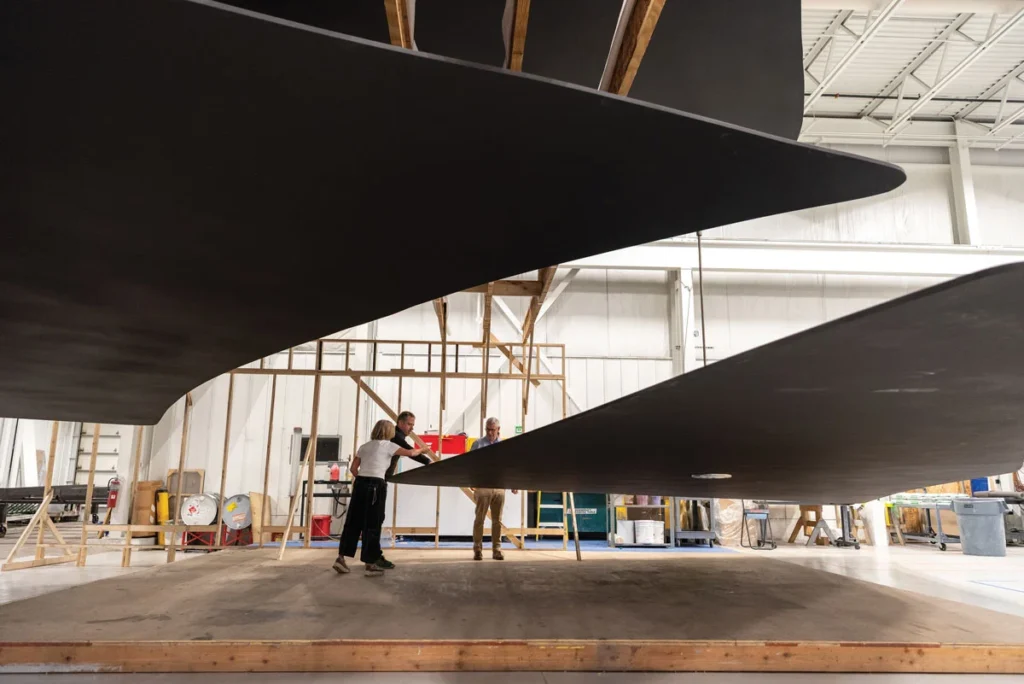
In the heart of the nation’s capital, within the soaring, austere marble atrium of the Hart Senate Office Building, a long-stilled dance is about to resume. For over a decade, one of the most significant works of American modernism sat incomplete—a "mountain" without its "clouds." Now, thanks to a decade of persistence and a $10 million gift from former Microsoft President Jon Shirley and his wife, Kim, Alexander Calder’s Mountains and Clouds (1976/1986) is being restored to its full, kinetic glory.
The project represents more than just a technical repair of a massive sculpture; it is a monumental act of cultural stewardship. As the largest work of modern public art in Washington, D.C., second in scale only to the Washington Monument, the restoration of Mountains and Clouds restores a sense of equilibrium to a space defined by the heavy business of governance.
Main Facts: A Landmark Restored
The restoration of Mountains and Clouds is the culmination of a ten-year odyssey spearheaded by Jon and Kim Shirley. Jon Shirley, who led Microsoft during its formative years of global dominance, has long been one of the world’s preeminent collectors of Alexander Calder’s work. The Shirleys’ commitment to the artist is well-documented; only three years ago, they donated a staggering 48 works by Calder—valued at approximately $200 million—to the Seattle Art Museum.
However, their focus shifted to Washington, D.C., in March 2016. While attending a meeting of the National Gallery of Art’s Collectors Committee, the couple visited the Hart Senate Office Building. What they found was a masterpiece in a state of sculptural "amputation." The "Mountains"—a 50-foot-tall, 38-ton steel stabile—remained anchored to the floor. But the "Clouds"—a massive mobile designed to float from the 90-foot-high ceiling—were nowhere to be seen.
The mobile had been dismantled following the 2011 Virginia earthquake, which sent tremors through the capital. Subsequent inspections revealed that the clouds were not only structurally compromised but also suffered from mechanical defects that made reinstallation a safety hazard. Dismayed by the absence of the work’s kinetic half, the Shirleys pledged to fund the entire restoration process, regardless of the cost. A decade later, that pledge has manifested as a $10 million investment in the nation’s artistic heritage.
Chronology: The Life, Death, and Rebirth of a Masterpiece
The history of Mountains and Clouds is as dramatic as the sculpture itself, intertwined with the death of its creator and the shifting political winds of the Cold War era.
1975–1976: The Artist’s Final Act
In 1975, the architects of the Hart Senate Office Building—then under construction—selected Alexander Calder to create a site-specific work for the central atrium. Calder, the inventor of the mobile and a titan of 20th-century art, was the natural choice to fill the 90-foot void. The design was approved by Senator Philip Hart, the "Conscience of the Senate," for whom the building was named.
In November 1976, Calder traveled to Washington to inspect the maquette (a small-scale model) and finalize the placement. It was to be his final professional act. The very next day, after returning to New York, Calder passed away. The project became his posthumous legacy, the only work in his vast oeuvre designed to integrate a separate mobile and stabile into a single unified composition.
1979–1987: Funding Battles and Dedication
The path from design to installation was fraught with obstacles. During the late 1970s, as the Hart building faced cost overruns and public scrutiny, funding for the sculpture was unceremoniously cut. The "Clouds" nearly evaporated before they were ever built.
It took the intervention of Senator Nicholas F. Brady of New Jersey to rescue the project. Brady organized a private fundraising effort, securing a critical donation from Paul Mellon, the legendary philanthropist and son of National Gallery of Art founder Andrew Mellon. With private funding secured, the work was finally fabricated and dedicated in 1987.
2011–2016: The Great Silence
For 24 years, the mobile’s four black clouds drifted above the steel mountains, powered by a computer-controlled motor. However, the 5.8-magnitude earthquake that struck Virginia in August 2011 changed everything. While the stabile remained secure, the mobile’s suspension system was deemed a risk. The clouds were lowered, crated, and stored, leaving the atrium feeling cavernous and incomplete.

2016–2024: The Shirley Intervention
Upon discovering the mobile’s absence in 2016, the Shirleys began a complex negotiation with the Architect of the Capitol (AOC) and the Calder Foundation. What followed was an intensive period of engineering analysis, archival research, and fabrication. Installation finally commenced in late August 2024, marking the beginning of the end of a 13-year hiatus for the clouds.
Supporting Data: The Scale of an Icon
To understand the magnitude of the restoration, one must look at the sheer physical data of Calder’s creation. Mountains and Clouds is a marvel of mid-century engineering, pushed to its limits.
- Total Height: The work occupies a volume nearly 90 feet high.
- The Mountains (Stabile): Standing 50 feet tall and weighing 38 tons, the stabile is composed of five intersecting steel plates. It is finished in a matte black "Calder Red" (though in this case, the artist chose black to contrast with the building’s white marble).
- The Clouds (Mobile): The mobile consists of four distinct "clouds." The largest of these is 43 feet long.
- Weight: The mobile assembly weighs approximately 2,000 pounds (one ton).
- The Motor: The original mechanical system was prone to failure. The 2024 restoration introduces a state-of-the-art, whisper-quiet motor and a sophisticated computerized control system that allows the clouds to move with the precise, slow-rolling grace Calder originally intended.
The $10 million restoration budget reflects not just the materials, but the immense logistical challenge of working within a high-security federal building. Scaffolding, structural reinforcement of the ceiling joists, and the use of aerospace-grade alloys for the internal skeletons of the clouds were necessary to ensure the work remains safe for centuries to come.
Official Responses: A Bipartisan Artistic Triumph
The restoration of Mountains and Clouds has served as a rare point of absolute consensus in a frequently divided Washington. The Shirleys emphasized that the project would have been impossible without the cooperation of a "determined team of solutions-oriented senators from both sides of the aisle."
Jon Shirley praised the "devoted interagency group of government staff under the guidance of the Architect of the Capitol," noting that the project required navigating layers of federal bureaucracy and safety regulations.
Alexander S.C. Rower, Calder’s grandson and the president of the Calder Foundation, played a pivotal role in ensuring the restoration remained true to his grandfather’s vision. Foundation archives revealed that the original 1986 installation had made certain technical compromises due to the limitations of the era’s technology. The 2024 version, Rower notes, actually brings the sculpture closer to Calder’s 1976 intent than the original installation did, utilizing modern materials to achieve a more "fluid and natural" motion.
Implications: Equilibrium in the Seat of Power
The return of Mountains and Clouds carries a symbolic weight that transcends its physical dimensions. In a building where the nation’s laws are debated and political friction is the norm, the sculpture serves as a visual metaphor for the American experiment.
Jon Shirley noted that while Calder was not a political artist in the traditional sense, his work speaks to the concept of "equilibrium." The mobile consists of disparate, heavy parts that, through careful balance, achieve a state of harmony. "The work’s symbolic power—its incredible demonstration of equilibrium and the unlikely harmony that can be achieved across different planes—is symbolically potent," Shirley remarked.
Furthermore, the project highlights the evolving role of private philanthropy in the preservation of public space. As federal budgets for the arts remain a perennial target for cuts, the stewardship of the Shirleys demonstrates how private individuals can safeguard national treasures that might otherwise be lost to time and neglect.
As the installation nears completion and the motor is finally engaged, the Hart Senate Office Building will regain its heart. The "Mountains" will no longer stand alone; they will once again be shadowed by the drifting "Clouds," reminding those who walk beneath them that even the heaviest of structures can find a way to move in harmony. For Jon and Kim Shirley, the $10 million and ten years of effort represent a debt of gratitude to an artist who redefined the relationship between art and space—and a gift to a city that remains the ultimate stage for the "composition in motion" that is American democracy.



