

By Dalia Marin
September 18, 2026
For decades, the Federal Republic of Germany served as the global gold standard for political stability and economic resilience. Its postwar success was anchored in an implicit, ironclad bargain: Germany’s high-value manufacturing sector would act as the engine of the nation, generating robust export revenues and sustaining a vast middle class. In return, political institutions would translate this prosperity into enduring social cohesion and a predictable electoral landscape.
However, as of September 2026, that bargain is being shaken to its foundations. The rise of the far-right Alternative für Deutschland (AfD) has transitioned from a fringe movement to a structural threat, culminating in a seismic shift in the state of Saxony-Anhalt. As global competition intensifies and the traditional industrial pillars of the German economy falter, the electorate is signaling a profound disillusionment with the status quo.
The Turning Point: The Saxony-Anhalt Election
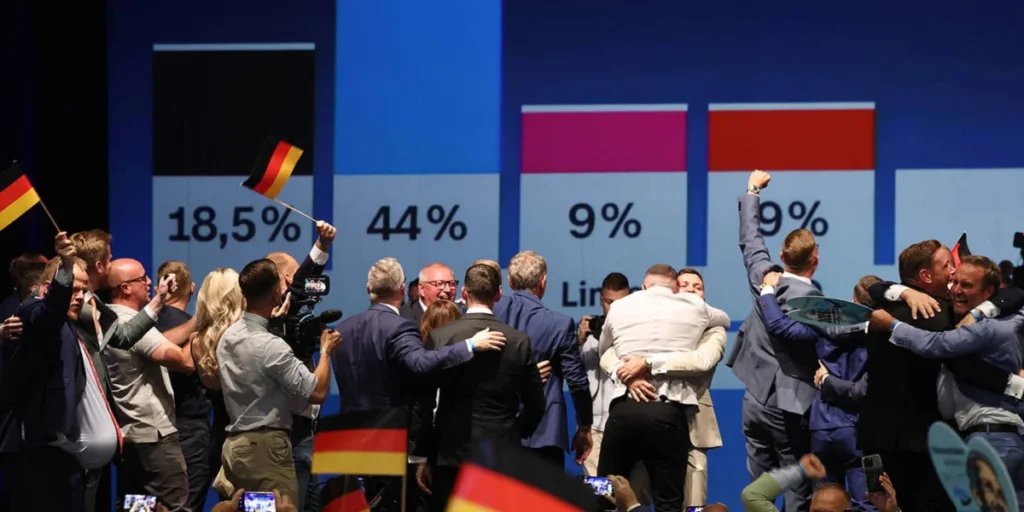
On September 6, 2026, the German political map underwent a radical transformation. In what many analysts are already calling the most significant electoral shift in postwar history, the AfD surged to 43.8% of the vote in the Saxony-Anhalt state election.
This result was not merely a protest vote; it was a near-triumph. Falling just three seats short of an absolute majority, the AfD effectively dismantled the hegemony of the center-right Christian Democratic Union (CDU). The incumbent party, led nationally by Chancellor Friedrich Merz, saw its support collapse from 37.1% in 2021 to a dismal 17.2%. The scale of this defeat suggests that the "Merz Era" is facing an existential crisis, as the CDU finds itself unable to contain the populist tide on its right flank.
Chronology of a Political Realignment
The ascent of the AfD in Eastern Germany is not an overnight phenomenon, but rather the culmination of years of systemic economic anxiety and cultural alienation.
- 2021: The CDU maintains a dominant position in Saxony-Anhalt with 37.1% of the vote, signaling that the traditional political order remains largely intact despite global economic headwinds.
- 2023-2024: Persistent inflationary pressures and the escalating costs of the "Green Transition" begin to strain the German Mittelstand. Supply chain disruptions and energy price volatility start to erode the competitiveness of German manufacturing.
- Early 2026: Public discourse intensifies around Germany’s trade dependency on China. As Beijing pivots from a partner to a systemic rival, German firms find their market access restricted and their technological edge challenged.
- August 2026: Final campaigning intensifies. The AfD adopts a "Germany First" economic platform, explicitly linking industrial decline to federal policy failures and the cost of European integration.
- September 6, 2026: Election Day. The results shatter the "cordon sanitaire" that mainstream parties had hoped would keep the AfD at bay.
Supporting Data: The Anatomy of Decline
To understand the shift in Saxony-Anhalt, one must look at the structural pressures weighing on the German economy. The "German Model"—characterized by Ordnungspolitik and export-oriented industrial growth—is facing a perfect storm of external and internal challenges.
The China Factor
For years, China was the primary engine of German export growth. Today, that relationship has curdled into a strategic liability. According to recent data from the ifo Institute, German direct investment in China has stagnated for the first time in two decades. Chinese domestic firms, particularly in the automotive and mechanical engineering sectors, are now producing high-tech goods at prices that German manufacturers cannot match. As China moves up the value chain, the "Made in Germany" brand is losing its premium status.
The Erosion of the Middle Class
The social cohesion that once defined Germany is predicated on job security in the manufacturing sector. However, the energy transition (Energiewende) has introduced significant uncertainty. While necessary for climate goals, the rapid decarbonization of heavy industry has led to "carbon leakage," where energy-intensive companies shift production abroad. In states like Saxony-Anhalt, which still host significant legacy manufacturing assets, the fear of "deindustrialization" has become a potent political mobilizing tool.
Demographic and Regional Disparities
The demographic divide between the aging, industrial East and the more service-oriented West remains a fault line. The AfD has successfully exploited this, positioning itself as the defender of the "left-behind" worker. The 2026 election data shows that the party’s growth is strongest among blue-collar voters aged 30–55—the very demographic that previously formed the backbone of the CDU’s support base.
Official Responses and Political Fallout
The response from Berlin has been one of shock, followed by a scramble for a new strategy.
Chancellor Friedrich Merz’s Stance:
Addressing the Bundestag shortly after the election, Chancellor Merz acknowledged the "painful result," but insisted that the CDU would remain committed to its core principles of fiscal discipline and European integration. He explicitly ruled out any coalition or parliamentary cooperation with the AfD, labeling the party a "danger to the constitutional order." However, critics within his own party are calling for a more populist, right-leaning shift to win back voters who have drifted to the AfD.
The Opposition’s View:
The AfD’s leadership in Saxony-Anhalt has declared the result a mandate for a "new beginning." Their rhetoric focuses on ending sanctions against trade partners, halting the transition to renewables in its current form, and reclaiming national sovereignty from Brussels.
International Reaction:
European partners, particularly in Paris and Brussels, have expressed deep concern. The prospect of a major German state effectively governed by, or under the heavy influence of, an anti-EU party threatens the fragile consensus on the European Green Deal and the common defense policy.
Implications: A New Era of Uncertainty
The implications of the Saxony-Anhalt election extend far beyond the borders of that state. Germany is entering a period of "political volatility" that is unprecedented in the postwar era.
1. The Death of the "Big Tent"
The traditional two-party system (CDU and SPD) is effectively dead in the East. Future governments will likely require complex, unstable coalitions of three or four parties to keep the AfD out of power. This "politics of the smallest common denominator" risks gridlock at both the state and federal levels.
2. Economic Policy Paralysis
As long as the political establishment is preoccupied with containing the AfD, long-term strategic decisions—such as overhauling the tax code, reforming the pension system, or accelerating digitalization—are likely to be deferred. A country that cannot reform itself will inevitably see its global economic standing decline.
3. The Challenge to European Integration
Germany has historically been the anchor of European stability. If the German political system becomes preoccupied with internal dissent and economic protectionism, the European Union loses its primary stabilizer. The AfD’s success provides a blueprint for other populist movements across Europe to challenge the Brussels-based status quo.
4. Re-evaluating the China Relationship
The election results will force the German government to rethink its China strategy. While the business community remains cautious, the political reality is that the German public is increasingly wary of the country’s dependence on Beijing. Expect a move toward "de-risking" that is more aggressive, even if it comes at the cost of short-term industrial profits.
Conclusion: The Path Ahead
The events of September 2026 are a loud warning that the implicit social contract of the German postwar era has expired. The combination of global competition, industrial transformation, and political fragmentation has created a landscape where the old solutions no longer suffice.
For Chancellor Merz and the traditional political establishment, the challenge is clear: they must demonstrate that the German model can still deliver prosperity in a changing world. If they fail, the Saxony-Anhalt election will be remembered not as an outlier, but as the beginning of a broader unraveling of the modern German state. The question is no longer whether Germany will change, but whether it can adapt fast enough to survive the coming storm without abandoning the democratic values that have defined its modern identity.



