

By Laurent Warlouzet
October 9, 2026
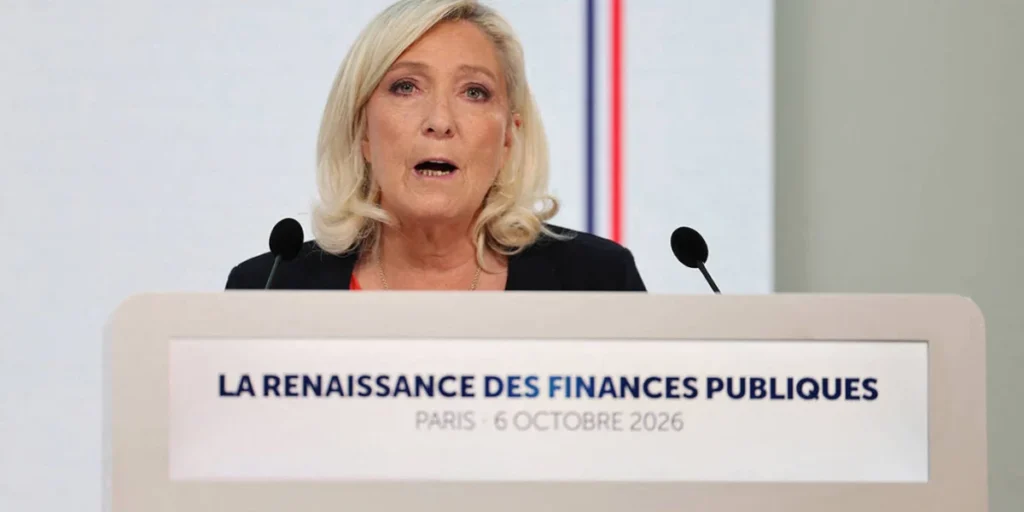
In a high-stakes address that has sent ripples through the European political landscape, Marine Le Pen, the long-standing leader of France’s National Rally (RN), has unveiled an economic manifesto that marks a profound ideological departure. Once the standard-bearer for protectionist welfare-chauvinism, Le Pen is now championing a program of rapid fiscal consolidation—a move that effectively embraces the language of austerity. This pivot, paradoxical in its nature, represents a calculated gamble: she is betting that the path to the Élysée Palace lies not in radical redistribution, but in fiscal credibility. Whether this transition can withstand the scrutiny of both the markets and her own base will determine her political future, and perhaps the trajectory of the nationalist right across the continent.
The Core Mandate: Fiscal Consolidation as a Strategic Tool
The cornerstone of Le Pen’s latest economic platform is a rigorous commitment to narrowing France’s ballooning budget deficit. For years, the National Rally has been synonymous with "social populism," promising generous subsidies for the working class, early retirement, and tax cuts funded by abstract levies on international finance. The new program, however, shifts the focus toward state efficiency, debt reduction, and a promise to "reclaim the sovereignty of the national budget."
Le Pen’s rhetoric has transitioned from attacking the "globalist elite" to attacking "fiscal mismanagement." By proposing deep cuts to administrative overhead and a streamlined public sector, she is attempting to shed the party’s reputation as an economic outlier. This is not merely a change in policy; it is a fundamental rebranding of the party’s relationship with the French electorate and the European Union’s fiscal monitors.
A Chronology of Ideological Evolution
To understand the weight of this pivot, one must look at the evolution of the National Rally’s economic identity over the last decade.
- 2014–2017: The Anti-Globalist Phase. During this period, Le Pen focused heavily on "economic patriotism." Her platform centered on exiting the Eurozone and restoring the French franc to allow for competitive devaluation. The rhetoric was explicitly anti-austerity, characterizing the European Central Bank as an instrument of German-led oppression.
- 2018–2022: The "Social" Rebranding. Following the Gilets Jaunes (Yellow Vests) movement, Le Pen softened her stance on the Euro but doubled down on purchasing power. She prioritized massive tax breaks for energy and fuel, positioning the RN as the only party truly concerned with the rising cost of living for the rural and peri-urban working class.
- 2023–2025: The Institutional Realignment. Recognizing that fears of "economic chaos" were the primary barrier to her presidential bid, Le Pen began an intensive campaign to engage with financial analysts and international investors. She replaced firebrand populists with technocratic advisors, laying the groundwork for the current shift toward fiscal discipline.
- October 2026: The Austerity Pivot. The current speech marks the culmination of this evolution. By adopting the language of fiscal responsibility, Le Pen is attempting to insulate herself from the "irresponsibility" narrative that has historically been the Achilles’ heel of far-right candidates in France.
Supporting Data: The Fiscal Reality of France
The necessity for this pivot is rooted in cold, hard numbers. France currently faces a debt-to-GDP ratio that has surpassed 110%, with annual budget deficits consistently exceeding the 3% threshold established by the EU’s Stability and Growth Pact.
Recent economic data suggests that the "easy" policy of unfunded tax cuts is no longer viable. Inflationary pressures in the Eurozone, combined with the rising cost of servicing French sovereign debt, have forced a reality check. Le Pen’s advisors have noted that the bond markets have become increasingly sensitive to the political volatility of French governance. By signaling a move toward fiscal consolidation, the RN is attempting to lower the "risk premium" associated with a potential Le Pen administration.
However, critics point to the "multiplier effect" of austerity. If the RN’s proposed cuts—which include significant reductions in subsidies for local governments and a freeze on non-essential public sector hiring—are implemented, economists fear a stagnation in growth that could exacerbate the very social grievances that fueled the party’s rise in the first place.
Official Responses: A Divided Political Sphere
The reaction to Le Pen’s announcement has been predictably polarized.
The Government’s Critique
The incumbent administration, led by the centrist coalition, has dismissed the pivot as a "cynical masquerade." Government spokespeople argue that Le Pen’s math remains incoherent. "One cannot promise to protect the French people from the consequences of globalization while simultaneously dismantling the welfare state to appease bond markets," stated the Minister of Finance. The government maintains that the RN’s plan is a dangerous experiment that would lead to mass social unrest.
The Left-Wing Opposition
For the left, Le Pen’s move is a betrayal of the working class. "She has finally shown her true colors," argued a prominent leader of the New Popular Front. "She is not the voice of the people; she is a candidate of the neoliberal establishment wearing a nationalist mask."
The Market and Institutional View
Financial analysts have been more cautious. While many have welcomed the focus on fiscal consolidation as a "step toward normalization," they remain skeptical about the implementation. The key question for the European Commission is whether Le Pen’s austerity is "pro-European" or if it is a vehicle for "national preference"—an exclusionary policy that would prioritize French citizens for state resources, potentially violating EU single-market laws.
Implications: The Future of the European Right
The implications of this shift extend far beyond France. If Marine Le Pen can successfully synthesize nationalism with fiscal conservatism, she provides a blueprint for other European populist movements.
1. The Normalization of the Far-Right
By adopting the language of traditional conservative economics, Le Pen is stripping away the "extremist" label that has historically marginalized her movement. This makes coalition-building with center-right parties more plausible in future legislative elections, potentially breaking the "cordon sanitaire" that has kept the RN out of power for decades.
2. The Erosion of the Welfare State
There is a profound irony in the RN embracing austerity. Traditionally, the nationalist right has sought to strengthen the state to protect the nation. If Le Pen proceeds with these cuts, she will be shrinking the state at a time when global instability suggests it might need to be larger. This creates a potential "trust deficit" with her core voters, who may feel abandoned by their champion.
3. European Stability
The European Union now faces a new type of threat. A far-right leader who respects the EU’s fiscal rules is, in some ways, more dangerous to the institutional status quo than a firebrand who openly calls for secession. By playing by the rules of the Eurozone, Le Pen could theoretically influence the bloc from within, pushing for a "Europe of Nations" that emphasizes border security and protectionism over liberal integration.
Conclusion: The Final Gamble
Marine Le Pen’s latest speech is a testament to the maturation of her political project. She has recognized that the path to power requires not just a fervent base, but the tacit consent of the economic establishment. However, in trading her populist economic identity for fiscal credibility, she is walking a tightrope.
If she cuts too deeply, she risks alienating the disillusioned voters who see the RN as their only defense against the ravages of globalization. If she fails to cut enough, she risks being sidelined by the markets and the European Commission. The next two years will be defined by this precarious balancing act. For France, and indeed for the future of the European nationalist right, the era of "Populist Austerity" has begun. Whether it ends in a triumph of political pragmatism or a collapse of the nationalist project remains the most critical question in contemporary European politics.



