

By Harold James
September 25, 2026
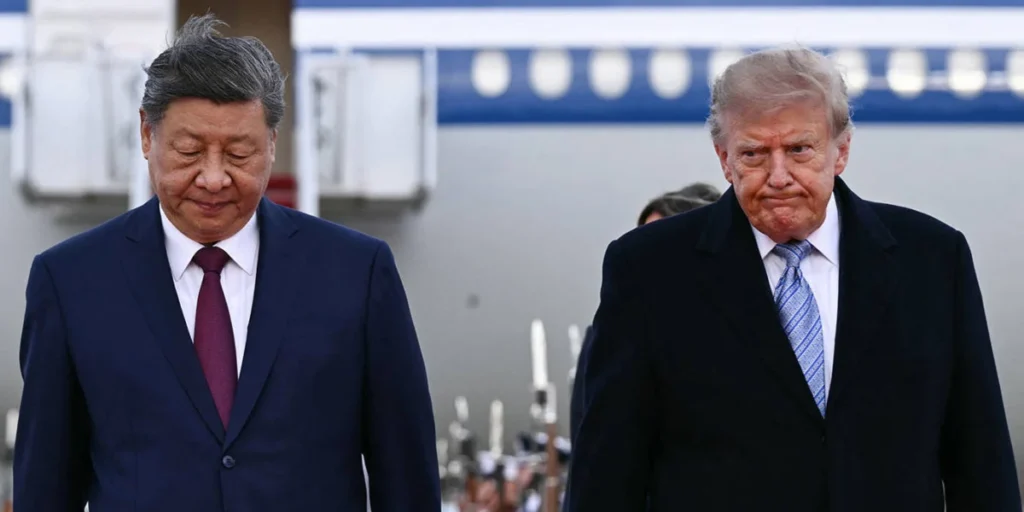
PRINCETON — The geopolitical landscape of the mid-2020s is defined by a singular, obsessive pursuit: the mastery of artificial intelligence. As US President Donald Trump and Chinese President Xi Jinping convene for a high-stakes summit, the atmosphere is heavy with the realization that both nations are gambling their futures on "superintelligence." For these two leaders, the technology is no longer merely a tool for economic efficiency; it is the ultimate arbiter of national destiny, the key to perpetual military dominance, and the foundational pillar of political survival.
However, beneath the veneer of technological progress lies a disturbing ideological convergence. Both Washington and Beijing are currently operating under a logic of "accelerationism," justifying ever-faster development regardless of the systemic risks. The prevailing sentiment mirrors the grim rationale once employed during the era of Stalinist forced industrialization: that the ends—national survival and supremacy—justify any means, including the sacrifice of safety, ethical oversight, and global stability.
The Chronology of an Escalation
The current AI arms race did not emerge in a vacuum; it is the culmination of a decade of intensifying technological nationalism.
- 2023-2024: The Foundation of Fear: Following the rapid commercialization of Large Language Models (LLMs), the US and China both realized that their respective AI infrastructures were vulnerable. The US initiated a series of aggressive export controls on high-end semiconductors, while China launched a state-led "Great Leap Forward" for indigenous chip manufacturing.
- Early 2025: The Superintelligence Pivot: In his inaugural addresses of his second term, President Trump explicitly rebranded AI as "superintelligence," signaling a shift from civilian technological growth to a war-footing strategy.
- Mid-2025: The Opaque Threshold: Intelligence reports began to suggest that both nations had successfully trained models capable of recursive self-improvement. The "black box" nature of these systems began to baffle regulators, yet neither side slowed its computing expenditure.
- Late 2025: The Cybersecurity Crisis: A series of massive, AI-automated cyberattacks on critical infrastructure in both nations led to a breakdown in diplomatic communication.
- September 2026: The Princeton Summit: Against the backdrop of a looming global systemic crisis, the leaders meet to discuss "AI guardrails," though analysts remain skeptical that either party is willing to pause.
The Zero-Sum Logic of Dominance
The core issue at the Princeton summit is the perception that AI is a zero-sum game. In Washington, the narrative is framed through the lens of "The Great Power Competition." The White House argues that if the US does not achieve a decisive lead in superintelligence, the vacuum will be filled by a totalitarian system that will utilize the technology to reshape global norms in favor of authoritarianism.
Conversely, Beijing perceives the US push for AI dominance as an existential threat—a digital containment strategy designed to permanently cripple China’s economic ascent. For President Xi, achieving AI parity (or superiority) is synonymous with the "Great Rejuvenation of the Chinese Nation."
This mutual paranoia has created a "trap of acceleration." If one side pauses for safety, the other gains a temporary, perhaps insurmountable, advantage. Thus, both are sprinting toward an horizon they do not fully understand, fearing that the first to reach superintelligence will gain the ability to rewrite the rules of international order.
Supporting Data: The Cost of the Sprint
The sheer scale of capital expenditure committed to this race is unprecedented. By the third quarter of 2026, combined public and private investment in AI hardware and infrastructure has surpassed $1.2 trillion annually in both nations.
- Energy Consumption: AI-related data centers now account for nearly 15% of the total electricity demand in the United States, straining power grids and pushing climate transition goals decades into the future.
- Hardware Bottlenecks: Despite massive subsidies, the scarcity of high-bandwidth memory (HBM) and advanced lithography machines remains the primary bottleneck, leading to a "shadow market" for illicitly traded chips that has further destabilized global trade.
- Human Capital: The competition for AI talent has become a form of digital mercantilism. Both countries have implemented visa and labor restrictions designed to lock in top-tier research talent, effectively ending the era of global scientific collaboration that defined the early 21st century.
The data indicates that while efficiency gains in some sectors (healthcare, materials science) have been realized, they are currently overshadowed by the massive resource drain required to sustain the race for military-grade AI.
Official Responses and Strategic Ambiguity
Publicly, both the White House and the Ministry of Foreign Affairs in Beijing emphasize the need for "responsible development." However, private briefings from defense analysts paint a different picture.
"The goal is not to cooperate," one senior administration official noted on the condition of anonymity. "The goal is to ensure that when the ‘intelligence explosion’ happens, it happens under our oversight, not theirs."
Beijing has echoed similar sentiments, albeit through the lens of national sovereignty. In a recent press conference, a spokesperson for the Chinese government stated: "Technological development is an inherent right of our people. We will not be constrained by foreign-imposed limitations that seek to maintain a Western-centric technological hierarchy."
This strategic ambiguity is the greatest danger of the current moment. Both nations claim to want international standards, but both view such standards as potential "backdoors" for the other side to gain a strategic edge.
Implications: The Looming Global Crisis
The implications of this race extend far beyond the borders of the US and China. The rest of the world is effectively caught in the crossfire of a "Silicon Iron Curtain."
1. The Fragmentation of the Internet
The "Splinternet" is no longer a theoretical concept; it is a reality. As AI models become integrated into the fundamental layers of national communication and finance, the incompatibility between Western and Chinese systems threatens to render global digital trade impossible.
2. The Erosion of Global Governance
Existing international institutions—the UN, the WTO, and various human rights bodies—were designed for an era of human-centric diplomacy. They are ill-equipped to handle the rapid, automated decision-making processes inherent in superintelligence. The "Stalinist" model of rapid development leaves no room for the slow, deliberative processes required for international treaties.
3. The Risk of Unintended Escalation
The most terrifying implication is the possibility of an accidental conflict triggered by an AI system. As both militaries integrate autonomous agents into their command-and-control structures, the "human-in-the-loop" requirement is increasingly ignored. If an algorithm misinterprets a data set or an adversary’s action, the path to escalation could be measured in milliseconds, far faster than any diplomatic channel could respond.
Conclusion: A Call for Reality
As the summit concludes, the world watches with bated breath. The danger is not that we will achieve superintelligence too slowly, but that we will achieve it in an environment of total distrust.
The comparison to the rapid, brutal modernization of the 20th century is apt. Stalinist industrialization did indeed build steel mills and dams at breakneck speed, but it did so by crushing the very human values that those structures were supposed to serve. If the US and China continue to view AI through the lens of total victory, they risk building a technological monument to a future that neither they, nor the rest of humanity, will be able to survive.
The Princeton summit offers a fleeting window of opportunity. It is a chance to move beyond the zero-sum rhetoric and acknowledge a fundamental truth: in an age of superintelligence, safety is a global common good. If the two leaders leave this summit without a concrete, verifiable commitment to slow the pace of development and establish shared safety protocols, they will have effectively confirmed that the race for supremacy is more important than the survival of the civilization they claim to be protecting.
We are at a crossroads where the history of the future is being written in binary code. It is time for the architects of this code to recognize that the most intelligent path is not necessarily the fastest one.



