Introduction: A Phoenix in the Digital Age
The name "Digg" carries significant weight in the history of the internet. Once the undisputed titan of social news aggregation, the platform has spent the better part of two decades navigating a turbulent existence of peaks, valleys, and radical reinventions. Now, in a move that signals both nostalgia and a desperate pursuit of relevance, Digg has returned from its latest hiatus.
Following the collapse of its short-lived attempt to challenge Reddit—a venture that shuttered its doors in March after struggling with bot infestations and a lack of clear market differentiation—the company is once again pivoting. Under the leadership of founder Kevin Rose, a partner at True Ventures, the platform has re-emerged with a singular focus: to distill the chaotic, noise-filled landscape of artificial intelligence news into a curated, data-backed feed.
Chronology of a Turbulent Comeback
To understand the current state of Digg, one must look at the recent, dizzying timeline of its operations.
- June 2025: After a period of development, a rebooted version of Digg was unveiled, designed to serve as a direct competitor to Reddit. The strategy was to foster community-driven discussions and link-sharing on a massive scale.
- January 2026: The new Digg officially launched to the public. The reception was tepid, as the platform immediately grappled with an influx of bot traffic that hindered genuine human discourse.
- March 2026: Recognizing the failure to gain traction against established community giants, the leadership team initiated layoffs and shuttered the mobile application to "go back to the drawing board."
- April 2026: Kevin Rose returned to full-time operational status, signaling a definitive shift in strategy. The team began stripping away the "Reddit-clone" features that had defined the previous year.
- May 2026: A new iteration of Digg was previewed to a select group of beta testers. This version abandoned the forum-style architecture in favor of a clean, algorithmic news-ranking engine focused exclusively on the AI sector.
The New Architecture: Data Over Discussion
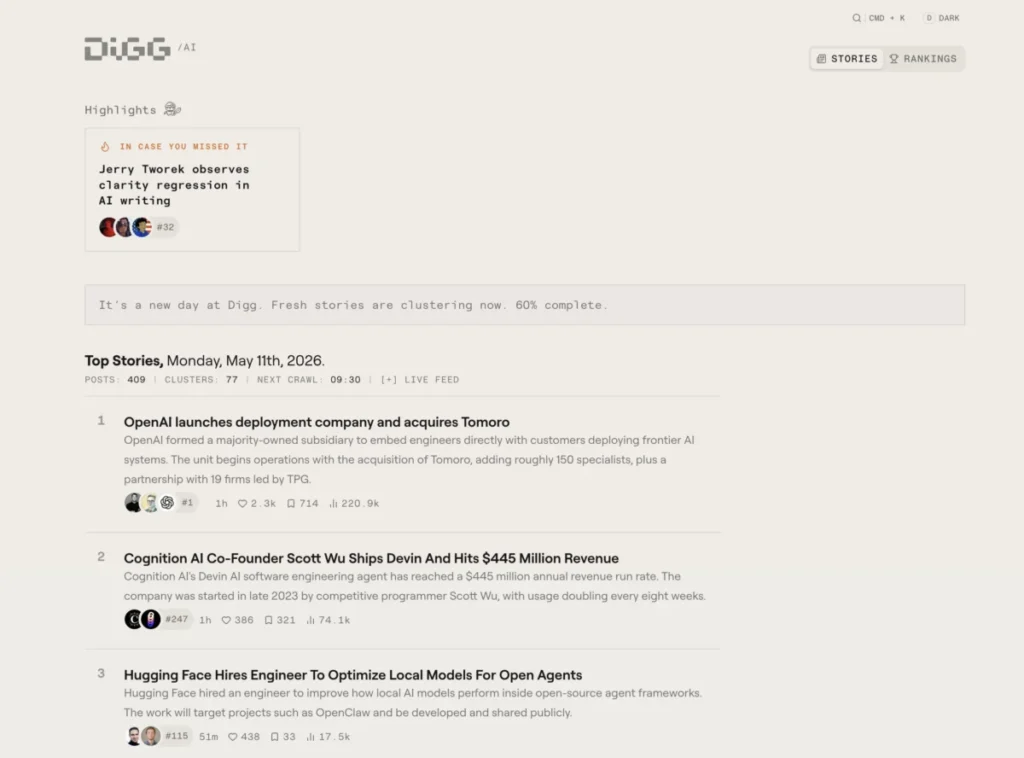
The most striking aspect of the "new" Digg is its complete rejection of its former self. The site no longer encourages users to post, comment, or argue in internal threads. Instead, it serves as a high-fidelity filter for the vast, often overwhelming, stream of information originating from X (formerly Twitter).
How the Engine Works
Digg has shifted its focus to become a "signal detection" platform. By ingesting real-time data from X, the site performs a multi-layered analysis:
- Sentiment Analysis: Assessing the tone and reception of news items as they break.
- Clustering: Grouping disparate posts into a single, cohesive narrative or story.
- Signal Detection: Identifying which stories are gaining genuine traction among influential voices in the tech and AI sectors.
The homepage is now organized into four distinct tiers of urgency: the most viewed story, a story witnessing rapid discussion, the fastest-climbing topic, and an "In case you missed it" section. This structure is designed for the high-speed information consumer—someone who wants the insight of a power user without the burden of doom-scrolling through a platform as chaotic as X.

Supporting Data and The "Altman Effect"
Kevin Rose has publicly noted that the platform’s logic is heavily predicated on the influence of key industry players. For instance, when a figure as prominent as OpenAI CEO Sam Altman engages with a post, the ripple effect on X is almost immediate. Digg’s new backend is designed to track this propagation, turning the platform into a visual dashboard for the "who’s who" of the AI revolution.
Beyond just headlines, the platform tracks the "top 1,000" entities in the AI space, including influential individuals, corporations, and political figures. By quantifying engagement—views, likes, and saves—the platform attempts to provide a "temperature check" on the industry. It transforms raw social metrics into digestible charts and graphs, effectively catering to data-hungry users who value quantitative analysis over anecdotal chatter.
The Implications: Is This the Future of News?
The implications of this shift are profound, both for the platform and for the broader publishing ecosystem.
The Publisher’s Dilemma
One of the most compelling arguments for the new Digg is its potential utility for publishers. In an era where Google’s AI Overviews and shifting search algorithms have decimated traditional referral traffic, publishers are starving for new, high-quality discovery channels. If Digg succeeds in becoming a trusted "signal" for what matters, it could drive significant, intent-driven traffic to original reporting, potentially acting as a life raft for journalism in an age of automated summaries.
The "Noise" Problem
However, critics argue that the platform faces a significant "value proposition" hurdle. For the average user, the barrier to entry is high. If the site offers no internal discussion—no place for the community to "dig" into the nuance—why would a user choose it over an RSS reader, a curated newsletter, or their own personalized "For You" feed?
Furthermore, Digg’s reliance on X as its primary data source is a double-edged sword. While AI news is currently concentrated on X, other industry verticals are increasingly fragmented. With the rise of platforms like Meta’s Threads and the migration of niche communities to private forums or decentralized networks, the "signal" on X is becoming less representative of the internet at large. If Digg cannot expand its ingestion engines to capture these disparate silos, it risks remaining a niche tool for a shrinking subset of users.

Official Stance and Future Outlook
In an email to its beta testers, the company was candid about the current state of the platform, admitting that the site remains "buggy" and "raw." This transparency is likely an attempt to manage expectations as they transition from a failed community-forum experiment to a professional-grade intelligence aggregator.
The company’s long-term roadmap suggests that if the AI vertical proves successful, they intend to expand into other topics. However, the path forward is narrow. To succeed, Digg must prove that it is not just a fancy visualization tool for social media engagement, but a necessary utility for staying informed.
Conclusion: A Delicate Balancing Act
Digg’s latest incarnation is an admission of failure in the "community-as-a-service" market, but it is also a bold recognition of the current media crisis: there is too much noise and not enough signal. By positioning itself as a curator of the AI zeitgeist, Digg is attempting to reclaim its status as a "front page of the internet," albeit a much more automated, cold, and calculated one than the Digg of 2005.
Whether this version of the company can survive the volatile landscape of modern tech remains to be seen. For now, it stands as a fascinating case study in pivots: a brand that once defined the social web is now attempting to survive by becoming the analytical layer that sits on top of it. Whether users will find value in this new, sanitized, and data-heavy experience will determine if this is the final chapter for the legendary site, or merely the start of a long-overdue recovery.