
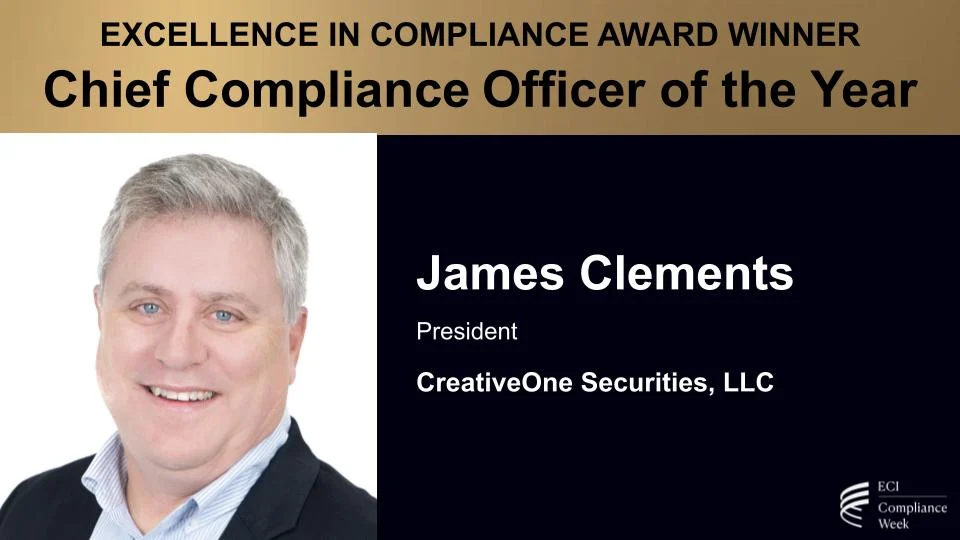
In the high-stakes world of financial services, where regulatory landscapes shift with the speed of a digital transaction, the role of a Chief Compliance Officer (CCO) has evolved from a back-office auditor to a strategic business partner. Few have navigated this transformation as effectively as James Clements, the former CCO of Carson Group. As the financial industry grapples with the integration of artificial intelligence and an increasingly aggressive regulatory environment, Clements’ tenure at Carson Group stands as a masterclass in operational excellence, human-centric leadership, and the art of "defensive" growth.
Main Facts: A Tenure Defined by Strategic Foresight
James Clements served as the CCO for Carson Group’s broker-dealer and registered investment advisory (RIA) entities from 2020 through April 2024. During a period defined by intense scrutiny from the U.S. Securities and Exchange Commission (SEC) and the Financial Industry Regulatory Authority (FINRA), Clements was tasked with safeguarding the firm’s reputation while simultaneously fostering a culture of innovation.
The hallmark of his recent tenure was the pioneering adoption of AI-driven compliance tools. By integrating automation into the firm’s advertising review process, Clements’ team significantly reduced the "time-to-market" for critical marketing materials while ensuring that compliance flags were raised with precision.
His leadership was not merely technical; it was recognized by his peers and the industry at large through prestigious internal nominations. These accolades highlighted his "strategic foresight, and operational excellence," noting that Clements consistently demonstrated the core values of effectiveness, collaboration, and vision—attributes that kept Carson Group’s compliance posture robust during some of the most complex regulatory cycles in recent history.
Chronology: From Advisor to Architect of Compliance
To understand Clements’ philosophy, one must look at his unconventional career trajectory. He did not begin his journey in the ivory tower of legal oversight; he started on the front lines as a financial advisor.
- Early Career: As a practitioner, Clements gained firsthand experience in the constraints and realities of financial advice. This "advisor-first" perspective would later become his greatest asset in the compliance department.
- 2020: Clements stepped into the role of CCO for Carson Group’s broker-dealer and RIA entities. This was a baptism by fire, as the firm navigated the initial chaos of a global pandemic and the subsequent surge in digital wealth management services.
- 2022–2023: Clements spearheaded the digital transformation of his department. Recognizing that the volume of content requiring regulatory review was outstripping human capacity, he oversaw the implementation of AI tools designed to flag problematic advertising and communication patterns.
- April 2024: After four years of strengthening the firm’s regulatory foundation, Clements transitioned into his current role as President of CreativeOne Securities, LLC. This move signaled a broader trend: the elevation of compliance-minded leaders into executive suites.
Supporting Data: The Human Element in a Digital Age
While AI provided the technical speed, Clements’ success was rooted in his "old-fashioned" approach to customer service. Despite the pressures of regulatory demands, his team was consistently ranked by partner advisors as one of the top three teams within the entire company.
The "Phone Call" Philosophy
In an era of email-heavy, sterile corporate communication, Clements implemented a rigid yet simple rule: if a complex compliance issue could not be resolved in two emails, the team was required to pick up the phone. This was not merely a communication preference; it was a strategy for building rapport.
"We return calls, answer questions, and have those difficult conversations," Clements noted in an interview. He argued that the failure of many compliance departments stems from a lack of "customer service." By fostering an environment where advisors felt heard rather than policed, Clements ensured that his team was seen as a partner in growth rather than an obstacle to it.
The AI Integration
The deployment of AI was specifically targeted at the advertising review area. By automating the screening process, the team was able to:
- Reduce Turnaround Time: AI flagged potential violations instantly, allowing humans to focus on nuanced, high-level editorial decisions.
- Maintain Consistency: Unlike human reviewers, who may vary in their interpretation of minor guidelines, AI provided a uniform baseline for compliance across all marketing collateral.
- Enhance Accuracy: By removing the "noise" of simple errors, the team could dedicate more focus to the high-risk regulatory areas demanded by the SEC and FINRA.
Official Responses and Professional Philosophy
Clements holds a nuanced view on the role of the CCO. He rejects the notion that compliance is about "getting to yes" with leadership. Instead, he views the CCO as the firm’s institutional memory and moral compass.
On Executive Pressure
Clements often speaks about the "thick skin" required to be an effective compliance officer. He recalls early in his career being told by a chairman that the ultimate goal was to ensure the company’s name never appeared in the press for the "wrong reasons." This principle served as his rudder. When leadership pushed for aggressive growth that bordered on regulatory thin ice, Clements was comfortable saying, "I don’t agree with that."
"If you’re looking for a lot of thanks and pats on the back, you’re not going to enjoy compliance," he admits. He believes that the true value of a CCO lies in the ability to project consequences into the future—to think years ahead when leadership is focused on the quarter.
On the AI Threat
Despite the rapid advancement of generative AI, Clements remains optimistic and calm. "AI won’t take away your job," he asserts. He believes the value of a human compliance officer lies in three areas:
- Institutional Knowledge: The context of why certain rules exist.
- Judgment: The ability to weigh a violation against the firm’s long-term health.
- History: Understanding the patterns and regulatory nuances that an algorithm—trained on data—might misinterpret.
Implications: The Future of Compliance Leadership
Clements’ transition from CCO to President of CreativeOne Securities is a testament to the changing value of compliance expertise. He is now applying his "compliance-first" mindset to the highest levels of firm management.
The Baseline for Future Success
In his current role, Clements is establishing a new baseline for how a firm should operate. He is working with the compliance group at CreativeOne to ensure they are integrated into the business strategy from the outset. This "compliance by design" approach is the logical evolution of his work at Carson Group.
The "No-Shortcuts" Mandate
As he looks toward the future, his priority remains clear: protecting the brand. In an industry where a single fine or regulatory sanction can irreparably damage client trust, Clements’ focus on long-term sustainability is a competitive advantage. He warns that short-term gains are rarely worth the regulatory price.
A Call for New Talent
Despite the high-pressure environment, Clements remains an evangelist for his profession. "Compliance is a great field for people who want to get into it," he says, encouraging the next generation to view the role not as a stifling bureaucratic position, but as a dynamic, intellectually stimulating career that sits at the very heart of how financial firms survive and thrive.
As the industry moves further into a world dominated by algorithms and rapid regulatory change, the legacy of leaders like James Clements suggests that the most successful firms will be those that pair the speed of technology with the steady, ethical, and communicative human touch of a seasoned compliance professional.
