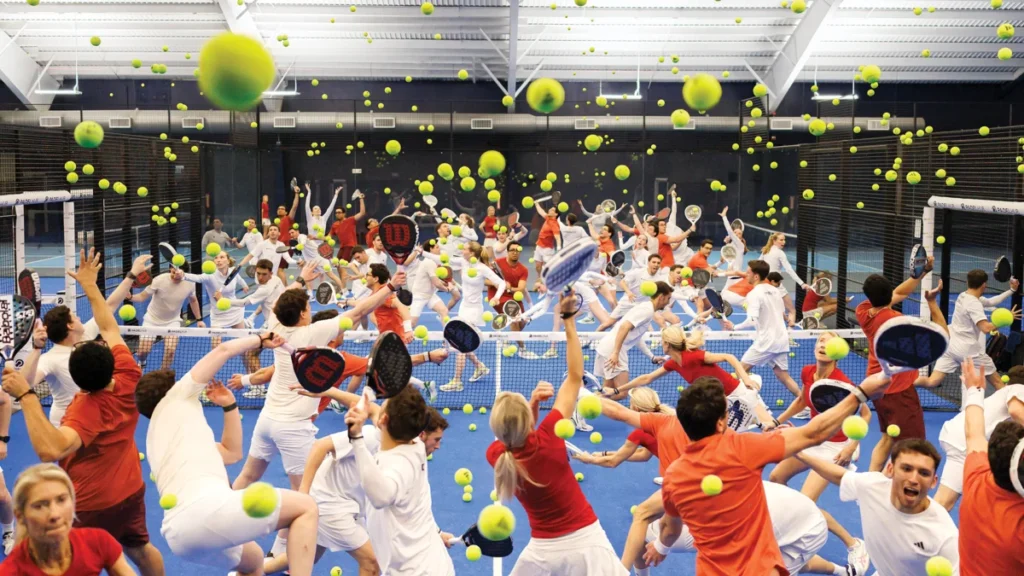
In the rarefied air of the American luxury sector, a new obsession has taken root—one that is as addictive as it is enigmatic. It is a sport that promises the aerobic intensity of tennis, the strategic nuances of squash, and, most importantly, the high-octane social currency of a private members’ club. Yet, for all its momentum, the sport currently suffers from a bizarre identity crisis: no one, particularly in the Northeastern United States, seems entirely sure how to pronounce it.
Is it "PA-del," with the sharp, percussive cadence of the word "battle"? Or is it "pa-DEL," with the soft, European inflection of "lapel"? This linguistic rift is more than a simple matter of phonetics; it is a symptom of a sport that has undergone a rapid, sometimes chaotic, metamorphosis as it attempts to break into the American consciousness. While the world’s elite brands—Rolex, Prada, and Lamborghini among them—vye for the attention of a burgeoning cohort of wealthy players, the sport’s pioneers are engaged in a quiet, firm campaign to standardize its identity.

A Chronology of Confusion: From Mexico to the Boardroom
The roots of the current confusion trace back to the strategic maneuvers of Marcos del Pilar, the self-styled "Godfather of Padel in the U.S.A." Nearly a decade ago, the Spanish entrepreneur arrived in the United States with a singular mission: to export a sport that was already a national pastime for over six million of his countrymen.
Padel, which originated in Mexico in the 1960s, had long been a staple of the Spanish-speaking world. For del Pilar, it was a compelling commercial proposition for racket-sport associations and American investors. However, when he first pitched the concept to U.S. clubs, he met a wall of skepticism. To the American establishment, "paddle" was already a known quantity—specifically, "platform tennis," a cold-weather sport played in enclosed cages at private, exclusive country clubs since the 1920s. It was perceived as aloof, unscalable, and strictly tied to the tradition of cable-knit sweaters and old-money social circles.

Faced with rejection, del Pilar executed a brilliant, if controversial, pivot: he changed the pronunciation. By leaning into the "pa-DEL" cadence, he imbued the sport with a pseudo-Spanish, cosmopolitan flair. It no longer sounded like the stuffy winter pastime of New England elites; it sounded like a high-energy, modern, and accessible alternative. The "pa-DEL" brand resonated with the venture capitalists and real estate developers he was courting. The rebranding worked, the narrative shifted, and the capital began to flow.
The Data of Dominance: A Global Surge
The growth of padel is nothing short of exponential. According to the International Padel Federation (FIP), the sport has evolved from a niche regional activity into a global juggernaut. In 2018, there were fewer than 8 million padel players worldwide. By the close of 2025, that figure had skyrocketed to an estimated 35 million.

The infrastructure is expanding in lockstep with the player base. Between April 2024 and November 2025, approximately 4,775 new clubs opened their doors, representing a 24.1 percent increase in global capacity. The FIP reports that there are now more than 77,000 padel courts worldwide—a 23 percent increase over an 18-month period. Perhaps most tellingly, the sport’s footprint has expanded from 50 countries five years ago to 150 today.
The professional circuit has mirrored this growth. In 2024, 36 countries hosted 182 FIP-licensed tournaments. By the following year, that expanded to 290 tournaments across 49 countries, with over 11,000 players now holding a professional FIP ranking. Like professional tennis, the sport now boasts four major championships, a tiered tour structure, and a year-end finale that attracts significant prize pools. Top-tier players, such as the world’s No. 1 duo, Agustín Tapia and Arturo Coello, are now earning close to seven figures annually through a combination of tournament winnings, appearance fees, and lucrative sponsorship deals.

Official Responses: "Padel is Proper"
As the sport matures, its domestic pioneers are eager to shed the "pa-DEL" marketing artifice. Industry leaders are now attempting to steer the conversation back to the original, standard pronunciation: "padel."
"It’s padel," asserts Wayne Boich, a former competitive tennis player and the founder of Reserve, a Miami-based luxury lifestyle brand. Reserve has become a cornerstone of the American padel scene, operating elite, members-only clubs in Manhattan’s Upper East Side and the high-end Hudson Yards development. For Boich, the branding is now secondary to the quality of the product.

Michael Dorfman, the C.E.O. of the Pro Padel League (PPL), now in its third season, is similarly committed to the correction. "Padel is proper," he says. "I’ve been constantly correcting folks." For the leaders of the sport, the phonetic debate is a sign that padel has outgrown its need for an "exotic" wrapper; it is now a legitimate, established pillar of the global sporting landscape.
The Luxury Ecosystem: Why the Elite are Circling
What makes padel so uniquely attractive to the luxury world? Advocates describe it as "aerobic nirvana"—an accessible, high-energy game that is inherently social because it is played exclusively in pairs.

"There’s a sexiness to it because it’s a very easy game to understand and to participate in," says Glenn Spiro, a renowned London private jeweler and an avid convert to the sport. "It’s a revolution."
The business model for these clubs is built on exclusivity. Benji Markoff, co-founder of the Padel United Sports Club in the upscale New Jersey suburb of Cresskill, has transformed a 36,000-square-foot warehouse into a high-end wellness and sports facility. With annual family memberships reaching $4,500, the club targets high-net-worth individuals, entrepreneurs, and venture capitalists.

At the higher end of the spectrum, memberships at clubs like Reserve can reach six figures, offering not just courts, but a networking environment where city power brokers and private equity managers strike deals over a three-foot net. It is the new golf, with one distinct advantage: a match is completed in two hours, compared to the four or five required for a round of 18 holes.
This environment has invited an unprecedented level of luxury branding. Rolex has signed Arturo Coello as a brand ambassador, and Swiss watchmaker Frederique Constant has secured a multi-year deal with the PPL. Retail brands are also capitalizing on the trend; Prada’s $1,970 carbon-fiber padel racket is currently sold out, as is the $600 Lamborghini-branded Babolat racket. Furthermore, the Kith Ivy private club in New York’s West Village—which features padel courts, a Giorgio Armani-designed spa, and an Erewhon location—charges a staggering $36,000 initiation fee, signaling that padel has firmly arrived as a status symbol.

Future Implications: The Road to the Olympics?
The "padel effect" on luxury marketing is being driven by the unique demographics of its player base. Merrick Haydon, founder of the sports-marketing agency ThirtyThree18, notes that padel offers brands access to a "socially active, image-conscious, and highly networked" consumer. Unlike mass-market sports, padel aligns perfectly with the lifestyle ecosystems of hospitality, fashion, travel, and real estate.
Looking ahead, both Boich and Dorfman are focused on deepening the sport’s roots. Plans are underway to leverage the massive global audience of the FIFA World Cup to host high-profile events featuring soccer stars from Spain, Argentina, and Italy—countries where the crossover between soccer fanbases and padel players is significant.

While padel currently holds a relatively small share of the North American market—roughly 7.7 percent of the world’s players—the trajectory suggests that this is only the beginning. With the sport’s visibility bolstered by celebrity enthusiasts like David Beckham, Jay-Z, and Dwyane Wade, and the potential for increased distribution through legacy media, the prospect of future expansion is all but guaranteed.
"I’d be amazed if it wasn’t an Olympic sport one day," says Spiro. Whether it is called "PA-del" or "padel," the conclusion remains the same: this is a sport that has successfully captured the imagination, the investment, and the leisure time of the world’s elite, and it shows no signs of slowing down. As the sport moves from its experimental phase in the U.S. toward a more standardized, professionalized future, the only thing that might remain in flux is the pronunciation—though, at this level of play, the winners are far too busy to worry about the vowels.